Santa Teresa
2666Santa Teresa is a border city whose relentless growth brings industrial production, migration, commercial wealth, poverty, and violence into a single unsettled landscape. The city’s significance lies in the friction between movement and abandonment: workers and goods cross its industrial corridors, the United States lies just beyond its northern fence, and women’s disappearances and killings recur amid inadequate infrastructure, fragmented attention, and investigative dead ends.
Urban Form and Expansion
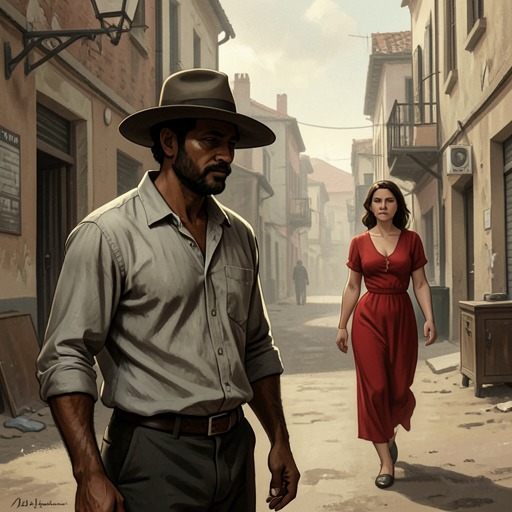
Santa Teresa appears not as a coherent center surrounded by a periphery but as a city of sharply changing districts. To the west, most streets are unpaved and houses are assembled from scrap. The old center retains three- and four-story buildings and arcaded plazas in a neglected condition. Eastward, carefully pruned trees, playgrounds, shopping centers, and the university mark middle- and upper-class neighborhoods. The contrast is not simply between rich and poor: as the city extends east, settled middle-class districts eventually give way to slums, hills, valleys, dry riverbeds, and the remnants of old ranches.
Northward, abandoned factories and sheds precede a street of bars, souvenir shops, and small hotels; farther out, poorer neighborhoods are more dispersed, and vacant lots occasionally contain a school. Southward, railway lines run past shantytown soccer fields, two highways lead away from the city, and a gully has become a garbage dump. Industrial warehouses punctuate the horizon, the visible edge of the maquiladoras. The city’s districts thus record several forms of development at once: industrial expansion, neglected infrastructure, informal housing, and public facilities appearing amid open land.
The scale of the place defeats any sense of a finished boundary. The observers who drive around it are convinced that Santa Teresa is growing by the second. At its far edge, black vultures move through barren fields; in the west, industrial parks are themselves being encircled by slums. The city is not merely expanding outward: the image of industry surrounded by informal settlements captures how employment and urban hardship advance together.
Border and Circulation
The border is both a visible barrier and a working passage. At the northern edge of Santa Teresa, a fence separates Mexico from the United States, with the Arizona desert on the other side. On the American side, Adobe—once the site of an adobe factory—has become a line of houses and appliance stores along a main street, ending at a brightly lit empty lot and the American border post. A traveler then advances a few hundred feet to the Mexican crossing, where he must leave his car, open his suitcase, and show his papers before proceeding.
This compact sequence places ordinary movement under two jurisdictions. The traveler’s press identification prompts a question about whether he is coming to write about the killings; he says he is assigned to cover a boxing match. At the Mexican post, exhausted police officers process forms beneath the long fence. The crossing offers no simple separation between the city and the United States: people, reporting, and commerce move through the same border zone in which authorities scrutinize travelers and the desert begins immediately beyond the built-up streets.
Santa Teresa’s economy also ties the border to production and freight. The city has factories and maquiladoras, a steady inflow of workers from other cities, and Central American immigrants. In a conversation about the city, Chucho Flores describes a low unemployment rate alongside poverty, a cocaine cartel, bureaucracy, and an urban infrastructure unable to sustain the rate of demographic growth. The contrast between money and poverty is part of the city’s ordinary description, not an exception to it.
The cross-border network extends beyond the factories. Pedro Uribe owns more than a hundred cargo trucks, transports merchandise from maquiladoras in Hermosillo and Santa Teresa, and sends trucks across the border every half hour or hour. His family’s property and business connections extend into Phoenix and Tucson. The account places formal freight and industrial work beside narco networks and police connections: the same city is a manufacturing and transport hub, a destination for workers, and a setting where criminal power is entangled with local wealth.
Work, Infrastructure, and Exposure
The city’s physical shortcomings shape daily life. In the industrial park where Margarita Lopez Santos worked, the roads beyond the route to the Nogales highway lacked adequate lighting, paving, and drainage. Much of the northern part of Colonia Guadalupe Victoria had no electricity. Waste from the industrial park collected in Colonia Las Rositas, where it formed a muddy lake that turned white under the sun. These are not incidental details of scenery: they establish the conditions through which workers traveled between factories and home.
Margarita was sixteen and worked the third shift at K&T, from nine at night until five in the morning. She arrived punctually and was known as dependable. After leaving at about five-thirty, she would have had roughly a fifty-minute walk to her home in Colonia San Bartolome, crossing the highway and the streets of Guadalupe Victoria. The route is reconstructed from the work shift, the distance, and the poor lighting, yet the account cannot establish what happened along it. Her mother reported her missing the next day; after more than forty days, children found her body in Colonia Maytorena. The gap between a precisely described commute and the unanswered disappearance gives the city’s infrastructure a direct human consequence.
Other cases likewise meet the city at its neglected edges. In July, a young woman’s body was found in a car at an auto repair shop near the Nogales highway; another was discovered behind Pemex tanks along the Casas Negras highway. Investigations produced no witnesses or leads and soon stalled. In March 1996, a ten-year-old girl was found in a valley beside the Casas Negras highway, with another young girl discovered nearby days later. The valley, highways, industrial zones, and vacant ground recur as places where bodies are found, while the cases themselves remain difficult to identify and resolve.
Killings, Institutions, and Public Attention
The killings of women alter the meaning of Santa Teresa’s streets and outlying districts. When European visitors hear that more than two hundred women have died since 1993 or 1994, they initially struggle to believe the figure. The account stresses that the total may be higher—perhaps two hundred and fifty or three hundred—and that no one will ever know. The uncertainty is itself part of the city’s record: the scale of the violence is described through an estimate that cannot be securely closed.
Public attention moves in cycles. Chucho Flores says that whenever the numbers rise, the killings become news again; reporters and residents discuss them, the story grows, and then attention melts away and people return to work. He compares the killings to a brutal strike, an image that makes the violence part of the city’s labor landscape while also emphasizing how quickly its public visibility can dissipate. His pencil sketches of women’s faces, made while he talks, offer a counterpoint to that disappearance: the faces are individualized, but none is smiling, and none is presented as a reassuring emblem of the city.
That recurring loss of attention is reinforced by institutional and editorial limits. A visiting American consul receives permission to examine photographs of unidentified bodies, but the sheriff he is seeking is not found among them. When a feminist organization stages the first protests after two women are killed in July, it has only three members in Santa Teresa. Meanwhile, a journalist’s editor declines interest in a proposed story on the killings, or says there is no budget, and instructs him to complete his sports assignment and return. The city’s violence is therefore not only a sequence of crimes: it is also a struggle over whether evidence, reporting, and protest will retain attention long enough to produce accountability.
Narrative Significance
Santa Teresa’s landscape repeatedly puts systems of circulation beside conditions of disappearance. A truck crosses the border with manufactured goods; a worker walks home through unlit streets; a reporter passes between border posts; a body is found beside a highway or in a valley. These movements share a map, but not equal protections. Industrial growth and international connection do not ensure adequate lighting, drainage, security, or sustained investigation.
The city is described as endless, and that sense of unbounded expansion resonates with the uncertainty surrounding the killings. Its borders are materially marked by a fence and checkpoints, yet its urban edges keep shifting outward through industrial parks, shantytowns, and new subdivisions. Meanwhile, the number of victims resists a definitive count, and cases that generate reports or brief public attention can remain unresolved. Santa Teresa thus serves as more than a setting: its geography and economic networks make visible the structures within which labor, capital, policing, and violence intersect, while its recurring gaps—unlit routes, failed investigations, abandoned ground, fading news—show the cost of that intersection.