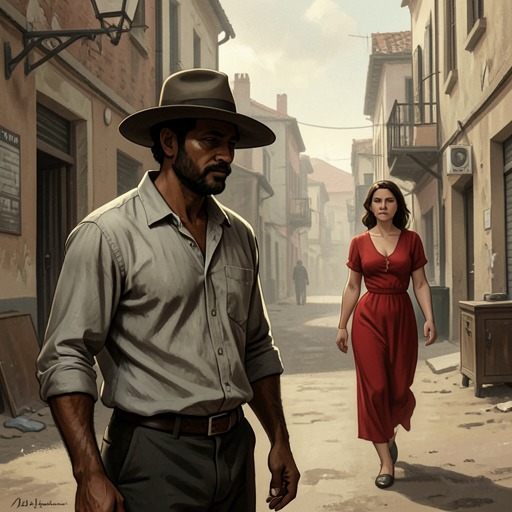
Santa Teresa crafts market
2666The Santa Teresa crafts market is both a tourist-oriented remnant of a regional trading post and a workplace where Manuel Espinoza meets Rebeca, a local student selling rugs. Its changing clientele reflects Santa Teresa’s economic transformation, while its repeated appearances in Espinoza’s story bring the city’s abstract divisions down to the scale of conversation, purchases, and daily work.
From regional market to tourist stop
The market was originally intended to serve people living around Santa Teresa. Craftspeople and peasants from across the region brought goods by cart or burro; cattlemen came from Nogales and Vicente Guerrero, and horse dealers from Agua Prieta and Cananea. By the time the European critics visit, however, the market is maintained almost entirely for American tourists arriving from Phoenix by bus or in small caravans of cars. They leave before nightfall. The visitors like looking around even when they do not plan to buy, a pattern that makes the market’s activity increasingly dependent on passing visitors rather than its former regional exchange.
Jean-Claude Pelletier buys a clay figure of a blond man seated on a stone and reading a newspaper, with two small horns on his forehead. Manuel Espinoza buys a rug from a young vendor, though he does not particularly like it; he is drawn into conversation because she is pleasant to talk to. She says she is from Santa Teresa, from a neighborhood west of the market, and is still in high school. If circumstances go well, she plans to study nursing. Her account makes clear that the market is not merely a picturesque destination: it is also a place of work for local residents pursuing lives and ambitions beyond the stalls.
A city viewed from its edges
The critics’ visits to the market sit within a wider effort to understand a city they cannot read from newspapers. They search Santa Teresa’s papers for evidence that Archimboldi has passed through, checking death notices, society and politics pages, agricultural news, and the limited arts coverage. Finding nothing, they continue their search through the city itself. Their subsequent drive takes them across neighborhoods and industrial outskirts, revealing sharp contrasts between unpaved streets and scrap-built homes, neglected central plazas, better-off eastern districts, abandoned factories, and poorer settlements. At the horizon stand the maquiladoras; farther north, a fence divides Mexico from the United States.
The market’s tourist economy belongs to this larger border geography. Santa Teresa’s growth, factories, workers, visitors, and cross-border traffic coexist with inadequate infrastructure and widespread poverty. Chucho Flores describes a city with factories, maquiladoras, low unemployment, a cocaine cartel, a steady influx of workers and Central American immigrants, and infrastructure unable to keep pace with demographic growth. The market is one modest point in that system: goods and visitors circulate through it, while the city’s uneven development remains visible just beyond its commercial display.
Espinoza and Rebeca
After the first conversation, Espinoza returns to the market and recognizes the vendor, though at first he cannot place her. When he asks whether she remembers him, she answers calmly. The following day he asks her name. She says she is Rebeca, and he thinks the name suits her. He stays at her stall for three hours while tourists and browsers pass. Only two potential customers approach, and neither buys. Espinoza feels responsible for the poor business because his persistent presence may be keeping customers away, so he tries to compensate by buying a large rug, two smaller rugs, a mostly green serape, a mostly red one, and a matching cloth knapsack.
Rebeca asks whether he will soon return to his country; he says he does not know. She calls a boy to carry the purchases to Espinoza’s car. The boy tells Espinoza that Rebeca is his sister. Espinoza gives him a ten-dollar bill. The scene connects the stall to a family’s shared work: Rebeca sells the goods, while her brother helps transport them. Her calm authority in calling him leaves a strong impression on Espinoza, whose attention is increasingly fixed not just on the merchandise but on the person organizing the work.
Routine, attention, and departure
Their meetings extend beyond the stall. At a cheap restaurant near the market, Rebeca’s younger brother remains outside watching the cart used each morning to transport the rugs and folding table. Espinoza asks whether the boy can leave the cart to eat with them; Rebeca says it would likely be stolen if left unattended. From the restaurant window, Espinoza sees the boy perched on the rugs, watching the horizon. When Espinoza offers to bring him something, Rebeca says he likes ice cream, but the restaurant has none. Espinoza considers going to find some, then gives up the idea because he fears Rebeca may be gone when he returns. He settles on bringing the boy a sandwich, and Rebeca tells him that in Mexico it is called a torta and that her brother likes ham.
On another visit, Rebeca sits on a wooden bench reading a colorful pop magazine about Mexican singers. Her brother has gone to school, as he does every morning. Espinoza sits beside her and is uncertain whether to greet her with a kiss; meanwhile, a new stall across the way sells small clay figures, including tiny gallows that make him smile sadly. When a woman stops to speak with Rebeca, Espinoza leafs through the magazine she has left beneath the table. He finds the silence between them easy to inhabit, while also recognizing that he will never become accustomed to it. He leaves for a bar, returns with a half-empty beer, and tells Rebeca he is going home. She says nothing.
The market’s recurring details—the cart that must be guarded, the unsold rugs, the magazine, and the purchases carried to the car—keep the relationship grounded in the practical rhythm of Rebeca’s work and family life. Espinoza’s attention gives these ordinary exchanges weight, but does not change their circumstances: the stall remains a place where customers may not come, and Rebeca’s plans remain her own. In a novel where the city is searched for a missing writer and women’s lives are repeatedly made difficult to trace, the market offers a contrasting form of encounter: brief, specific, and rooted in the everyday labor of a named local person.