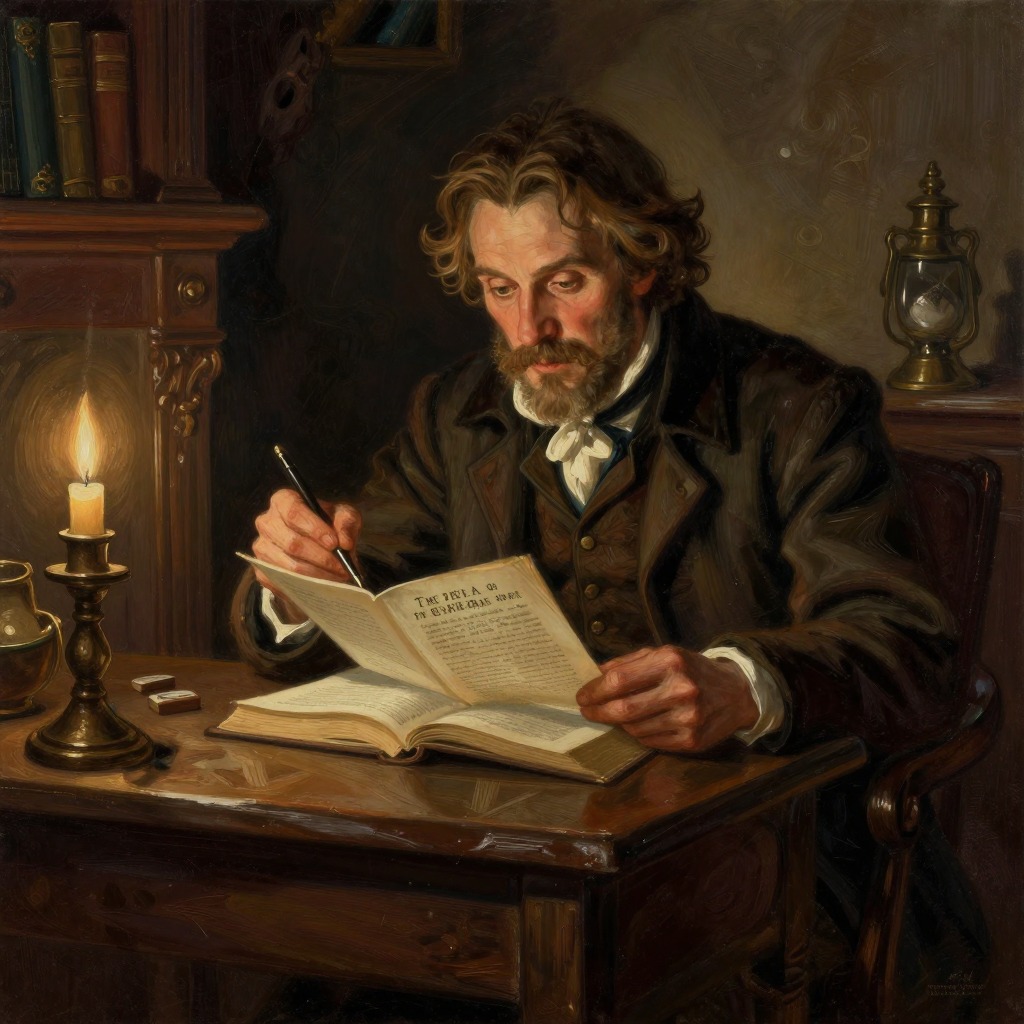
God bless us, every one!
The phrase "God bless us, every one!" is the final, emblematic utterance of Tiny Tim in Charles Dickens's A Christmas Carol, and it closes the book itself. It condenses the story's moral vision—a vision of universal charity, shared joy, and the sacredness of every human life—into a single benediction. Spoken by the frailest character, it becomes the story's most powerful statement of hope and communal blessing, and it is the phrase that Scrooge himself, in his transformed state, implicitly endorses by becoming a second father to Tiny Tim.
Origin and First Utterance
The phrase first appears in the story during the Cratchit family's Christmas dinner, the central domestic scene shown to Scrooge by the Ghost of Christmas Present. After Bob Cratchit proposes a toast—"A merry Christmas to us all, my dears. God bless us!"—the family re-echoes the sentiment. Then Tiny Tim, the last of all, speaks: "God bless us every one!" He is seated very close to his father's side upon his little stool, and Bob holds his withered little hand in his, as if he loves the child and dreads that he might be taken from him. The moment is both tender and foreboding, for the Ghost has already shown Scrooge a vision of a vacant seat and a crutch without an owner, implying that Tiny Tim will die if the shadows of the future remain unaltered.
The Phrase as a Narrative and Thematic Anchor
The benediction recurs at the very end of the book, in the final sentence of the final chapter. After describing Scrooge's complete transformation—his generosity to the Cratchits, his raising of Bob's salary, his becoming "as good a friend, as good a master, and as good a man as the good old City knew"—the narrator concludes: "May that be truly said of us, and all of us! And so, as Tiny Tim observed, God bless Us, Every One!" The phrase thus bookends the Cratchit feast and the entire narrative, transforming Tiny Tim's personal prayer into a universal blessing that the narrator extends to the reader. It is the story's last word, and it carries the full weight of Scrooge's redemption and the Christmas spirit the book champions.
Critical and Cultural Significance
From its first publication, the phrase was recognized as the story's essential note of pathos. One early commentator observed that "deep from the childish heart comes that true note of pathos, the ever memorable toast of Tiny Tim, 'God bless Us, Every One!'" The phrase is not merely a sentimental tag; it is the moral counterpoint to Scrooge's earlier, utilitarian dismissal of the poor. When Scrooge, in his unredeemed state, tells the charity collectors that the poor "had better do it, and decrease the surplus population," he denies the very idea that every person is worthy of blessing. Tiny Tim's benediction, by contrast, affirms the infinite value of each individual, regardless of social station or physical frailty. The phrase thus encapsulates the story's central ethical argument: that human beings are not surplus to be managed but fellow-passengers to the grave, deserving of kindness, charity, and love.
The Phrase and Scrooge's Transformation
Scrooge's own journey toward redemption is implicitly measured by his relationship to this blessing. At the Cratchit dinner, he hears the words spoken by the child whose death the Ghost has predicted, and he is moved to ask, "tell me if Tiny Tim will live." The Ghost's rebuke—quoting Scrooge's own words about decreasing the surplus population—drives Scrooge to penitence and grief. By the story's end, Scrooge has not only saved Tiny Tim from death ("who did NOT die") but has become a second father to him. The final invocation of Tiny Tim's blessing thus signals that Scrooge has fully entered the community of care and gratitude that the phrase represents. He has learned to keep Christmas well, and the benediction is the seal of that learning.
Legacy and Enduring Power
The phrase has become one of the most famous in English literature, synonymous with the spirit of Christmas charity and goodwill. It is often quoted, adapted, and referenced in popular culture, and it appears on Christmas cards, in holiday sermons, and in countless adaptations of the story. Its power lies in its simplicity and its universality: it asks for a blessing not for oneself alone, but for everyone, without exception. In the context of the book, it is the voice of the most vulnerable character, and it is that voice—not the voice of the powerful or the wealthy—that speaks the story's final, hopeful word.