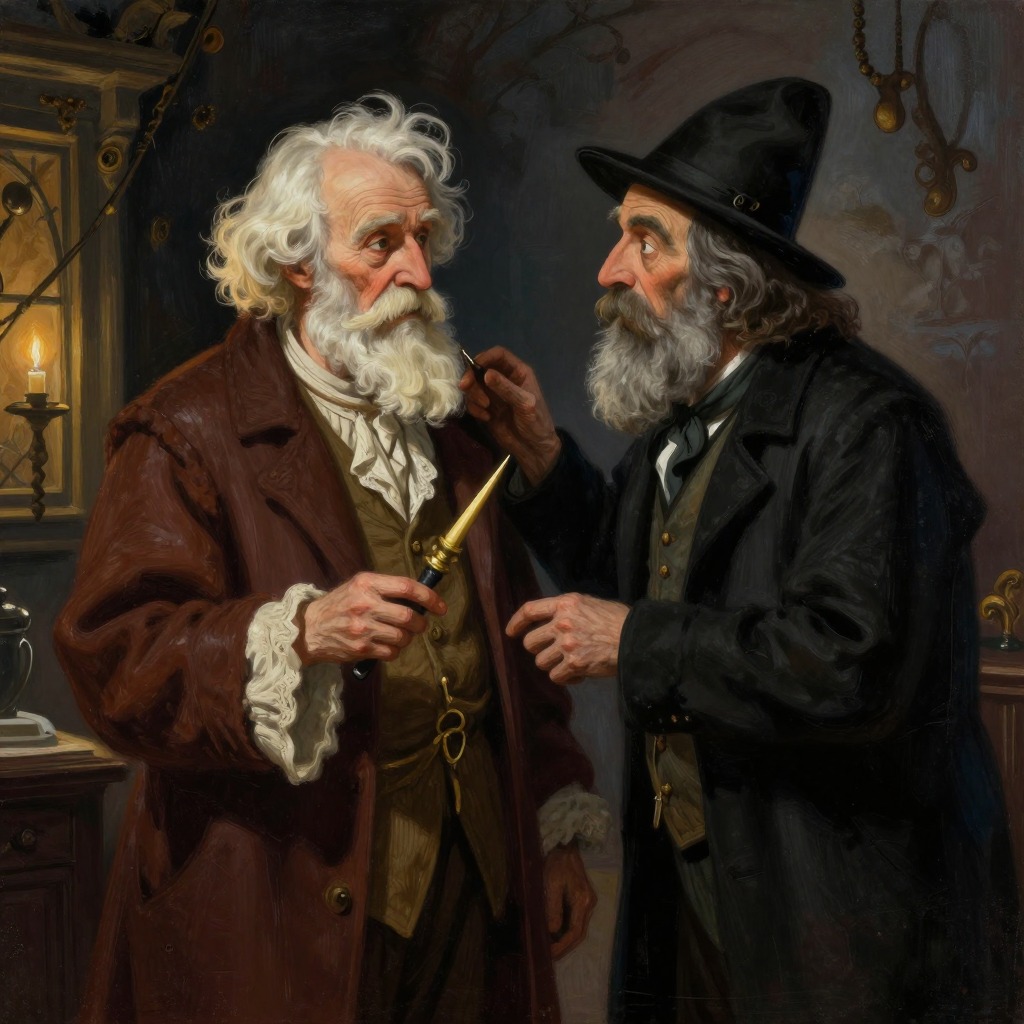
Scrooge and Marley
Scrooge and Marley is the counting-house and partnership firm that gives Ebenezer Scrooge his public identity and his moral starting point in Charles Dickens's A Christmas Carol. The firm's name, painted above the warehouse door and unchanged years after Jacob Marley's death, represents not merely a commercial enterprise but the shell of isolation and avarice that Scrooge must break open to reclaim his humanity. The story's entire arc—from Scrooge's initial hardness to his final generosity—is measured against the firm's cold, narrow premises and the values they enshrine.
Identity and Physical Setting
The firm known as Scrooge and Marley occupies a counting-house in the City of London, a place defined by its physical and moral chill. The office is described as a dismal little cell where Scrooge's clerk, Bob Cratchit, works in a sort of tank, copying letters by the light of a single candle because Scrooge keeps the coal-box in his own room. The counting-house door is kept open so Scrooge can keep his eye upon his clerk, a detail that underscores the master's distrust and control. The firm's name remains "Scrooge and Marley" even after Marley's death, and Scrooge answers to both names when people new to the business address him. The chambers where Scrooge lives once belonged to his deceased partner, and the gloomy suite of rooms in a lowering pile of building reinforces the firm's entanglement with death and isolation.
The Firm as Symbol of Scrooge's Worldview
Scrooge's entire philosophy is expressed through his conduct of the firm's business. When charity collectors approach him at the counting-house, he dismisses them with the question "Are there no prisons?" and declares that the poor who would rather die "had better do it, and decrease the surplus population." He tells his nephew Fred that Christmas is a humbug and that every idiot who goes about with "Merry Christmas" on his lips should be boiled with his own pudding. The counting-house is where Scrooge enforces his miserly discipline: he grudgingly gives Bob Cratchit Christmas Day off only after complaining that it is "a poor excuse for picking a man's pocket every twenty-fifth of December." The firm's premises are also the site of Marley's ghostly visitation, which begins when Scrooge sees Marley's face in the door knocker and culminates in the ghost's appearance in Scrooge's chambers, which had once belonged to Marley.
The Firm's Role in the Spirits' Revelations
The Ghost of Christmas Past takes Scrooge back to his apprenticeship at Fezziwig's warehouse, a contrasting model of business where the master's generosity and joy create a warm, communal atmosphere. This memory highlights what Scrooge and Marley lacks: Fezziwig spends only a few pounds on his Christmas Eve party, yet the happiness he gives is "quite as great as if it cost a fortune." Scrooge, watching his former self, wishes he could say a word or two to his clerk. Later, the Ghost of Christmas Present shows Scrooge the Cratchit family's meager Christmas dinner, where Bob Cratchit proposes a toast to "Mr. Scrooge, the Founder of the Feast," a bitter irony that Mrs. Cratchit resents. The Ghost of Christmas Yet to Come shows Scrooge a future where businessmen on the Royal Exchange discuss his death with indifference, one saying "I only know he's dead" and another joking about a cheap funeral. The firm's name is invoked by the portly gentleman who addresses Scrooge as "Scrooge and Marley's, I believe?" even after Marley's death, a reminder that the partnership's shadow outlasts the partner.
Transformation and Aftermath
Scrooge's redemption is enacted through his relationship with the firm. On Christmas morning, he sends the prize turkey to Bob Cratchit's house in Camden Town, a gesture that reverses his earlier stinginess. He then goes to the counting-house early the next morning, pretending to scold Bob for being late before announcing a raise in salary and promising to assist his struggling family. Scrooge becomes "as good a friend, as good a master, and as good a man as the good old City knew," and he lives "upon the Total-Abstinence Principle ever afterwards." The firm's name, once a symbol of Marley's dead hand and Scrooge's living coldness, becomes the vehicle for a new kind of commerce—one that includes charity, kindness, and human connection. The counting-house, where Scrooge once iced his office in the dog-days and refused to thaw it at Christmas, is transformed into a place where he can be a second father to Tiny Tim and a benefactor to his clerk.
Narrative and Thematic Significance
Scrooge and Marley functions as the story's central symbol of the worldly mind that the spirits must redeem. The firm's name, unchanged after Marley's death, represents the persistence of a dead worldview that Scrooge must reject. The counting-house's physical details—the small fire, the coal-box kept in Scrooge's room, the tank where Bob works—embody the miser's philosophy of scarcity and control. The firm's location in the City of London, surrounded by the bustle of commerce, contrasts with the warmth of the homes Scrooge visits with the spirits. The story's movement from the counting-house to the Cratchits' four-roomed house, from the Royal Exchange to the churchyard, traces Scrooge's journey from isolation to community. The firm's ultimate significance lies in its transformation: what was once a place of cold calculation becomes the foundation for Scrooge's new life of generosity and connection.