Marley's Ghost
Marley's Ghost is the first supernatural visitor to appear to Ebenezer Scrooge in Charles Dickens's A Christmas Carol, and its visitation establishes the moral and narrative framework for the entire story. As the ghost of Scrooge's former business partner, Jacob Marley, it returns from the dead not as a figure of vengeance but as a warning, burdened by the chains it forged in life and condemned to wander the earth witnessing the happiness it can no longer share. Its appearance initiates Scrooge's psychological and spiritual journey, setting in motion the sequence of revelations that will ultimately lead to his transformation.
Appearance and Form
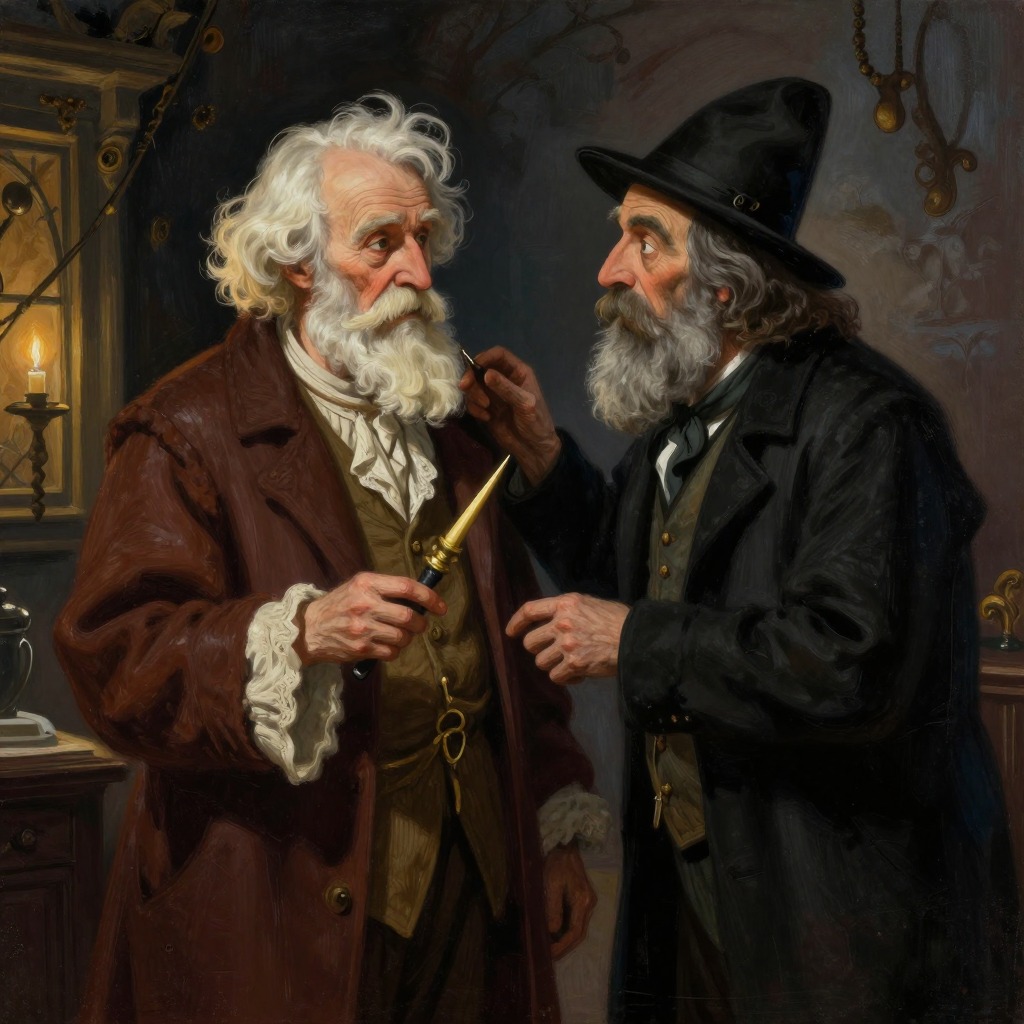
Marley's Ghost first manifests not as a full apparition but as a terrifying vision in Scrooge's door knocker. As Scrooge inserts his key into the lock of his gloomy chambers, the knocker transforms into Marley's face without any intermediate process of change. The face is not angry or ferocious but looks at Scrooge as Marley used to look, with ghostly spectacles turned up on its ghostly forehead. Its hair is curiously stirred as if by a breath of hot air, and though its eyes are wide open, they are perfectly motionless. The face has a dismal light about it, like a bad lobster in a dark cellar, and its livid colour makes it horrible, though the horror seems to be in spite of the face and beyond its control. When Scrooge looks fixedly at this phenomenon, it becomes a knocker again. Later, the full ghost appears, passing through the heavy door of Scrooge's room. It is the same face, and Marley appears in his pigtail, usual waistcoat, tights, and boots, with the tassels on the latter bristling. The chain he draws is clasped about his middle, long and wound about him like a tail, made of cash-boxes, keys, padlocks, ledgers, deeds, and heavy purses wrought in steel. His body is transparent, so that Scrooge, looking through his waistcoat, can see the two buttons on his coat behind. The ghost's lower jaw drops down upon its breast when it removes the bandage from its head, and its voice, though unmistakably Marley's, disturbs the very marrow in Scrooge's bones.
The Chain and Its Meaning
The central symbol of Marley's Ghost is the chain it drags, which represents the spiritual burden it forged during its lifetime. The ghost explains that it wears the chain it forged in life, made link by link and yard by yard, girded on of its own free will and worn of its own free will. It reveals that Scrooge himself bears a similar chain, which was already as heavy and as long as Marley's seven Christmas Eves ago and has been laboured on since. The chain is composed of the instruments of Marley's worldly preoccupations: cash-boxes, keys, padlocks, ledgers, deeds, and heavy purses. This material manifestation of spiritual failure is the ghost's permanent companion, and it shakes the chain with a dismal and appalling noise that causes Scrooge to hold on tight to his chair to save himself from falling into a swoon. The chain is not merely a punishment but a consequence, the visible form of a life spent in the narrow limits of a money-changing hole, a life in which Marley's spirit never walked beyond the counting-house.
The Ghost's Message and Warning
Marley's Ghost delivers a theological and moral lesson that redefines the meaning of business and human responsibility. When Scrooge, trembling, asks why spirits walk the earth, the ghost explains that it is required of every man that the spirit within him should walk abroad among his fellow-men and travel far and wide; if that spirit does not go forth in life, it is condemned to do so after death, doomed to wander through the world and witness what it cannot share but might have shared on earth and turned to happiness. The ghost explicitly counters Scrooge's self-justification that he was always a good man of business, crying out that mankind was his business, that the common welfare, charity, mercy, forbearance, and benevolence were all his business, and that the dealings of his trade were but a drop of water in the comprehensive ocean of his business. It suffers most at Christmas time, the season of the rolling year, because it walked through crowds of fellow-beings with its eyes turned down and never raised them to the blessed Star that led the Wise Men to a poor abode. The ghost's purpose is not to torment Scrooge but to warn him that he still has a chance and hope of escaping its fate, a chance and hope of the ghost's own procuring. It announces that Scrooge will be haunted by Three Spirits, and without their visits, he cannot hope to shun the path the ghost treads.
The Vision of the Wandering Spirits
After delivering its warning, Marley's Ghost floats out upon the bleak, dark night, and Scrooge, desperate in his curiosity, follows to the window. The air is filled with phantoms wandering hither and thither in restless haste, moaning as they go. Every one of them wears chains like Marley's Ghost; some few, possibly guilty governments, are linked together; none are free. Many had been personally known to Scrooge in their lives, including one old ghost in a white waistcoat with a monstrous iron safe attached to its ankle, who cries piteously at being unable to assist a wretched woman with an infant whom it sees below upon a doorstep. The misery with them all is clearly that they seek to interfere for good in human matters and have lost the power for ever. This vision expands the ghost's personal warning into a universal one, showing that the fate of Marley is not unique but is shared by all who have lived with their eyes turned down, and it reinforces the urgency of Scrooge's potential redemption.
Narrative Role and Significance
Marley's Ghost functions as the herald and threshold guardian of Scrooge's transformation, the catalyst that breaks through his hardened exterior and forces him to confront the reality of his spiritual condition. Its appearance is the first of the supernatural events that Scrooge cannot dismiss as humbug, and it prepares him for the more extensive journeys with the three Spirits. The ghost's own fate serves as a direct warning of what awaits Scrooge if he does not change, and its words echo throughout the subsequent visions, particularly when the Ghost of Christmas Present quotes Scrooge's own earlier dismissal of the poor back at him. The ghost's final act is to bind its wrapper round its head again and walk backward from Scrooge, floating out the window and joining the mournful dirge of the other phantoms. Scrooge, after this encounter, tries to say "Humbug!" but stops at the first syllable, and goes straight to bed, falling asleep upon the instant. The visitation has already begun its work, and the ghost's warning, combined with the terrifying vision of the wandering spirits, sets the stage for the redemptive journey that follows.