Aeneas's Alliance with Evander
AeneidAeneas's Alliance with Evander marks the point at which Aeneas's search for a promised homeland becomes a deliberate coalition-building enterprise. Approaching Evander with a gesture of peace, he is received not merely as a displaced foreigner but as the son of a remembered friend, and the alliance joins Trojan purpose to Arcadian loyalty, military preparation, and the larger destiny of Italy.
Causes and Diplomatic Setting
The alliance grows out of the Trojans' long uncertainty after leaving Troy. Warned by celestial omens, they had retreated into foreign lands seeking a happier settlement; near Antandros, at the foot of Mount Ida, they cut timber from sacred groves and built a fleet without yet knowing where it would finally land. That history gives Aeneas's diplomacy its urgency. His people possess endurance and a fleet, but their future requires local allies, knowledge, and armed support rather than continued movement alone.
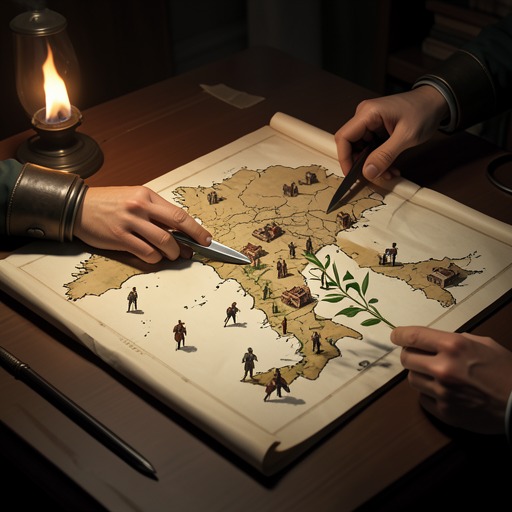
The meeting takes place at night, when sleep has quieted birds, fish, beasts, and human beings. Against this darkness, Aeneas's arrival is defined by controlled public action rather than surprise or violence. He stands high on the stern holding an olive branch and declares that the visitors are Phrygians whose arms are visible, presenting their identity and intentions in a form that makes peaceful recognition possible. The olive branch functions as both diplomatic signal and ethical restraint: Aeneas enters Evander's sphere by asking to be heard before he asks to be helped.
Recognition and the Pact with Evander
Evander responds by descending to the shore, embracing the stranger prince, and joining hands with him. The welcome is then formalized in the grove, where Aeneas addresses the king and Evander answers with royal courtesy. Evander recognizes in Aeneas the features of his father, Anchises, and recalls Anchises through the son's appearance. This recognition transforms an encounter between unknown rulers into a renewal of an older bond. Aeneas's identity is therefore authenticated through family resemblance and remembered friendship before it is established through military credentials.
The alliance is not a casual expression of sympathy. Evander commits practical assistance to the Trojan cause, while Aeneas receives a political foothold in the Italian world. The compact also establishes a pattern of hospitium: the stranger is treated as a guest whose lineage and purpose impose obligations on the host, and the guest's conduct answers that welcome with loyalty. Personal recognition thus becomes public strategy. What begins with an olive branch and a joined hand develops into a partnership capable of altering the balance of the coming war.
Pallas and the Military Extension of the Alliance
Young Pallas accompanies his father when Evander meets Aeneas, making the alliance a relationship between generations as well as between peoples. Evander presents his son as someone who will observe Aeneas's courage and conduct and begin early to admire and imitate them. Aeneas is consequently positioned as a model for Pallas, not simply as a commander seeking temporary troops. The proposed cooperation contains an educational and dynastic dimension: Trojan excellence is to be transmitted through the Arcadian prince's association with the foreign hero.
Evander assigns Pallas two hundred horse, a small but carefully selected warlike band. The number makes the promise concrete, while the emphasis on their selection gives quality greater weight than mass. Pallas's contingent converts hospitality into action and places the young prince directly within the military consequences of the pact. The alliance therefore carries an internal risk: the future of two communities is bound together through the exposure of a son who is expected to learn courage by entering the field.
The compact also opens Aeneas's path toward additional Italian support. His request is not confined to Evander's household; it belongs to a broader effort to secure assistance from Evander and the Etruscans. The alliance is thus a diplomatic hinge between a small Arcadian kingdom and a larger anti-Rutulian coalition. Aeneas's wandering identity begins to change into that of a leader able to gather forces, negotiate obligations, and make a future state appear through alliances before it exists as territory.
From Alliance to the Law of Peace
The ethical logic established in the meeting with Evander persists when Aeneas later receives suppliants from Laurentum carrying olive branches and asking for a truce. Aeneas grants their request because their suit is just, and he condemns the causeless quarrels that have armed the Latian princes against an unoffending man. The repeated olive branch links the Evander alliance with a broader political grammar: legitimate power must distinguish a request for peace from an act of aggression, and mercy can be a form of authority rather than weakness.
Aeneas subsequently sends to the Latian king to end the rage of arms and ratify peace. When peace is publicly tied with solemn vows and sworn on both sides, with the required holy rites performed, diplomacy acquires a sacred and quasi-legal force. The alliance with Evander is therefore part of a progression from personal recognition to military cooperation and finally to the public ordering of communities through oaths. Its significance lies not only in gaining troops but in defining the kind of political future Aeneas is meant to found: one in which hospitality, just appeals, ritual obligations, and negotiated peace stand against uncontrolled fury.
Historical Memory and Narrative Significance
The alliance is framed by memories of Troy's departure and by the uncertain transmission of its origins. It is said that when Aeneas prepared his flight and felled timber from Mount Ida, the goddess approached her son, preserving the departure within a divine and legendary history. The fleet built from timber at the beginning of exile thus finds a later counterpart in the organized forces gathered for settlement and war. Wood, ships, land, horses, and oaths form successive stages in the same transformation from uprooted survivors to a people with a political destiny.
The alliance's ultimate meaning is tested by the war's violence. Aeneas can pause before striking a yielded opponent, repressing his hand in deep suspense, even while the pressures of victory, honor, and revenge demand action. That hesitation recalls the restraint of the olive branch and exposes the conflict between the discipline required to found a future order and the fury generated by battle. Aeneas's compact with Evander therefore does more than advance the plot. It supplies the moral and institutional counterweight to war, joins the Trojan and Italian futures through Pallas, and makes the promised foundation depend on relationships that are at once personal, military, and sacred.