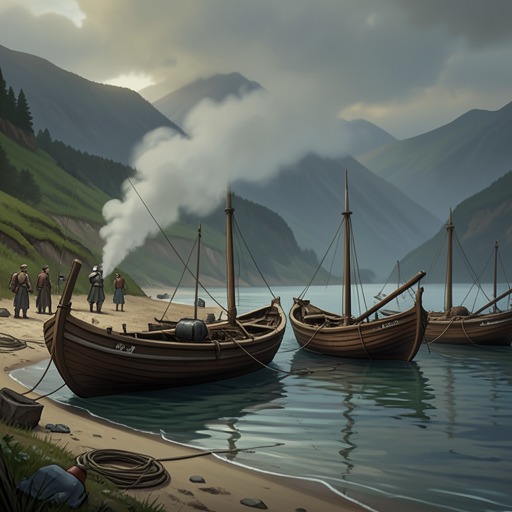
Burning of the Trojan Ships
AeneidBurning of the Trojan Ships is a decisive crisis in the Trojan exile: the fleet that carries the survivors away from the ruins of Troy is nearly destroyed by fire at the Sicilian shore. The episode begins in mourning for Anchises, gathers force through the remembered authority of Cassandra, and ends not with the abandonment of the voyage but with its redefinition. The ships are both practical instruments of migration and emotional links to a lost homeland; when the Trojan matrons burn them, grief becomes an attempt to halt the future.## Causes and Background After the fall of Troy, Aeneas and the surviving Trojans retreat under celestial omens to seek a new home. Near Antandros, at the foot of Mount Ida, they cut timber from sacred groves and build their fleet. The ships therefore arise from a difficult compromise: the exiles must use the resources of the land they are leaving in order to reach the land they have not yet found. Their construction embodies uncertainty, endurance, and dependence on a promised destination rather than a known one.
The fleet’s voyage is marked by exposure and instability. At sea the galleys move with no land in sight, surrounded only by ocean and sky; a sudden burst of rain, black night, and rising winds turn the passage into an environment of immediate danger. This vulnerability helps explain why the ships carry such emotional weight. They are the Trojans’ shelter, livelihood, and sole means of pursuing fate, but they are also a reminder that the exiles have been denied a settled home.
The immediate occasion of the burning is the funeral remembrance of Anchises. The Trojan matrons sit alone upon the sands, lamenting his death and looking back toward the sea. Their mourning is not merely private grief. It becomes a collective meditation on the impossibility of restoring the Trojan walls or recovering the familiar landscape of home. In that atmosphere, Cassandra’s remembered command acquires force: the women are urged to consume the fleet, and the authority of a prophetic figure from Troy is made to speak through a dream.
What Happens
The Trojan matrons set fire to the ships while the fleet lies without defence. Their action converts mourning into revolt against the journey. The fleet, previously a sign of common purpose, becomes the object on which accumulated exhaustion, homesickness, and fear are discharged. The women’s gesture is therefore both destructive and expressive: they cannot renew Troy, and they attempt to prevent the continued movement that makes their loss irreversible.
The crisis divides the Trojan community. Some are ready to remain behind, while others still hold to the promised land. The conflict is defined by a painful double consciousness: the Trojans hope for the fated destination but fear the fatal route. The ships’ destruction makes that division visible, separating those whose strength or desire for further travel has failed from the “brave remaining few” who continue to support Aeneas’s mission.
Aeneas responds as a pious leader rather than as a commander seeking revenge. He tears his robe, raises his hands to heaven, and appeals to Jupiter, asking that the divine power responsible for the disaster strike him instead if prayer still has any place. His reaction identifies the burning as a communal catastrophe, not simply an act of insubordination. He accepts responsibility for the people entrusted to him, while also recognizing that human strength cannot master the victorious element once the fire has taken hold.
The answer comes through a violent storm. Southern winds rise, lightning crosses the sky, and thunder shakes the mountains and plain. Divine weather overwhelms the fire, doing what buckets and human hands cannot do. The storm does not restore the fleet untouched; it arrests total destruction. The result is a reversal in the value of the voyage: the fleet passes from apparent security to near annihilation, then from annihilation to damaged survival. Divine intervention preserves the expedition while confirming that its continuation depends on forces beyond ordinary control.
Consequences and Aftermath
The survivors repair what remains. The Trojans who are still prepared to risk their lives renew their oars, benches, and cables, many of which have been half consumed. This practical rebuilding gives the episode its political outcome. Fire has exposed the limits of the migrating community, but reconstruction restores enough material capacity for the mission to proceed. Aeneas’s people do not simply resume the voyage as before; they emerge as a smaller, more disciplined group.
Those who remain behind are not treated as irrelevant to the Trojan future. The episode leads to the establishment of a settlement for the weaker or unwilling members, while Aeneas designs a city with the plow. The burning thus produces a double foundation: one community continues toward the fated Italian destination, and another is assigned a place where it can end its wandering. The crisis separates destinies without erasing the common origin that binds both groups to Troy.
The memory of the episode also reaches backward into the legendary history of the fleet. The narrative later recalls that when Aeneas prepared his departure and felled timber from Mount Ida, the great mother goddess approached her son. That recollection places the ships within a sacred genealogy and makes their burning more than an accidental fire. Their material substance originates in a divinely significant landscape, while their destruction reveals how precarious even a divinely framed mission can become.
Narrative and Thematic Significance
The episode combines the master plots of escape, quest, and sacrifice. The Trojans are escaping the destroyed city, pursuing an uncertain future, and sacrificing the very means by which that future might be reached. The value shift is especially sharp because the fleet embodies freedom of movement at the moment when the women try to destroy it. What appears to be liberation from an intolerable journey threatens to become permanent captivity on an unnamed shore.
Burning also establishes a central tension between human exhaustion and imperial destiny. The future associated with Aeneas requires mobility, settlement, and eventual political order, but that future is purchased through repeated losses: Troy has already fallen, Anchises has died, and now the fleet itself is endangered. The narrative refuses to present destiny as effortless progress. Fated purpose survives only by passing through grief, division, damaged resources, and the exclusion of those who cannot continue.
The ecological dimension is inseparable from the political one. The fleet is built from timber cut in sacred groves near Mount Ida, and its later destruction turns worked wood back into fire. Forest resource, maritime travel, settlement, and catastrophe form one chain. The Trojans’ founding project depends on transforming living landscape into ships and then transforming ships into the means of a new city; the burning exposes the material cost and fragility of that process.
Finally, the episode tests Aeneas’s pietas. His first response is lament, prayer, and responsibility rather than coercion. Yet the community can be preserved only through division: some continue with him, while others remain to found a separate settlement. The burning of the Trojan Ships therefore marks neither a simple failure nor a simple miracle. It is the moment when the Trojan exiles learn that survival requires accepting both the loss of their old world and the unequal, painful shape of the future promised to them.