Murder of Polydorus
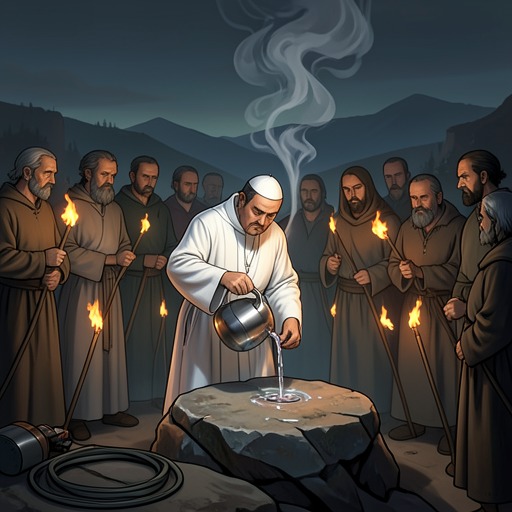
AeneidThe Murder of Polydorus is the discovery of a concealed Trojan murder through a bleeding myrtle tree. Its decisive significance lies in the reversal of apparent hospitality: a shore that once seemed joined to Troy by friendship and religious fellowship is revealed as unhospitable because it has absorbed the blood of Polydorus. The episode turns landscape into testimony, makes the dead speak through nature, and forces Aeneas and the Trojans to alter their course through ritual departure rather than ordinary settlement.
A Hospitable Shore Reversed
The episode begins after Aeneas reaches a realm described as hospitable while Fate remains favorable, a place bound to Troy by friendship and shared religious ties. Acting on the expectation that the landing may become a foundation for the exiled community, Aeneas worships the local gods, marks out a line along the shore, and begins laying the deep foundations of a wall. These actions present settlement as both practical construction and sacred negotiation: the Trojans do not simply occupy the coast, but attempt to establish a lawful relationship with its gods and its ground.
That promise collapses when the land answers the act of settlement with an omen. The same shore that seemed open to Trojan foundations contains a violence concealed beneath its surface. The contrast is crucial: friendship and religion join the realm to Troy in appearance, while buried blood separates it from the Trojans in truth. The discovery therefore does not merely interrupt construction; it invalidates the assumption that the place can receive a Trojan future.
The Bleeding Myrtle
While Aeneas goes into the wooded landscape to gather greenery and shade the altar, he pulls a plant from the earth. The apparently ordinary act of collecting foliage becomes a prodigy. As the rooted fibers rise from the wound, the plant discloses that the ground is not inert. Nature becomes an active medium of memory, and the extraction of a branch becomes an involuntary act of exhumation.
Aeneas tests the sign again. He bends his knees against the ground and pulls once more, after which the violated myrtle runs with gore. The repetition changes the event from a single inexplicable accident into confirmation. What first appears to be an uncanny injury to a tree is shown to be the recurrence of an older injury beneath it. The tree’s bleeding gives physical form to a crime that human testimony has concealed.
The revelation intensifies when a groan rises from the wounded earth and the caverns of the tomb, sounding like the renewed voice of a troubled ghost. The scene moves from omen to disclosure through a carefully graded sequence: uprooting, blood, repetition, and finally speech. The earth is simultaneously grave, witness, and wounded body. Its secret cannot remain buried once the Trojan ritual of settlement disturbs it.
Polydorus Speaks Through the Ground
The voice explains that every drop contained in the living tree is kindred blood, blood that ran in Trojan veins. The tree is therefore not merely growing beside a grave; it has become physically continuous with the murdered Trojan. Its sap and gore collapse the distinction between plant and corpse, making the natural world carry the identity and suffering that the killers attempted to suppress.
The speaker identifies himself as Polydorus and warns the Trojans to flee the inhospitable shore. This direct warning supplies the episode’s recognition: Aeneas learns that the land’s apparent welcome is false and that the danger is inseparable from its history. Polydorus is not encountered as a living companion but as a voice released by the act of touching the earth. His posthumous agency determines the movement of the living.
The revelation also gives the murder a political and ethical dimension. The blood is explicitly Trojan, so the crime is not an anonymous act of violence but an offense against the community from which Aeneas comes. The hidden victim’s identity transforms a local marvel into a matter of collective obligation. The Trojans must respond not only to fear but to kinship, pollution, and the dead man’s demand that his condition be acknowledged.
Abandonment and Funeral Rites
The Trojans seek divine guidance, asking that the prodigies of Heaven be interpreted and that the required command be made known. Their response treats the bleeding tree neither as a curiosity nor as a challenge to be mastered. Because the shore has been polluted by the blood of Polydorus, all agree to leave the execrable place.
Departure, however, is delayed by duty to the dead. Before sailing, the Trojans prepare funeral rites for Polydorus. The sequence establishes a necessary order: recognition must precede interpretation, interpretation must produce withdrawal, and withdrawal must be accompanied by burial observance. The living cannot safely build upon a ground where the dead has been denied proper acknowledgment.
The episode thus makes ritual the means by which the Trojans restore moral order. They do not retaliate against an identified murderer within the scene, nor do they attempt to retain the land after learning its secret. Their answer is flight shaped by reverence. The shore is abandoned because its hidden violence has made settlement impossible, while the funeral rites ensure that Polydorus is not abandoned again in death.
Narrative and Thematic Significance
As a plot movement, the Murder of Polydorus combines discovery with escape. Aeneas begins with a constructive objective—adoring the local gods, marking the coast, and founding a wall—but an external revelation reverses that objective. The episode’s central turn is therefore from foundation to flight. The same gesture that would have rooted the Trojan future in a new land exposes why that future cannot take root there.
The bleeding myrtle also unsettles the boundary between human history and the natural world. The landscape does not passively frame the crime; it preserves and announces it. The tree’s living substance becomes the medium through which Polydorus survives, while the wound in the earth makes violence visible after human silence has hidden it. The scene gives environmental space narrative agency without separating that agency from the ethical history imposed upon it.
The episode’s horror arises less from spectacle than from delayed recognition. At first, Aeneas is engaged in worship and construction, acts associated with order, piety, and permanence. Only gradually does the ground reveal that these acts have brought him into contact with a violated burial place. The final warning reverses the meaning of the landing: what looked like a providential opportunity is exposed as a fatal deception. Yet the discovery also protects the Trojan community, because Polydorus’s voice converts concealed murder into actionable knowledge.
In the larger pattern of Trojan exile, the event shows that movement is governed not only by hostile seas or visible enemies but also by the moral condition of places. Aeneas’s community must read signs, respect the dead, and accept that a promising shore may be barred by an older crime. Polydorus’s murder therefore becomes both a story of wrongful death and a test of Trojan religious responsibility. The dead man’s blood makes the land speak, and the Trojans’ rites allow them to leave without turning the victim’s silence into a second abandonment.