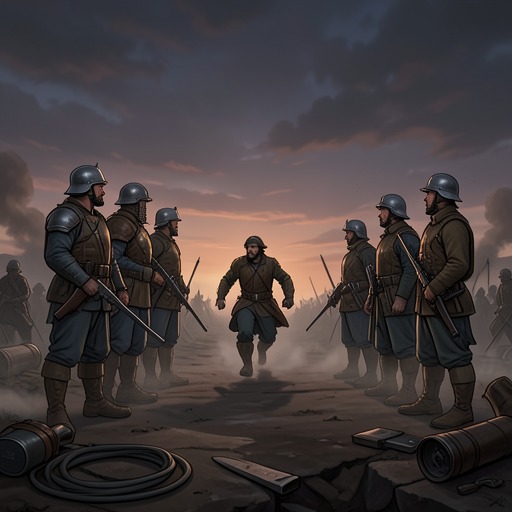
Aeneas–Turnus Duel
AeneidAeneas–Turnus Duel is the climactic single combat between Aeneas and Turnus, designed to replace a wider war with a contest between its principal champions. The encounter carries the fate of the Latins, the Trojans, Lavinia, and the promised peace, but it also exposes the tension between public settlement and private vengeance. Its final movement leaves Turnus defeated and pleading, while Aeneas hesitates before recognizing the Belt of Pallas and delivering the fatal blow.
Causes and Political Background
The duel emerges after Turnus has become the object of public resentment. When the Latins abandon the field and their armies are broken, Turnus himself becomes marked by the anger of the people. The military crisis converts the war from a collective struggle into a personal test: Turnus challenges Aeneas to single combat, and the proposed encounter offers a way to determine the conflict without requiring every army to continue fighting.
The movement toward combat is repeatedly framed by diplomacy. Envoys from Laurentum approach Aeneas with olive branches and ask for a truce; they appeal to his mercy and request permission to gather the dead. Aeneas grants the request, describing the Latins’ quarrel as a severe fate that has armed them against an unoffending man. The episode establishes him not merely as a conqueror but as a commander willing to recognize the claims of the defeated and the obligations surrounding burial.
A second diplomatic step follows when Aeneas sends to the Latin king to end the violence and ratify peace. On the next morning, the opposing parties publicly bind the settlement with solemn vows, swear on both sides, and complete the rites required by religious custom. The duel therefore does not begin in a condition of unlimited violence. It is surrounded by truce, oath, ritual, and the expectation that an agreed contest will settle what armies have failed to resolve.
The War Narrows to Its Champions
The duel condenses a much larger political and military sequence. Earlier, Aeneas has left Evander and sought the Tyrrhenian camp and Tarchon’s tent, showing that his cause depends on alliances and coordinated forces rather than on isolated heroism. Elsewhere, the Latin side sends Venulus to Diomede to request aid in defending Ausonia and to explain the common danger. These embassies reveal the war’s international scale; the final duel is powerful precisely because it narrows that network of alliances into the bodies and reputations of two men.
The agreement itself is therefore a form of limited warfare. Collective armies withdraw from the immediate decision, while the champions assume the risk that had previously been distributed across the battlefield. The public vows give the encounter a quasi-legal force: peace is not simply hoped for but ceremonially tied, with both sides performing the dues required by sacred custom. Yet the surrounding narrative keeps divine power active, so the apparent human settlement remains subject to forces beyond the contracting parties.
That instability appears when Juno consents after her desires have found success and withdraws from the cloud. The peace that has been made is followed by Jupiter’s preparation to force the watery goddess from the wars. The settlement thus stands at the intersection of human agreement and divine management. The duel is meant to close the conflict, but its final authority depends on whether the gods permit the political order to hold.
The Final Combat
When the decisive confrontation reaches its last phase, Aeneas stands over Turnus as the stronger fighter. Turnus is astonished, crouches beneath his conquering opponent, forgets to guard himself, and waits for the blow. The image reverses the earlier balance between the champions: the proud challenger is now physically reduced, while Aeneas possesses the initiative and the power to determine whether the encounter ends in death or restraint.
Aeneas raises his weighty spear and reproaches Turnus for seeking another subterfuge. Turnus’s defeat is not presented as a mere accident of weapons; it is treated as the consequence of evasions and failed alternatives after the terms of the contest have brought him face to face with his enemy. The spear becomes an instrument of judgment, but the judgment is still suspended while Aeneas decides what to do with a man who can no longer defend himself.
The surrounding battle repeatedly threatens to break the duel’s ritual boundaries. In an earlier moment of widespread fighting, Aeneas stretches out his arm as a sign of peace and cries for the Rutulians and Latin troops to withdraw. His gesture attempts to preserve the distinction between the agreed personal combat and the uncontrolled violence of the armies. The contrast matters: the duel is presented as a mechanism for ending war only when the combatants and their followers accept its limits.
The scene also recalls the fragility of martial fortune. A traitor’s sword flies apart in the middle of a stroke and deserts its lord, leaving the fighter with only death or flight. Such reversals make the duel’s outcome legible within the epic’s wider pattern: weapons fail, courage collapses, and the battlefield’s apparent certainties repeatedly turn against those who rely on them. Turnus’s final helplessness is the culmination of this process.
Hesitation, Recognition, and Death
Aeneas does not strike immediately. In deep suspense, he seems prepared to deliver the blow but represses his hand; he rolls his eyes and feels the pressure of the decision. Turnus’s submission creates a moral and emotional interruption inside the logic of victory. A defeated enemy can be killed, but the scene makes clear that the killing is not automatic. Aeneas must choose whether military success will become execution.
Turnus appeals to the obligations of victory and marriage, presenting Aeneas with the claim that the conquest and the royal wife are already his and that striking a yielded man would be mean and ignoble. The plea reframes the conflict from battlefield justice to personal mercy. It asks Aeneas to regard the defeated Turnus as a vulnerable other rather than as the embodiment of the war that has obstructed his destiny.
The hesitation ends through recognition. Aeneas sees the Belt of Pallas on Turnus, a concrete object that recalls the young warrior’s death and Turnus’s possession of its spoils. The sight changes the value of the moment: pity and restraint give way to remembered loss and renewed anger. The belt is not merely armor or treasure; it is evidence carried into the final encounter, binding Turnus’s present vulnerability to the earlier killing of Pallas and to the grief of Evander.
With that recognition, Aeneas’s hand is no longer repressed. The duel concludes in Turnus’s death. The outcome fulfills the immediate political purpose of the single combat by removing the leader whose challenge sustained resistance, but it also gives the peace a violent foundation. The settlement is ratified through vows, while its final enforcement comes through the death of the defeated champion.
Consequences and Significance
The duel’s consequence is the conversion of war into a new political order. Aeneas’s victory clears the way for peace between the Trojans and the Latins, while Turnus’s death removes the principal obstacle to the marriage and alliance that the conflict has contested. The event therefore joins personal victory to the larger movement toward the postwar union of the two peoples.
Its ethical force remains deliberately divided. Aeneas has earlier granted a truce, accepted the claims of the suppliants, and tried to keep the armies from violating the boundaries of the combat. These actions support an image of disciplined mercy and public responsibility. Yet at the decisive instant, the memory attached to Pallas’s belt summons a different obligation: the defeated man is no longer only a suppliant but the killer associated with a wound that has not been politically or emotionally closed.
The ending consequently refuses to make peace synonymous with gentleness. The war concludes through a scene in which ritual agreement, divine consent, military necessity, personal grief, and the desire for retribution converge. Aeneas wins the right to impose the new order, but the final act shows that the order is born from violence that remains visible in its founding gesture. The duel is both a legalizing substitute for general battle and the last eruption of the fury that the peace is supposed to overcome.