Death of Palinurus
AeneidDeath of Palinurus marks a cruel interruption in the Trojan voyage: Palinurus, the fleet’s master pilot, is overcome by the god of Sleep while still holding the rudder, plunged into the sea, and separated from the funeral rites required for passage into the Underworld. His death turns ordinary vigilance into helpless exposure to divine power and later makes burial itself the condition of his hoped-for release.
The Night Voyage and Palinurus’s Vigil
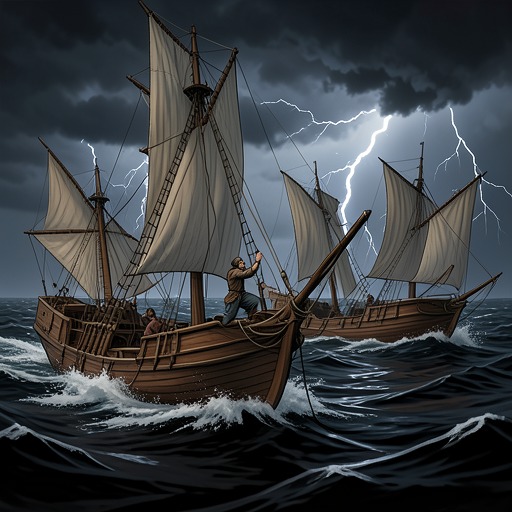
The episode begins with the Trojan fleet moving through the night. The steeds of Night have traveled halfway across the sky, and the rowers lie drowsing on their benches, but Palinurus remains awake at the helm. He steers ahead of the other ships, and the following navy turns as he leads it. His position is therefore both practical and symbolic: the fleet’s direction depends upon a single man who continues to resist the general surrender to sleep.
Palinurus is presented as a figure of professional vigilance rather than heroic display. His hands are fastened to the rudder, and his eyes remain fixed upon heaven while he repels invading sleep. The scene gives his alertness a physical form: the grip on the steering oar and the upward gaze express a duty maintained against the body’s exhaustion. The safety of the collective fleet rests upon that exhausted individual discipline.
The God of Sleep’s Assault
The god of Sleep does not wait for Palinurus to yield naturally. He approaches with easy flight, becomes angry at the pilot’s resistance, and throws at his temples a branch dipped in Lethe and drenched with Stygian dew. The imagery joins sleep to the geography of death: Lethe is the river of forgetfulness, while the Styx belongs to the boundary of the dead. Palinurus is thus attacked with substances already associated with the loss of ordinary consciousness and with passage beyond mortal life.
The divine action makes the death an externally imposed catastrophe rather than a simple failure of seamanship. Palinurus is doing exactly what his office requires when the supernatural power intervenes. His hands remain fixed upon the rudder, yet the branch defeats the will expressed by those hands. The episode places human vigilance beneath a power that can extinguish awareness without warning, making the pilot’s care necessary but ultimately insufficient.
The Fall into the Sea
Once the divine force has overcome him, Palinurus’s limbs scarcely have time to extend. The god, exploiting his superior strength, falls heavily upon him, plunges him into the sea, and tears away the rudder with the stern. Palinurus falls headlong and struggles in the deep, while the vessel continues without him. His drowning is therefore accompanied by the destruction of the instrument through which he had protected the fleet: the loss of the pilot and the loss of the rudder occur as one violent severing of human control.
The sea intensifies the danger. The fleet is passing among rocks, shoals, and waters white with bones; the impetuous ocean roars, and the rocks answer from the shores. The danger is not merely that Palinurus has disappeared but that his disappearance occurs at the precise moment when navigation is most perilous. The surviving hero feels the shocks of the vessel and discovers that it is sailing over shallow ground. The physical knocks become the first evidence that the fleet’s unseen guardian has been lost.
The hero concludes that his pilot is gone and takes measures in response, but the evidence supplied by the scene emphasizes how late recognition comes. The ship has already entered shoaly water before the loss is understood. Palinurus’s vigilance had concealed the fleet’s vulnerability; once he is removed, the danger becomes audible and tangible through the vessel’s collisions with the ground. His death consequently threatens not only one life but the passage of the entire Trojan company.
The Unburied Spirit in the Underworld
Palinurus later appears among the spirits in the Underworld, newly admitted though still fresh from life. His presence confirms that the fall from the ship ended in death, but it also shows that death has not completed his transition. He is described as a spirit who had been steering while watching the stars and bearing the fleet onward when disaster came upon him. The contrast between his former upward gaze and his present situation among the dead binds the two scenes together: the pilot who watched the heavens now exists on the other side of mortal navigation.
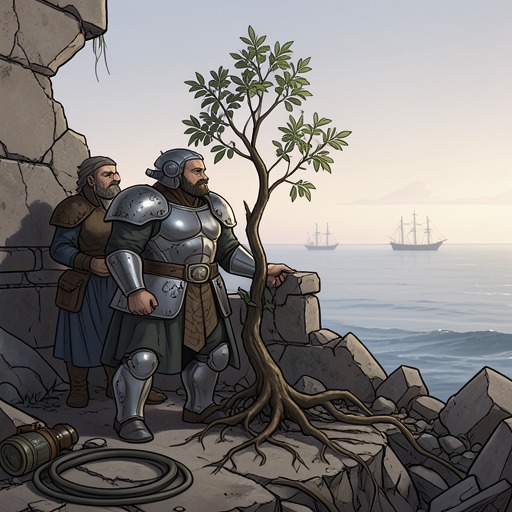
His central problem is not simply that he has died. He remains unburied, and that lack of burial prevents him from crossing the floods toward the forbidden shore. He asks for help and seeks passage to the sweet banks beyond, but the prophetess rejects the hope that an unintombed man can cross the waters. The scene establishes the right of burial as a boundary rule of the Underworld. Palinurus’s death has left him in an intermediate condition, dead in fact but unable to receive the ritual completion that would permit him to proceed.
This later encounter changes the meaning of the drowning. At sea, the event appears as the loss of a necessary pilot caused by Sleep’s intervention; below the earth, it becomes an unresolved ritual and social injury. The fleet has continued, but Palinurus has not been allowed to reach the destination proper to the dead. His body’s absence from burial keeps his spirit attached to the consequences of the voyage.
Narrative and Thematic Significance
The episode is structured around a sharp reversal. Palinurus begins as the one man resisting the common sleep of the rowers, the indispensable guide whose vigilance keeps the fleet moving safely. He ends as a newly admitted spirit unable to cross the Underworld’s waters. The reversal is not produced by recklessness, betrayal, or a voluntary abandonment of duty; it comes when divine power turns the very conditions of the voyage—night, fatigue, and the sea—against him.
The event also exposes the precariousness of the Trojan mission. A fleet advancing toward its destined future can still be diverted toward rocks by the removal of one exhausted servant. The path toward the larger foundation associated with Aeneas therefore passes through losses that are both personal and infrastructural: Palinurus is not an ornamental casualty, but the pilot whose absence is immediately registered by the vessel’s course and blows against the shoals.
Finally, Palinurus’s fate links bodily sleep, maritime danger, death, memory, and burial. Lethe’s branch first erases his resistance; the sea then separates him from the living; the absence of a tomb finally prevents his passage among the dead. His story gives the voyage a cost that cannot be measured only by whether the fleet survives. The Trojans continue onward, but the pilot who bore them through the night remains suspended between the waters he navigated and the waters he is forbidden to cross.