Aeneas's Encounter with Andromache and Helenus
AeneidAeneas's Encounter with Andromache and Helenus is a pivotal meeting at Buthrotum in which the wandering Trojan survivors confront a living remnant of their destroyed homeland. Aeneas arrives in Epirus expecting a new Dardanian settlement, but instead finds Andromache mourning Hector before a memorial altar. Her recognition of the “goddess-born” hero, and her desperate question about whether Hector survives even as a ghost, expose the emotional persistence of the Trojan catastrophe. Helenus then turns that grief toward prophecy, revealing the route and duty that will carry Aeneas onward: he must pursue the fate assigned by Heaven and establish the Trojan state through armed strength.
Arrival at Buthrotum
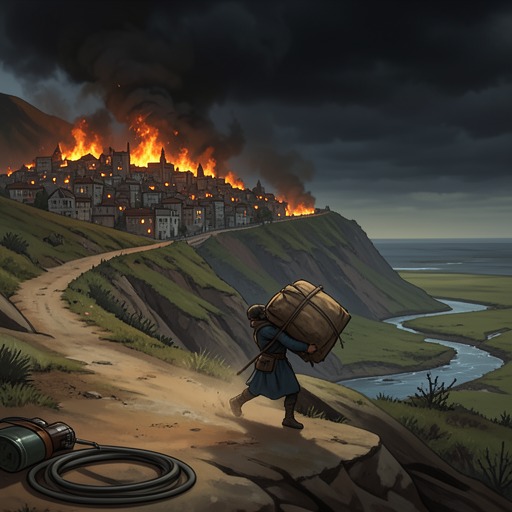
After leaving the coast of Epirus, Aeneas and his companions steer toward the port of Chaonia and land beneath the heights of Buthrotum. The setting appears to promise a new Trojan court, a place where displaced people might have rebuilt a version of what they lost. Aeneas leaves his ships riding in the harbor because he longs to see this new Dardanian community. The expectation of political kinship makes the discovery there more affecting: Buthrotum is not simply a stop in the voyage but a possible mirror of the homeland that the Trojans can no longer recover.
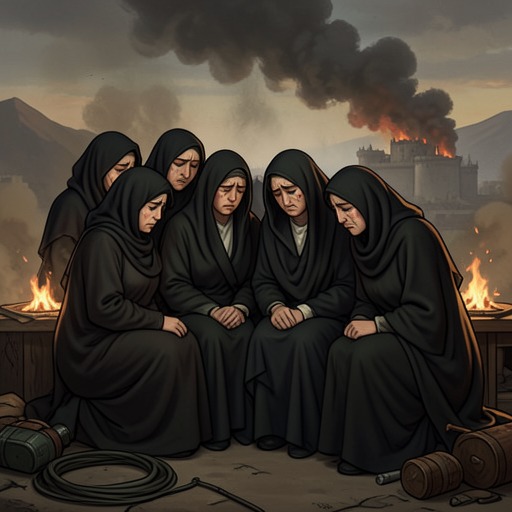
The meeting begins by chance. Before the gate, Andromache is solemnizing the fate of her former husband, Hector. Her rites are marked by green turf altars crowned with gifts, a modest but deliberate reconstruction of sacred and familial remembrance. The ceremony gives physical form to a past that cannot return. Andromache does not merely remember Hector privately; she stages his loss at the threshold of the settlement, making mourning part of the public landscape and linking Buthrotum's new Trojan identity to the dead of Troy.
Andromache's Recognition and Grief
When Andromache sees Aeneas, the shock overwhelms her. She faints, falls, and only with difficulty recovers enough strength to speak. Her first response is not political inquiry but bewildered recognition. She asks whether he is alive, “O goddess-born,” or whether he is a ghost, and immediately asks where Hector's shade may be found. The question reveals how completely war has disordered ordinary categories: the living appear improbable, while the dead remain vividly present.
Her cry also establishes the particular burden of the reunion. Aeneas is not encountered as an ordinary traveler. To Andromache, he is a survivor who seems to have crossed the boundary between life and death, a figure carrying the vanished city with him. Her attention moves from Aeneas to Hector, so that recognition becomes an act of searching for the absent. The encounter therefore joins two forms of knowledge: the physical certainty that Aeneas stands before her and the emotional certainty that Troy's dead still govern the meaning of the living.
The memorial scene gives Andromache's grief a wider historical force. She is a former wife mourning a former husband, but she is also preserving the memory of Trojan kinship in a foreign land. Her altar and gifts make Buthrotum resemble a place of exile that has attempted to become a homeland. Yet the rite remains oriented toward loss. The settlement's newness cannot erase the older catastrophe; it can only repeat its names and gestures in another landscape.
Helenus and the Authority of Prophecy
The encounter continues beyond Andromache's lament to Aeneas's consultation with Helenus, the royal seer. After two days spent in friendship, favorable southern winds fill the Trojan sails, but Aeneas does not depart without seeking supernatural guidance. He addresses Helenus as one who knows the laws of Heaven and what the stars decree, approaching him not as a mere political host but as an interpreter of a destiny inaccessible to ordinary human judgment.
Aeneas comes before the shrine burdened by religious doubt and fearful uncertainty. Helenus, possessed by his god, speaks from within that sacred authority. His prophecy does not dissolve the difficulty of exile; it gives the difficulty a direction. The Trojans are told to follow the will appointed by Heaven, under auspices more favorable than adverse, and to raise the Trojan state through strength of arms. The future is thus presented as both divinely sanctioned and historically demanding. Aeneas cannot fulfill it through passive hope. The promised state must be founded by action, endurance, and warlike capacity.
Helenus's speech changes the function of Buthrotum in the narrative. What first appears to be a destination or substitute homeland becomes a station from which Aeneas must depart. The community's existence demonstrates that Trojan identity can survive displacement, while Helenus's prophecy insists that Aeneas's own mission remains unfinished. Buthrotum offers recognition and temporary fellowship, but not the final settlement required by fate.
Farewell and the Forward Movement of Exile
When the priest has delivered his message, he gives Aeneas permission to continue and prepares rich gifts for the departure. This farewell combines hospitality with separation. The gifts affirm the bond between the travelers and the people of Buthrotum, while the license to leave acknowledges that friendship cannot cancel the larger command of destiny. Aeneas must carry what the meeting has given him—memory, warning, and prophetic assurance—into the next stage of the voyage.
The encounter consequently contains a compressed pattern of the Trojan exile. Arrival brings the possibility of recovered community; recognition reopens the wound of Troy; prophecy converts grief into obligation; and departure restores the movement toward Italy. Andromache anchors the past in ritual mourning, while Helenus projects the future through divine knowledge. Between them, Aeneas is positioned as the survivor who must remember the dead without allowing remembrance to halt the mission.
Narrative and Thematic Significance
The meeting works as both an emotional recognition scene and a narrative turning point. Andromache's response confirms the continuity of Trojan relationships across distance and catastrophe, but her bewilderment also shows that the old world survives only in fragments. Helenus supplies the complementary form of recognition: he identifies the shape of Aeneas's future and places his voyage within a heavenly order. Personal grief and public destiny are therefore not separate strands; the prophecy gains urgency because it follows the visible evidence of what happens when a homeland is lost.
The scene also distinguishes two models of rebuilding. Andromache's altar preserves Troy by repeating its mourning rites, creating a sacred memory of the dead. Helenus's instruction preserves Troy by carrying its political future elsewhere, toward the state Aeneas is commanded to establish. One form faces backward to Hector's shade; the other sends Aeneas forward toward Italy. Their encounter makes clear that the Trojan state will not be recovered as a physical return to Troy. It must be remade through exile, armed effort, and obedience to the fate that Helenus reveals.