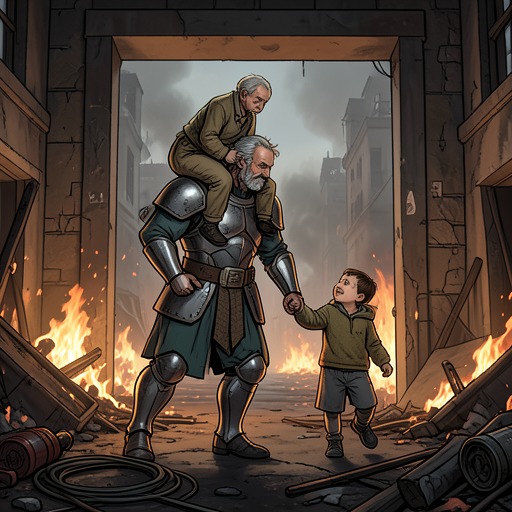
Anchises's Vision of Rome's Future
AeneidAnchises's Vision of Rome's Future is the great prophetic disclosure in which Anchises shows Aeneas the descendants and achievements that will emerge from the Trojan line. In a secluded vale of the Underworld, the father does more than identify future figures: he interprets the laws of soul, history, and destiny that make Rome's rise intelligible. The vision turns the dead into a living genealogy and gives Aeneas's exile a future-oriented meaning, presenting the founding of Rome and the Roman imperial destiny as the culmination of a long chain of suffering, renewal, and public service.
Setting and Revelation
Anchises reviews his assembled race in a flower-filled valley, counting the happy spirits ordained by fate. The scene is separated from the ordinary regions of the dead by a secret grove, where a gentle breeze moves among the trees. Its quiet enclosure gives the parade of future Romans the character of a sacred disclosure rather than an ordinary speech. Aeneas sees history before it has happened, while Anchises occupies the position of an interpreter who can connect the invisible company to the political world awaiting his son.
The vision follows the earlier movement through the Underworld, where Aeneas and the Sibyl have encountered shades, punishment, and blessedness. Anchises leads them through swarms of spirits to a rising ground from which the procession can be viewed. The elevated vantage point is narratively important: the future is presented as something surveyed in ordered succession, not as an accidental collection of events. Aeneas's journey below the earth therefore becomes a passage from mourning and uncertainty to recognition of a transgenerational design.
Anchises on the Soul and Renewal
Before naming Rome's future rulers, Anchises explains the condition of the souls gathered before him. He teaches that heaven, earth, and the elements share a divine spirit, but that mortal bodies and worldly contact burden the soul with corruption. After death, souls undergo purification until they can return to the light and, eventually, suffer mortal flesh again. This account gives the parade a metaphysical foundation: the figures whom Aeneas sees belong to a cycle of death, cleansing, embodiment, and renewed historical action.
Anchises's explanation also answers the apparent contradiction between the soul's divine origin and its willingness to return to mortal life. The soul is not simply released from history; it is repeatedly drawn back into embodied existence. In this framework, Rome's future is not detached from pain but made through recurring encounters with it. The history that Anchises displays is consequently linked to a larger rhythm of renewal, in which individual mortality feeds a continuing lineage rather than ending it.
After speaking, Anchises guides the Sibyl and Aeneas through the multitude of shades and brings them to a place where the future can be seen more fully. The act of leading is as significant as the doctrine itself. Anchises remains both father and mentor, turning the Underworld descent into an education that Aeneas could not obtain from ordinary human experience. The revelation depends on his authority to distinguish the meaningful line of succession from the innumerable dead.
The Roman Line and Its Founders
Anchises then points out the future settlements that will one day possess great fame, although they currently lie obscure and nameless. The contrast between present insignificance and future renown defines the prophetic method of the scene. Places that have not yet acquired political identity are already held within the vision as the beginnings of a mighty historical order. Fame is shown not as an immediate possession but as the delayed consequence of generations fulfilling their appointed roles.
Among these descendants stands Romulus, born to restore the crown once worn by his injured grandsire. His appearance joins the founding of Rome to an act of dynastic repair. Rome does not arise as an isolated invention; it emerges through bloodline, injury, restoration, and the recovery of rightful sovereignty. The future city is therefore presented as both a new beginning and a continuation of ancestral claims.
Anchises next commands Aeneas to fix his sight on the Roman race and the Julian progeny. Caesar awaits his appointed hour, and the vision gathers the future Roman people into a family whose political reach will extend beyond ordinary human limits. The Julian line is not treated as a detached later development but as part of the same genealogical current that begins with the Trojan survivors. Through this arrangement, Aeneas's private descent from Troy becomes the remote origin of a public dynasty.
The prophetic sequence extends from ancestral Trojans to the rulers and heroes who will give Rome its recognizable greatness. Anchises does not merely predict that Rome will exist; he places its future within a succession of persons whose names embody conquest, government, restoration, and sacrifice. The parade converts genealogy into political argument: Rome's authority is made to appear ancient before the city has been founded and inevitable before its institutions have taken shape.
Marcellus and the Emotional Cost of Destiny
The vision reaches a particularly charged moment when Anchises calls attention to Marcellus. He praises Marcellus's tireless labor, manly grace, and royal spoils, presenting him as a figure of exceptional promise within the Roman future. Yet the admiration is shadowed by the knowledge that the glory of such a descendant cannot be separated from mortality. The scene's splendor therefore carries an elegiac pressure: future greatness is visible, but so is the fragility of the person who bears it.
Marcellus's appearance prevents the prophecy from becoming a simple catalogue of triumphs. The Roman future contains not only expansion and imperial magnificence but also the loss of individuals who seem destined to embody it. Anchises's act of pointing and Aeneas's astonished watching make political history emotionally immediate. The future is not a remote abstraction; it is populated by bodies, faces, labor, and premature absence.
This mixture of triumph and grief gives the vision its distinctive moral texture. Rome's destiny is affirmed, but affirmation does not cancel suffering. The promised order will require the deaths of heroes and the endurance of those who survive them. In that sense, the prophecy prepares Aeneas to understand his own sacrifices as part of a pattern that will recur throughout the Roman line.
Narrative Function and Roman Destiny
Anchises's Vision of Rome's Future occupies the central prophetic position in Aeneas's Underworld descent. It supplies the knowledge that the journey below has been seeking: the Trojan past will not terminate in exile, and the present hardships are directed toward the founding of a people whose history will culminate in Rome. The revelation changes the scale of the narrative from one man's escape and wandering to the future of an entire civilization.
The vision also reorganizes earlier memories. Troy's fallen defenders, including Ripheus and Iph’itas, belong to the heroic past that Aeneas carries with him, while the figures shown by Anchises belong to the future made possible by that past. The connection between the two is neither accidental nor purely military. Courage, age, ancestry, sacrifice, and public obligation pass through the generations, allowing the old Trojan world to survive in transformed political form.
Its range reaches beyond the immediate Trojan story. The tale of Daedalus and the Cretan shore, Teucer's heroic race, and the sacred forest vowed by the first inhabitants of Grecian blood all place Roman origins within a wider Mediterranean and Greek inheritance. Anchises's forecast does not erase those earlier traditions; it gathers and redirects them toward Rome. Even the recollection of Greeks who came to Troy's destruction becomes part of a history in which warfare, migration, and cultural inheritance are absorbed into a new Roman order.
The prophecy's final force lies in its union of family memory and state ideology. Anchises speaks as a father, but he reveals a future of cities, rulers, armies, and civic glory. Aeneas receives not a private consolation alone but a mandate to carry the Trojan people forward. By showing him the Roman race in advance, Anchises makes endurance intelligible: the exile must continue because the future already contains the meaning of the journey, even though that future remains unseen by every ordinary human witness.