Creusa's Death
AeneidCreusa's Death is the decisive rupture in Aeneas's flight from Troy: while escaping through winding ways under cover of night, Aeneas loses Creusa, abandons the other duties that had governed his flight, and is forced to confront her death through a final supernatural encounter. Her ghost does not restore the marriage or permit mourning to halt the journey. Instead, she redirects Aeneas toward the living—his father, his son, and the Trojan gods—and makes the continuation of his exile the measure of his fidelity.
Circumstances of the Separation
The loss occurs during the confusion of Troy's destruction. Aeneas later attributes his failure to remain with Creusa to the intervention of a hostile god and to an unknown offence, presenting the separation as something imposed upon him rather than deliberately chosen. As he takes winding paths through the dark in search of shelter, Creusa disappears from his company. The broken route matters: flight is no longer a single family movement but a disjointed passage in which the obligations of escape can be violently rearranged.
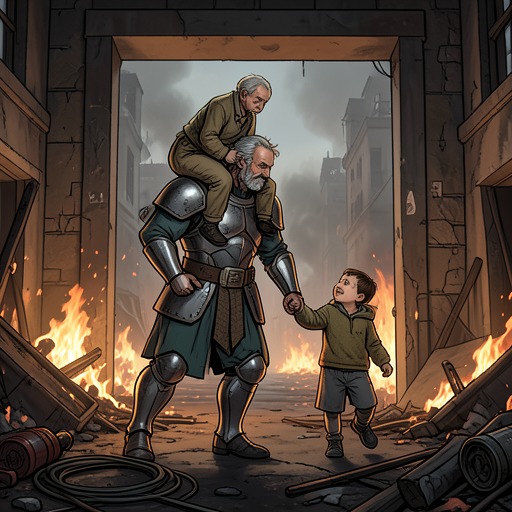
The immediate consequence is a collapse of Aeneas's practical and moral direction. Stung by the loss, he abandons the care of his father Anchises, his son Ascanius, and the Trojan household gods. The sequence reverses the priorities that define his escape. He had been charged with carrying family and sacred inheritance away from Troy, yet grief makes him leave precisely those beings and objects behind. His despair therefore becomes both emotional and functional: the survivor loses not only his wife but also, for a moment, the purpose that makes survival meaningful.
Aeneas's Search and Recognition
Aeneas returns toward the ruined city in a state of uncontrolled distress. Among the devastation he sees a line of captive youths and matrons with bound hands, an image of Troy's defeat that intensifies rather than resolves his private loss. In the silent streets he repeatedly calls Creusa's name. The repetition is an act of searching, but it also marks the point at which ordinary communication has failed: he can summon her only as a name before he can encounter her as a presence.
Creusa finally hears him, and her appearance changes the nature of the episode from pursuit to recognition. Aeneas stands aghast and speechless, with fear physically overtaking him, while Creusa's ghost addresses his grief. The scene does not present death as an absence that can be overcome by reunion. Creusa is visible and audible, yet already beyond the conditions of bodily return. Her apparition permits knowledge of the loss while preserving its irreversibility.
Creusa's Final Counsel
The ghost begins by restraining Aeneas's mourning, telling him that tears and cries cannot relieve the dead and urging him to desist from indulging his pain. Her words make consolation inseparable from command. She does not deny the legitimacy of his love or grief; she denies that grief can become the survivor's permanent action. The dead cannot be recovered through lament, and Aeneas must therefore convert attachment into responsibility.
Creusa entrusts their common issue to Aeneas's care. This instruction shifts the center of the broken household from the lost wife to the child who remains and to the future represented by that child. Creusa's last act is consequently maternal and political at once: she relinquishes her claim on Aeneas's immediate presence so that he may protect Ascanius and carry forward the family line. The marriage ends in separation, but its final speech preserves a duty arising from their shared child.
The Ghost's Departure and Aftermath
Creusa's ghost glides away unseen in the air after delivering her counsel. The movement confirms that the meeting is temporary and that the boundary between the living and the dead cannot be crossed at will. Aeneas tries to speak, but horror ties his tongue. He then attempts three times to embrace her neck, and each attempt fails. The repeated gesture gives the scene its physical climax: recognition has been achieved, but contact remains impossible.
The aftermath is not a completed farewell. Aeneas receives an explanation and a charge, yet he cannot answer Creusa or hold her. Her disappearance leaves him with knowledge rather than closure. The event thus sends him onward in a condition of unresolved mourning, where the vanished figure of Creusa remains bound to the duties of family preservation, religious continuity, and Trojan survival.
Narrative and Thematic Significance
Creusa's Death combines external compulsion with tragic misrecognition. A hostile divine force and the chaos of the night produce the separation, while Aeneas's despair produces the secondary abandonment of Anchises, Ascanius, and the household gods. The event's reversal is therefore double: the escape that should gather the remnants of Troy briefly scatters them, and the survivor who should lead the household temporarily deserts it. Recognition comes only when Creusa's ghost reveals that the loss cannot be repaired by returning to the past.
The episode also establishes a severe form of heroic maturation. Aeneas is not made faithful by escaping grief but by learning that grief cannot replace action. Creusa's appearance converts private bereavement into a mandate to care for the living and to continue the Trojan future. Her death is consequently both an intimate catastrophe and a structural turning point: the failed embrace closes the possibility of restored domestic life, while her final counsel clears the path toward Aeneas's larger destiny.