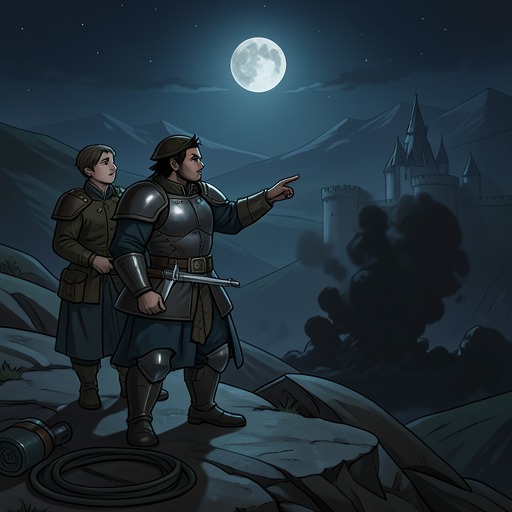
Nisus and Euryalus's Night Raid
AeneidNisus and Euryalus's Night Raid is the night operation in which Nisus and Euryalus leave the Trojan guard, penetrate the Rutulian camp, kill sleeping enemies, and attempt to return through hostile territory. What begins as a carefully chosen act of service becomes a catastrophe when their retreat is detected: pursued by three hundred horsemen under Volscens, Euryalus is killed, and Nisus abandons escape in order to seek Volscens and avenge him. The episode’s decisive significance lies in that reversal. Military success gives way to personal loyalty, and the language of shared duty is finally overtaken by grief and vengeance.
Identity and Purpose
The two young warriors are introduced as comrades who share a common danger in the war and have deliberately chosen to stand guard together. Their companionship is therefore not incidental to the raid; it is the condition from which the action grows. Nisus presents the impulse behind their undertaking as an ardour that may come from the gods or may arise from their own desire, leaving the source of their courage deliberately unresolved. Whether divinely inspired or self-generated, the feeling in his breast becomes a decision to act rather than remain within the safety of the guard.
Their proposal is directed toward the wider Trojan cause. When Ascanius receives the warriors and orders the more experienced men to speak first, Nisus asks the elders to listen before judging the attempt too daring for their years. He argues that the enemy is securely drenched in sleep and wine, making the camp vulnerable to a sudden passage. The speech is both a military recommendation and a test of credibility: the young men must persuade older authorities that youth does not cancel judgment. Nisus’s appeal places the raid under communal scrutiny before it begins, while Euryalus’s presence makes clear that the enterprise is conceived as a joint undertaking rather than as one man’s solitary exploit.
Course of the Raid
Nisus and Euryalus first pass the trenches and then move toward the Rutulian tents, where the sleeping enemy lies in pitched pavilions. Their advance has a sharply practical purpose: they are to cut through the camp while the defenders are insensible, and the operation is described through its fatal effect on many before the raiders themselves are overtaken. The night does not merely conceal them; it temporarily reverses the normal balance of power. The sleeping camp, ordinarily a protected military space, becomes terrain through which two intruders can move and strike.
Nisus takes the active lead in opening the way. He tells Euryalus to look around while he goes forward securely and hews a passage through the sleeping foe. Speaking softly, he advances with his drawn sword toward Rhamnes, who lies with his head raised high on tapestry beneath him. The scene concentrates the raid’s method into a single image: silence, close violence, and the conversion of an apparently secure resting place into the first site of destruction. Nisus’s swordsmanship enables the pair to continue, but the same confidence in their movement also carries them farther into danger.
The raiders leave the camp proud of their conquest and prouder still of their prey. That heightened confidence marks the point at which the operation shifts from successful penetration to hazardous withdrawal. They have achieved the immediate exhilaration of victory, but their departure is not yet safety. Before they have gone far, they see three hundred horsemen guided by Volscens. The scale of this pursuing force reveals the disproportion between the raiders’ small band and the enemy response, while the mention that a queen has sent a legion to King Turnus places the encounter within the larger mobilization of the war.
Discovery and Pursuit
The failed return changes the value of the entire undertaking. The two warriors had entered the camp under the protection of sleep, wine, darkness, and surprise; once the mounted force appears, those protections collapse. The raid’s movement is now governed by pursuit rather than initiative. What had been a controlled passage through the enemy’s quarters becomes a flight in which every delay threatens both men and the cause for which they had volunteered.
The episode’s violence then becomes increasingly public and retaliatory. A javelin flies with equal strength and strikes Tagus through the temples; the warrior staggers, his eyeballs roll in death, and short sobs mark his final breath. The death of Tagus demonstrates that the raiders are still capable of answering force with force, but it also makes the confrontation unmistakable. Their covert mission has become an open clash, and the brief, physical details of Tagus’s death bring the consequences of the pursuit into the foreground.
Loyalty, Revenge, and Ending
Euryalus’s death is the emotional and structural turning point of the night raid. The evidence presents the pair first as men united by shared danger and chosen guard duty, then as fugitives separated from the security of their comrades, and finally as figures caught in a chain of death. Nisus’s response is not an attempt to preserve the original plan at any cost. Despair, rage, and a vengeance he considers just drive him headlong into the hostile crowd. He seeks Volscens and bends his purpose toward that single enemy.
This final movement makes Nisus’s loyalty both heroic and destructive. He does not treat Euryalus’s death as an isolated loss that can be endured for the sake of escape. Instead, grief redirects his body and his objective: the survivor returns toward the danger from which he had been trying to flee. The raid therefore ends not in a clean military withdrawal but in a personal counterattack, with Nisus’s desire for vengeance replacing the original tactical aim.
Narrative and Thematic Significance
The episode combines the plot patterns of adventure, pursuit, sacrifice, and revenge. Its first phase is a voluntary quest undertaken for the Trojan war effort; its second is an escape through an alerted enemy camp; its last is a revenge action prompted by the loss of one comrade. The decisive value shift is from confidence to exposure, and then from collective military purpose to private grief. Each stage grows directly from the previous one: the audacity that makes the raid possible also carries the warriors into the danger of discovery, while the bond that makes their shared action noble makes Euryalus’s death impossible for Nisus to accept passively.
The narration gives special force to the contrast between controlled speech and uncontrolled action. Nisus speaks softly when he enters the camp and explains the plan before the elders, but after Euryalus falls, the language of despair and rage governs him. The story’s movement from deliberation to headlong attack is thus also a movement from communal authorization to individual passion. The raid remains a military episode, yet its lasting meaning comes from the way friendship exposes the human cost beneath strategic language. Nisus and Euryalus are remembered not simply because they penetrate a sleeping camp or kill enemies, but because their shared danger becomes a bond so powerful that, after Euryalus is slain, Nisus makes revenge the final expression of comradeship.