Event 1
D-Day (Normandy landings)

[D-Day (Normandy landings)](entity:event-recall-event-d-day-normandy-landings-7bf2747ace5f) serves as a measure of how far the war has shifted—and how unevenly that shift is felt. Two months after the landings, victories across [France](entity:location-recall-location-4f282e1af8a7) suggest that German control is weakening, but [Saint-Malo](entity:location-recall-location-saint-malo-85b1c832a945) remains an occupied stronghold. The event matters in the novel not only as a military turning point, but as a contrast between liberation advancing across Europe and coercion continuing in places still held by German forces.
## A Turning Point Seen from Two Months Later
The narration places the landings two months before the scene and takes stock of the changing front: Cherbourg, Caen, and Rennes have been liberated, and half of western France is free. Further east, Minsk has been retaken, the [Polish Home Army](entity:organization-recall-organization-7902fa7c3559) is revolting in Warsaw, and some newspapers have begun to suggest that the tide has turned. These developments make [D-Day](entity:time-recall-time-d-day-f3ccc2c85ec4) a hinge in the war’s wider chronology, even though the account gives no description of the landing operation itself.
The passage’s emphasis falls instead on the distance between news of progress and the experience of those still under occupation. Reports of liberated cities and a turning tide establish a broad movement toward German defeat; they do not mean that every occupied place has been reached or freed. The two-month interval makes that distinction concrete: the military situation has changed substantially, while Saint-Malo remains under German control.
## Saint-Malo as the Exception
Saint-Malo is presented as the last citadel on the edge of the continent, the final German strongpoint on the Breton coast. The contrast is stark: much of western France is free, but the city remains a fortified exception. The account relays residents’ reports of two kilometers of underground corridors beneath the medieval walls, along with new defenses, conduits, and escape routes. Beneath the peninsula’s [La Cité stronghold](entity:location-recall-location-la-cit-40cc6c658486), people believe, lie rooms for bandages and ammunition and an underground hospital.
The reported defenses extend beyond the tunnels: a two-hundred-thousand-liter water tank, a direct line to [Berlin](entity:location-recall-location-769cdeac2511), flame-throwing booby traps, pillboxes with periscopic sights, and enough ordnance to fire shells into the sea for a year. These details convey why a general turn in the war has not immediately translated into local freedom. D-Day changes the strategic horizon; Saint-Malo’s fortifications keep that change at a distance.
## Occupation After the Advance
Later scenes show how occupation persists through orders and restrictions as well as military defenses. In Saint-Malo, residents are ordered to surrender their radio receivers at 27 rue de Chartres by noon the following day, under threat of arrest as saboteurs. Elsewhere, [Frau Elena](entity:character-recall-character-frau-elena-30fd83219873) writes of the criminal penalties for listening to foreign broadcasts and of the hard labor that may follow. The different settings share a concern with control over information: as the front moves, authorities still try to limit what people can hear and do.
The same divide between official power and civilian action appears in small acts of resistance. [Madame Ruelle](entity:character-recall-character-madame-ruelle-978cb46c14c9) and Madame Guiboux drive out at dusk with a ladder and a ratchet set to rearrange road signs, then return laughing to [Number 4 rue Vauborel](entity:location-recall-location-number-4-rue-vaubore-c7c0adfb6034). Their intervention does not end the occupation, but it gives the changing war a local, practical counterpoint: while large armies alter the map, residents make smaller attempts to disrupt the occupiers’ control of it.
## A Change in the War, Not an Instant Release
The novel’s framing keeps D-Day’s significance distinct from immediate liberation. The landings belong to the larger advance reflected in freed cities and increasingly bold reports, while Saint-Malo’s defenses, radio restrictions, and acts of resistance belong to the unfinished struggle that follows. The event therefore marks a change in what appears possible without erasing the dangers, commands, and delays that continue to shape everyday life under occupation.
Event 2
Liberation of Cherbourg
The liberation of Cherbourg marks the advance of [Allied forces](entity:organization-recall-organization-757f4f13ccd7) in western [France](entity:location-recall-location-4f282e1af8a7), but the novel invokes it chiefly to sharpen the contrast with [Saint-Malo](entity:location-recall-location-saint-malo-85b1c832a945), which remains under German control. Its significance lies in that contrast: elsewhere the tide has turned, while the people in the besieged coastal city still face an entrenched enemy.
## Place in the Wartime Chronology
The narration places Cherbourg’s liberation two months after [D-Day](entity:time-recall-time-d-day-f3ccc2c85ec4), alongside the liberation of Caen and Rennes. It describes half of western France as free and notes other signs of German reversals, including the Soviet recapture of Minsk and the [Polish Home Army](entity:organization-recall-organization-7902fa7c3559)’s revolt in Warsaw. Cherbourg thus belongs to a wider sequence of advances, rather than standing alone as the focus of a battle scene.
## Contrast with Saint-Malo
The account pivots from these gains to the fact that Saint-Malo is not free. It remains a German strongpoint on the Breton coast, with defenses and underground installations that, according to local belief, extend beneath the medieval walls and La Cité. Against this description of a heavily fortified holdout, Cherbourg’s liberation signals progress without implying that the war has ended or that every part of the coast has been secured.
## How the Event Is Presented
The liberation is reported in passing as established wartime context. The novel gives no account here of the fighting, the forces involved, or the precise date of Cherbourg’s liberation; instead, it uses the city’s status to establish the changing military situation around Saint-Malo. The event’s narrative weight comes from what its mention makes clear: liberation has reached nearby parts of the broader region, but not the city at the center of the immediate danger.
## Later Geographic Reference
Cherbourg appears again in [Jutta](entity:character-recall-character-jutta-678e69fe3386)’s later recollection of receiving two letters reporting [Werner’s death](entity:event-recall-event-37ba763f3b44), each naming a different burial place. One letter gives Cherbourg as a location. The passage does not connect that report to the city’s liberation or establish that it was Werner’s actual burial place; it brings Cherbourg back into the story as one of the place names through which Jutta encounters the distant consequences of war.
Event 3
Liberation of Caen
The [Liberation of Caen](entity:event-recall-event-353296b6973e) is one of the advances that marks the changing military situation in [France](entity:location-recall-location-4f282e1af8a7) in the novel’s account of the summer of 1944. Its significance here lies in the contrast it establishes: while much of western France has been freed, [Saint-Malo](entity:location-recall-location-saint-malo-85b1c832a945) remains under German control and faces an impending assault.
## Place in the Wartime Timeline
The event is mentioned retrospectively in a passage set two months after [D-Day](entity:time-recall-time-d-day-f3ccc2c85ec4). Caen is named alongside Cherbourg and Rennes as a city already liberated, while the broader account notes that half of western France is free. The reference situates the story within a wider Allied advance without narrating the battle for Caen itself.
## Contrast with Saint-Malo
The passage sharply distinguishes Caen’s liberation from the conditions in Saint-Malo. The latter is described as the last German stronghold on the Breton coast, with extensive underground defenses and military supplies. Caen’s status as a liberated city therefore measures the progress of the campaign, while Saint-Malo’s continued resistance marks the danger and uncertainty that persist despite that progress.
## Narrative Significance
Caen’s liberation functions as a point of historical orientation rather than a depicted episode: the text supplies no account of the city’s capture, its participants, or its immediate aftermath. By placing the event within a list of gains and setting it against the still-occupied city where the central wartime action unfolds, the narrative makes liberation both a real advance and an unfinished process.
Event 4
Liberation of Rennes
The [Liberation of Rennes](entity:event-recall-event-734c89286bf4) marks the widening Allied advance in western [France](entity:location-recall-location-4f282e1af8a7), but in the novel it matters chiefly as a measure of how much of the region has changed while [Saint-Malo](entity:location-recall-location-saint-malo-85b1c832a945) remains under German control. Mentioned alongside the liberation of Cherbourg and Caen, Rennes helps establish the distance between the broader turn of the war and the besieged city’s immediate danger.
## Place in the Allied Advance
Two months after [D-Day (Normandy landings)](entity:event-recall-event-d-day-normandy-landings-7bf2747ace5f), Cherbourg, Caen, and Rennes have been liberated, and half of western France is free. The passage places this regional progress within an even wider reversal: Soviet forces have retaken Minsk, the [Polish Home Army](entity:organization-recall-organization-7902fa7c3559) is revolting in Warsaw, and a few newspapers have become bold enough to suggest that the tide has turned. Rennes is thus part of a sequence of concrete gains, not an isolated report.
## Liberation and the Unfree City
The advance has not reached Saint-Malo. The narration sets the liberated cities against what it calls the last German strongpoint on the Breton coast, making Rennes a measure of both progress and its limits. While Rennes belongs to the newly freed half of western France, the people of Saint-Malo wake to danger and decide whether to seek shelter or dismiss the alarm as a drill.
The contrast is sharpened by rumors about the defenses beneath Saint-Malo: two kilometers of renovated corridors under the medieval walls, an underground hospital, a direct line to [Berlin](entity:location-recall-location-769cdeac2511), and a water tank holding two hundred thousand liters. These reports describe the formidable position that remains in German hands; they do not suggest that Rennes’s liberation itself caused or altered the city’s predicament.
## Narrative Significance
Rennes is named briefly, without a battle scene or account of its liberation. Its narrative function is contextual: the list of liberated places makes the changing military situation legible, then the abrupt insistence that Saint-Malo is still not free narrows the focus to the danger facing its remaining residents. The event therefore carries a double significance—evidence that the tide is turning elsewhere, and a reminder that this broader progress offers no immediate safety to those still trapped in the stronghold.
Event 5
Liberation of Minsk
The [Liberation of Minsk](entity:event-recall-event-1944-1479aee0056f) appears as a brief but consequential historical marker in the novel’s account of a Europe where German control is beginning to give way. The city’s retaking by Soviet forces is set against advances in western [France](entity:location-recall-location-4f282e1af8a7), making the changing fortunes of the war visible even from [Saint-Malo](entity:location-recall-location-saint-malo-85b1c832a945), which remains under German control.
## A Sign of the Changing Tide
Two months after [D-Day](entity:time-recall-time-d-day-f3ccc2c85ec4), the narration notes that Cherbourg, Caen, and Rennes have been liberated and that half of western France is free. In the east, Soviet forces have retaken Minsk, while the [Polish Home Army](entity:organization-recall-organization-7902fa7c3559) is revolting in Warsaw. A few newspapers have begun to suggest that the tide has turned. The reference places Minsk within a wider pattern of military setbacks for [Germany](entity:location-recall-location-a3c24dd56e42), rather than presenting its liberation as an isolated development.
## Distant News and Local Reality
The news does not mean that Saint-Malo is free. The city remains the last German strongpoint on the Breton coast, and its residents face a heavily fortified position. This contrast makes the liberation of Minsk matter not as an immediate change in the characters’ circumstances, but as evidence that the war’s broader direction is changing while local danger persists.
## Narrative Significance
The event is reported in passing, without a battle scene or account of the city’s liberation. Its compressed mention links the eastern front to the novel’s coastal setting and measures the gap between public signs of Allied progress and life inside a still-occupied stronghold. Minsk becomes one element in the accumulating evidence that German power is weakening, though that larger shift has not yet brought safety to Saint-Malo.
Event 6
Warsaw Uprising
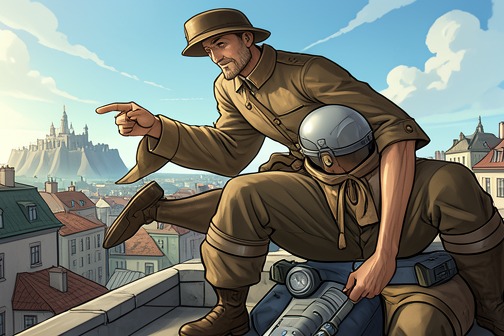
The [Warsaw Uprising](entity:event-recall-event-90795ecb50eb) is presented as an ongoing revolt by the [Polish Home Army](entity:organization-recall-organization-7902fa7c3559), one sign that the war’s momentum may be shifting. The narrative places it within a wider map of advances and resistance, but gives no account of the uprising’s operations, duration, or outcome.
## Place in the Wartime Situation
The uprising is mentioned two months after [D-Day](entity:time-recall-time-d-day-f3ccc2c85ec4), when Cherbourg, Caen, and Rennes have been liberated and half of western [France](entity:location-recall-location-4f282e1af8a7) is free. Farther east, the Soviet Union has retaken Minsk, and the Polish Home Army is revolting in Warsaw. A few newspapers have grown bold enough to suggest that the tide has turned. These developments form a broad backdrop of apparent Allied progress and local resistance rather than a detailed account of events in Warsaw.
## Contrast with [Saint-Malo](entity:location-recall-location-saint-malo-85b1c832a945)
The reference to Warsaw is set against the condition of Saint-Malo, where the narrative insists that the war has not yet turned: the city remains a German stronghold on the Breton coast. The juxtaposition makes the changing fortunes of the war uneven. Reports of liberation and revolt elsewhere coexist with a heavily fortified occupied city that still faces the threat of bombardment.
## Narrative Function and Limits
The uprising functions as a concise marker of resistance beyond the principal settings of the story. It helps establish the scale of the conflict and the sense that German control is being challenged across Europe, while the uncertainty of the newspapers’ claims keeps that shift from appearing complete. The passage identifies the Polish Home Army as revolting in Warsaw but supplies no further detail about participants, fighting, or consequences; the event remains part of the historical horizon against which the immediate danger in Saint-Malo is measured.
Event 7
Anschluss
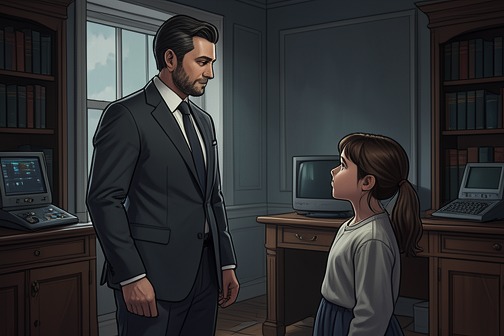
The [Anschluss](entity:event-recall-event-198937c269fd) is introduced through a brief exchange rather than a public scene: [Marie-Laure LeBlanc](entity:character-recall-character-marie-laure-leblanc-3b40e20f4b28) brings her father news of Austria’s takeover, and [Daniel LeBlanc](entity:character-recall-character-daniel-leblanc-64966d3a1873) treats it as no reason for alarm. That quiet response gives the event its significance in the novel. Political change arrives first as something heard and reported, while daily routines continue and the consequences of occupation emerge only gradually.
## News and Reassurance
Marie-Laure relays rumors to Daniel, including claims about poisoned chocolate and the confinement of disabled people. Each time, he repeats the name of [Germany](entity:location-recall-location-a3c24dd56e42) as if encountering it anew. He says the takeover of Austria is nothing to worry about, reasoning that everyone remembers the last war and that no one would be mad enough to repeat it. The director and department heads are not worried, he adds, so neither should a young girl with lessons to learn. The exchange does not establish Daniel’s ignorance of the danger so much as his effort to contain it: reports of political violence are answered with the authority of familiar routines and supposedly sensible adult judgment.
## Ordinary Life Beside Political Change
For a time, that reassurance appears borne out by the world around Marie-Laure. At the museum, the scientists and librarians still collect their keys, study specimens and herbarium sheets, and follow the same workday; secretaries talk about fashion, the director arrives in his Delage limousine, and sandwich vendors continue their rounds. Marie-Laure reads [Twenty Thousand Leagues Under the Sea](entity:object-recall-object-efa1e7f04e66) throughout the building and the gardens. The narrative places the takeover beside this repetition, making the event perceptible as news without yet making it visible as a break in ordinary life. That contrast also helps explain why rumors can seem both alarming and distant.
## From Rumor to Enforced Rules
Later episodes show a wartime environment in which state power reaches more directly into private conduct. In [Saint-Malo](entity:location-recall-location-saint-malo-85b1c832a945), residents are ordered to surrender their radio receivers by noon the next day; failure to comply is declared grounds for arrest as a saboteur. Daniel is later seized outside Vitré by plainclothes policemen, questioned first by French interrogators and then by Germans, and held without access to paper, linens, or a telephone. These scenes belong to the novel’s wider account of occupation and coercion; the text does not present them as immediate effects of the Anschluss. Read alongside Daniel’s earlier reassurance, however, they mark the distance between political change treated as remote news and power exercised through orders, detention, and restricted communication.
## Narrative Significance and Limits
The Anschluss functions as an early point of reference in the novel’s movement from reported threat toward lived constraint. Daniel’s confidence that another war is unthinkable sits in uneasy contrast with the later restrictions and arrests that shape the characters’ lives. The event is not dramatized as a battle or explored through the political process of annexation: its presence is confined to the news Marie-Laure brings home and her father’s response. Its narrative force lies in that small scene of misjudgment and in the widening gap between the belief that ordinary life will continue and the evidence, accumulating later, that it will not.
Event 8
Battle of France (1940)
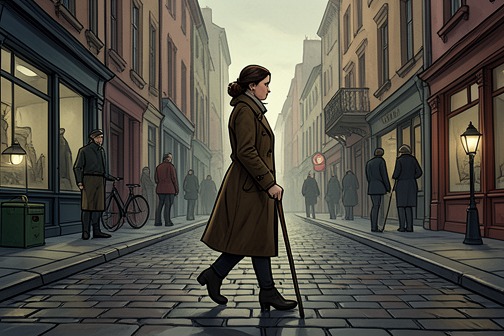
The [Battle of France (1940)](entity:event-recall-event-1940-61f6e02f09cf) is the rupture that makes the war impossible to dismiss as rumor: the familiar routines of [Paris](entity:location-recall-location-657453741ed3) give way to hurried evacuation, and [Marie-Laure LeBlanc](entity:character-recall-character-marie-laure-leblanc-3b40e20f4b28) is separated from her father. The novel renders the campaign less as a military overview than as pressure felt in museum corridors, on the road out of the city, and in the uncertain lives shaped by occupation afterward.
## From rumor to imminent danger
Before the crisis reaches the museum, Marie-Laure repeats alarming stories to her father, who responds to talk of [Germany](entity:location-recall-location-a3c24dd56e42) as if the country’s name were still a question. He reassures her that the takeover of Austria is nothing to worry about and that no one would be foolish enough to repeat the last war. Around them, the working day seems unchanged: museum staff collect keys, study specimens and manuscripts, and pass through familiar halls; the director arrives in his Delage limousine, and vendors wheel sandwich carts through the building. Marie-Laure reads [Twenty Thousand Leagues Under the Sea](entity:object-recall-object-efa1e7f04e66) wherever she can, returning to its first half until she nearly knows it by heart.
The contrast between routine and danger grows sharper as rumors become nightmares. Office workers circulate stories of Germans entering apartments and booby-trapping household objects; Marie-Laure dreams of silent boats on the Seine, chained beasts, and an assault on the museum. Yet spring still appears beautiful. [Bees](entity:creature-recall-creature-bees-40893e822389) move among the blooming aisles of the [Jardin des Plantes](entity:location-recall-location-jardin-des-plantes-4d8f3a747deb), and fluff from the plane trees gathers on the paths. That calm is increasingly strained: the museum protects its collections, couriers move objects to country estates, and [Daniel LeBlanc](entity:character-recall-character-daniel-leblanc-64966d3a1873) works late to secure crates and transport records. Fossils, manuscripts, jade, stones, pearls, and gold are packed away. Marie-Laure wonders whether the [Sea of Flames](entity:object-recall-object-sea-of-flames-fa38edaed37f) might be among the treasures.
## Paris prepares, then empties
The threat becomes tangible in the museum’s changing defenses. Deliveries stop; sandbags appear at the gates; soldiers watch the gardens from the roof of the Gallery of Paleontology. They scan the sky, but Marie-Laure sees no aircraft in the immense bowl overhead—only returning songbirds and the changing spring wind. The tension lies in the gap between what people fear and what they can see. On Marie-Laure’s twelfth birthday, her father is too busy to prepare their usual puzzle, but he gives her the second Braille volume of Twenty Thousand Leagues Under the Sea, an unusually thick book. A moment of anticipation survives even as the city approaches crisis.
In Paris, people pack china into cellars, sew pearls into hems, and hide gold rings in book bindings. The museum’s workspaces are stripped of typewriters, and its halls become packing yards strewn with straw, sawdust, and twine. Marie-Laure tries to read while Captain Nemo is about to take his companions through oyster beds, but the words break apart on the page; her attention cannot stay with the novel. When her father pulls her out and locks the key pound, panic seems to travel through the rows of trees. Soon he buttons her into a winter overcoat despite the middle-of-June weather. She carries her cane and holds on to his rucksack as they walk streets beyond the limits of the model he made for her, eventually reaching a crowd and a train for which the director has arranged tickets.
## Flight and Daniel LeBlanc’s arrest
The departure does not carry the family safely through the crisis. Daniel is seized outside Vitré, hours from Paris, when plainclothes policemen bundle him off a train as other passengers look on. French interrogators question him first, then German ones. They display his notebook, tool case, and ring of seven skeleton keys, asking what the keys open and why his notebook contains architectural measurements. Daniel explains that he is making a model for his daughter and that the keys belong to the museum where he works. The authorities nevertheless take him to a cell. Its antiquated lock and hinges prompt him to imagine that the museum’s director or colleagues will soon explain the misunderstanding, but no one arrives to do so.
A second interrogation offers no clarification. The Germans appear to suspect that Daniel planned to destroy the Château de [Saint-Malo](entity:location-recall-location-saint-malo-85b1c832a945), though the reason for the accusation remains unclear. They deny him paper, linens, and a telephone, and they already have photographs of him. Two days after his arrest, they drive him to a holding pen outside Strasbourg, where roughly thirty other prisoners sleep on straw over frozen mud. Daniel imagines kissing Marie-Laure on each eye while she sleeps. His arrest turns their hurried departure into a prolonged separation: on the twentieth morning without news, Marie-Laure stays in bed, stops asking [Madame Manec](entity:character-recall-character-madame-manec-624a3b197604) to take her to the station or petition the authorities, and hardly eats. The museum eventually tells [Etienne LeBlanc](entity:character-recall-character-etienne-leblanc-c0218becdb1a) that Daniel never arrived.
## Occupation’s long aftermath
The novel carries the consequences beyond the flight from Paris. In occupied Saint-Malo, administrative orders make control of everyday life explicit: residents must surrender radio receivers or risk arrest as saboteurs. Later, men between sixteen and sixty are ordered to assemble at the château before being marched to [Fort National](entity:location-recall-location-fort-national-f36fa39b06df) at low tide. These measures belong to the continuing occupation, not simply to the moment of departure, but they show how the military crisis becomes a lasting system of restrictions and coercion.
That system does not eliminate local action. [Madame Ruelle](entity:character-recall-character-madame-ruelle-978cb46c14c9) and Madame Guiboux strap a stepladder to a car and rearrange road signs at dusk, returning to [Number 4 rue Vauborel](entity:location-recall-location-number-4-rue-vaubore-c7c0adfb6034) laughing; one altered sign places Dinan far to the north, even in the sea. Their small intervention contrasts with the official orders that govern movement and communication. Across the story, work, letters, radios, and family routines all register the war’s reach: a letter from [Frau Elena](entity:character-recall-character-frau-elena-30fd83219873) describes the threat of punishment for listening to foreign broadcasts, while [Jutta](entity:character-recall-character-jutta-678e69fe3386)’s later letters are interrupted by censor marks and reports of shortages. The Battle of [France](entity:location-recall-location-4f282e1af8a7) thus matters not only as the beginning of flight, but as the decisive break after which ordinary objects and habits—keys, books, routes, and messages—carry new risks, while the people separated by war struggle to preserve any connection at all.
Event 9
Exode de 1940

[Exode de 1940](entity:event-recall-event-1940-d9d448daf5e0) enters the story through [Marie-Laure LeBlanc](entity:character-recall-character-marie-laure-leblanc-3b40e20f4b28) and her father, [Daniel LeBlanc](entity:character-recall-character-daniel-leblanc-64966d3a1873), trying to leave [Paris](entity:location-recall-location-657453741ed3) as a vast civilian flight overwhelms the routes out of the city. Their journey turns a national displacement into a child’s measured passage through unfamiliar streets and a crowded road: when the trains stop, they must continue on foot, surrounded by people whose varied possessions and circumstances reveal the scale of the upheaval.
## Departure from Paris
Daniel buttons Marie-Laure into her winter overcoat in the middle of June, and they leave their apartment on rue des Patriarches. The detail places practical preparation beside seasonal incongruity, while Marie-Laure’s cane and her hand on her father’s rucksack make their closeness essential to moving through an unfamiliar city. She hears distant stamping that seems to come from a great multitude on the move. As they turn through streets she does not recognize, she loses track of her steps and of the limits of the model her father made of Paris. The model can no longer orient her: their route has carried them beyond its known boundaries.
At the station, the scale of the flight becomes a direct obstacle. A crowd presses through the gates, and the gendarmes eventually lose control of the situation. By one in the morning, no train has arrived or departed for more than four hours. Marie-Laure falls asleep on her father’s shoulder; Daniel, who hears neither whistles nor the sounds of trains, decides at dawn that they should walk. The decision marks a practical reversal in their journey. They had reached the station as travelers hoping to use the railway, but the halted service leaves the road as their means of escape.
## The Road West
They walk through the morning as Paris gives way to low houses, detached shops, and long stretches of trees. At noon they reach a deadlocked motorway near Vaucresson, ten miles west of their apartment and farther from home than Marie-Laure has ever been. Distance here is both measurable and disorienting: the road has taken them well beyond familiar ground, yet congestion slows the journey to little more than walking pace.
The people moving west carry radically different fragments of ordinary life with them. Vehicles include vans, carts, and a sleek new V-12; some have wooden axles, others have run out of fuel. Furniture is strapped to roofs, while trailers carry farm animals. Alongside the vehicles, a woman bicycles wearing costume necklaces, a man pulls a leather armchair on a handcart, and women push baby carriages loaded with household goods. A man in a tuxedo calls for a way through, but the crowd does not part and he moves no faster than anyone else. The procession’s variety does not make it orderly. It shows how people attempt to transport what matters to them while sharing a road that cannot accommodate everyone’s plans.
The exodus also reaches beyond the roadway’s visible congestion. Marie-Laure hears disconnected questions about how far it is to Saint-Germain, where food might be found, and who has fuel. She hears arguments between husbands and wives and learns that a child has been struck by a truck farther ahead. When three aircraft pass low and fast in the afternoon, some travelers crouch, some scream, and others leave the road for the ditch. These brief responses show how movement west is shadowed by uncertainty and threat; the travelers have no common account of what lies ahead, only immediate questions and decisions.
## Nightfall and the Limits of Travel
By dusk, Daniel and Marie-Laure are west of Versailles. The day’s walk has worn Marie-Laure down: her heels hurt, her stockings are torn, and she stumbles repeatedly. When she says she cannot walk farther, Daniel carries her off the road and uphill through mustard flowers. They stop in a field a few hundred yards from a small farmhouse. The field has been only half mown; cut hay remains where it fell, unraked and unbaled. The unfinished work suggests an ordinary routine interrupted, placing the flight’s consequences in the landscape as well as on the road.
Their arrival at the field is not presented as the end of their escape or as a completed destination. It is a pause imposed by exhaustion after a day in which the station failed them and the motorway offered distance without speed. The episode leaves the family outside, near a farmhouse, with the road behind them and the outcome of the journey still unresolved.
## Narrative Significance
The episode makes mass displacement legible through contrasts of scale. Paris empties into an immense procession, but the account remains close to one father and daughter: Daniel chooses to abandon the stalled railway, guides Marie-Laure through streets beyond her model, and carries her when she can go no farther. Large numbers are registered not through an abstract count but through blocked gates, stopped trains, crowded lanes, and individual attempts to bring domestic life along.
Marie-Laure’s limited familiarity with the route shapes the account of leaving. The streets extend beyond her father’s model, while her steps, cane, and contact with his rucksack provide practical points of orientation. That shift from a bounded model of the city to an unfamiliar road underscores how quickly established ways of navigating can fail in a mass flight. The half-mown field at the close echoes that disruption on a smaller scale: work has been left unfinished, just as the LeBlancs’ journey has not reached a stated conclusion.
Event 10
Battle of Saint-Malo
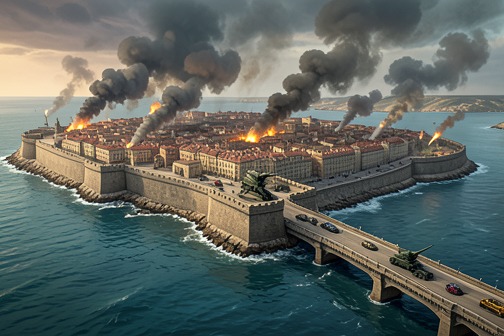
The [Battle of Saint-Malo](entity:event-recall-event-3eec2083a821) is portrayed as a struggle over an isolated coastal strongpoint whose military fortifications and civilian population are caught together in the violence of siege and bombardment. By August 1944, much of [France](entity:location-recall-location-4f282e1af8a7) has been liberated, but [Saint-Malo](entity:location-recall-location-saint-malo-85b1c832a945) remains a German-held citadel. The novel brings the battle close through the city’s geography, rumors of its defenses, the arrival of bombers, and the destruction that follows on 8 August.
## A strongpoint at the edge of the continent
Two months after [D-Day](entity:time-recall-time-d-day-f3ccc2c85ec4), Cherbourg, Caen, and Rennes have been liberated, half of western France is free, and Soviet forces have retaken Minsk. Saint-Malo, by contrast, remains under German control: the narrative presents it as the last German strongpoint on the Breton coast. The contrast between the changing military situation elsewhere and the city’s continued isolation gives the battle its particular tension. The tide may have turned beyond the walls, but that does not mean the people inside them are safe.
Water surrounds Saint-Malo on four sides. Its connections to the rest of France narrow to a causeway, a bridge, and a spit of sand, leaving the city physically exposed and difficult to approach. Its residents identify themselves first as people of Saint-Malo, then as Bretons, and only after that as French. That local allegiance sharpens the sense of a community facing the battle in its own place, even as the conflict is driven by forces far beyond it.
The German defenses are described through a mixture of concrete detail and anxious rumor. People speak of two kilometers of subterranean corridors beneath the medieval walls, with new conduits, escape routes, and underground complexes. Beneath [La Cité stronghold](entity:location-recall-location-la-cit-40cc6c658486), across the river from the old city, rumors place rooms for bandages and ammunition, an underground hospital, air-conditioning, a 200,000-liter water tank, and a direct line to [Berlin](entity:location-recall-location-769cdeac2511). The reported defenses also include flame-throwing booby traps, pillboxes with periscopic sights, and enough ammunition to fire shells into the sea for a year. The number of Germans supposedly ready to die for the position shifts in the telling from one thousand to five thousand or more. The uncertainty is part of the portrait: Saint-Malo’s military strength reaches the civilian imagination as a formidable, indistinct threat.
## The battle reaches the city
The approach of the attack makes ordinary responses feel inadequate. Some people hurry to shelters; some tell themselves the alarm is only a drill; others pause to collect a blanket, prayer book, or playing cards. An urgent notice instructs the inhabitants to leave for open country. At the same time, German anti-aircraft batteries flash on the outer islands, while guns in the old city send shells over the sea. At [Fort National](entity:location-recall-location-fort-national-f36fa39b06df), 380 imprisoned Frenchmen huddle in a moonlit courtyard and look up. The battle is already drawing together the people who defend the city, those held within its defenses, and the civilians trying to understand whether the approaching aircraft mean deliverance or destruction.
On 8 August, twelve bombers make their attack. Their payloads fall diagonally across the city; after the last anti-aircraft shells, the bombers turn back unharmed. The scale is given in numbers that resist abstraction: forty bombs per aircraft, 480 bombs altogether, and 72,000 pounds of explosives. The attack’s rhythm is also rendered from the ground. The bombs descend after the aircraft pass, and the resulting roar grows so immense that the sirens can no longer be heard. The assault is not shown as a clean contest between military targets: its force arrives as an overwhelming physical event in the streets, houses, and shelters of Saint-Malo.
## Fire, collapse, and shelter
The bombing tears through the built city. Doors fly from their frames, bricks become powder, and clouds of chalk, earth, and granite rise into the air. Fires catch in automobiles, curtains, lampshades, sofas, mattresses, and the public library’s 20,000 volumes. Flames spread through alleys, over rooftops, and along the ramparts. In one part of the old city, the blaze becomes a firestorm whose flames reach 300 feet; the heat draws objects toward it, while swifts driven from chimneys burn and fall into the sea. The destruction is described as a chain of transformations: smoke follows dust, ash follows smoke, and familiar things become fuel or debris.
The [Hotel of Bees anti-aircraft strongpoint](entity:location-recall-location-4aefcd1a6231), on the rue de la Crosse, is caught in that destruction. For an instant the building seems almost weightless, lifted in a spiral of flame, before pieces of it rain back to earth. The image collapses the distinction between fortress and city: a named defensive position becomes part of the same burning landscape as houses, streets, and public institutions.
At [Number 4 rue Vauborel](entity:location-recall-location-number-4-rue-vaubore-c7c0adfb6034), Marie-Laure shelters beneath her bed as the attack reaches the house. She holds the stone in one fist and a little model house in the other while nails shriek in the timbers and plaster, brick, and glass fall onto the floor and across the model city on the table. Elsewhere, people shelter in cellars and crypts, calling out prayers; old men clutch hurricane lamps, children shriek, and dogs howl. The battle’s scale is therefore registered both in the total weight of explosives and in the small, vulnerable objects people carry or cling to while buildings fail around them.
## Occupation, resistance, and civilian exposure
The bombardment occurs within an occupation that has already altered daily life and restricted civilian choices. Before the battle, the German authorities order residents to surrender their radio receivers at 27 rue de Chartres, warning that anyone who does not comply will be arrested as a saboteur. The order makes access to information a matter of coercion, not simply a household decision. It also places ordinary residents under threat before the bombs arrive: obedience is demanded, while failure to obey is assigned a criminal meaning by the occupying power.
The threat of detention extends beyond the radio order. During the siege, Marie-Laure is told that the city gates have been locked and that every man between sixteen and sixty is to assemble at the château tower before being marched to Fort National at low tide. These measures show how military control reaches into civilian movement and separates people from their homes. The order’s stated procedure does not lessen its coercive force; it organizes the removal of men from a city already under attack.
Resistance also takes forms that do not resemble open combat. [Madame Ruelle](entity:character-recall-character-madame-ruelle-978cb46c14c9) and Madame Guiboux drive out at dusk with a stepladder and ratchet set to rearrange road signs, then return laughing to the kitchen at Number 4 rue Vauborel. Their small disruption contrasts with the German network of defenses and the overwhelming violence of the air assault. Against that disparity, the act matters not because it can stop the battle, but because occupation has not eliminated the residents’ capacity to interfere with its routines.
## Significance
The novel presents the Battle of Saint-Malo through the collision of strategic claims and domestic life. The city is a fortified German position, but it is also a place of narrow routes, occupied homes, threatened families, and people who must decide what to save or where to shelter. Its isolation makes it a military strongpoint; the bombing exposes how little that status protects the people living within it. By setting distant reports of liberation beside the city’s underground defenses, imprisoned Frenchmen, locked gates, and collapsing buildings, the narrative makes the battle’s central contradiction visible: a position defended as a fortress is inhabited as a home.
Event 11
Bombing of Saint-Malo (1944)
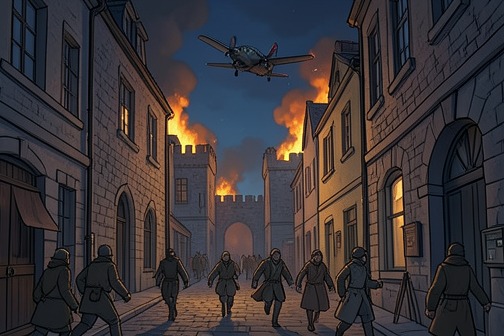
The [Bombing of Saint-Malo (1944)](entity:event-recall-event-1944-071ea6f93902) turns an approaching military attack into a catastrophe measured both in numbers and in intimate losses. On the night of 7–8 August, twelve bombers unload 480 bombs over the walled city. Fires race through streets and buildings, the public library’s books burn, and the [Hotel of Bees anti-aircraft strongpoint](entity:location-recall-location-4aefcd1a6231) is torn apart. In the upper floor of [Number 4 rue Vauborel](entity:location-recall-location-number-4-rue-vaubore-c7c0adfb6034), [Marie-Laure LeBlanc](entity:character-recall-character-marie-laure-leblanc-3b40e20f4b28) clutches a stone and a small model house while the real city collapses around her.
## Warning and Approach
At dusk on 7 August, leaflets fall across the ramparts and rooftops, urging the town’s inhabitants to leave for open country. The warning arrives as the tide climbs and American artillery units fire incendiary rounds toward mortar positions around the beachfront hotels. The town is given notice of danger, but the subsequent assault comes from above and at night, as the aircraft cross the Channel at midnight.
There are twelve bombers, identified by names taken from songs, including Stardust, Stormy Weather, In the Mood, and Pistol-Packin’ Mama. From above, the crews pass over the sea and make out the low islands along the horizon. As they approach the coast, anti-aircraft fire rises in red threads. Below them are ruined or burning ships and, on an outer island, sheep fleeing between rocks. The walled city on its granite headland becomes the target: seen through the bombardiers’ aiming windows, it is reduced to a dark shape to be struck.
The attack’s preparation is described through the bombers’ measured approach and the bombardiers’ countdown. That deliberate sequence contrasts with the chaos their release will produce. The city is not merely under threat in the abstract: the aircraft line up on it, descend, and open their bomb bays over the rooftops.
## The Bombs and the Firestorm
As the countdown reaches twenty, the sea gives way beneath the aircraft to rooftops. Two smaller planes mark the corridor with smoke; the lead bomber releases its payload, and the other eleven follow. The bombs fall diagonally while the aircraft climb and turn back toward the Channel. The account makes the scale unmistakable: forty bombs per aircraft, 480 in all, carrying seventy-two thousand pounds of explosives. The tally is not a substitute for the impact; it establishes how completely the attack fills the sky above the city.
The first effects are described as a violent transformation of ordinary spaces. Doors tear from their frames, bricks become powder, and clouds of chalk, earth, and granite erupt upward. Flames take hold of parked cars and the furnishings inside buildings, then spread through the city. Smoke follows dust, ash follows smoke, and even a burning newsstand floats through the destruction. In the old city, four-hundred-year-old beams catch fire. One section against the western walls becomes a firestorm whose flames reach as high as three hundred feet; the force of its demand for oxygen draws objects heavier than housecats toward the blaze. [Birds](entity:creature-recall-creature-ee69b0f09d33) driven from chimneys catch fire and fall as sparks into the sea.
The destruction reaches landmarks and shared civic spaces as well as private homes. Most of the public library’s twenty thousand volumes burn, while fire climbs the ramparts and spills through alleys, rooftops, and a car park. On the rue de la Crosse, the Hotel of Bees anti-aircraft strongpoint is lifted briefly by a spiral of flame before breaking apart and raining back to earth. The account’s sequence from individual objects to whole districts makes clear that the raid does not leave the city’s familiar places intact.
## Civilians in the City
People shelter in cellars and crypts as the bombardment overwhelms the town. The narrative registers their presence through oaths sent up from below, children shrieking, dogs howling, and old men holding hurricane lamps. Their prayers and cries coexist with the physical collapse overhead; they offer no protection from it. The scale of the assault also reaches beyond the streets: Marie-Laure’s great-uncle is among several hundred people locked inside [Fort National](entity:location-recall-location-fort-national-f36fa39b06df), a quarter mile offshore. Looking up as the sky darkens with bombs, he sees a mass moving in ranks, an image that measures the attack from the point of view of someone trapped within its reach.
The bombing’s sound becomes part of its bodily violence. The sirens disappear beneath the roar, and then everything is inaudible. The force is described as strong enough to separate the membranes in the middle ear. Even the anti-aircraft guns fire their final shells as the twelve bombers turn away unharmed. The contrast is stark: the aircraft leave, but the town remains inside the fires and falling debris they have unleashed.
## Marie-Laure and the Ruined City
On the sixth floor of Number 4 rue Vauborel, sixteen-year-old Marie-Laure is beside the [Saint-Malo City Model](entity:object-recall-object-9262a92ef7a9), the miniature city she has been studying. As the attack strikes, she crawls beneath her bed. She holds the stone in her left fist and a little model house in her right. Nails shriek in the timbers while fragments of plaster, brick, and glass fall onto the floor, onto the model city, and onto the mattress above her.
The scene places a carefully constructed miniature beside the destruction of the real city it represents. The model’s streets and landmarks had made [Saint-Malo](entity:location-recall-location-saint-malo-85b1c832a945) available to Marie-Laure through touch; now debris falls across the model as the surrounding house shakes. The contrast does not make the miniature a refuge from the attack. Instead, its small, ordered version of the city is exposed to the same violence as the larger one, while Marie-Laure’s immediate actions narrow to sheltering and holding on.
The raid’s decisive consequence is therefore both collective and particular: Saint-Malo is engulfed by fire, while a blind teenager endures the assault inside one threatened house. The aircraft’s departure does not resolve the catastrophe. On 8 August the destruction continues in the streets, where fire spreads through homes, civic buildings, and military positions; for those sheltering in the city, survival begins amid damage that has already reached their doors.
Event 12
German occupation of Saint-Malo
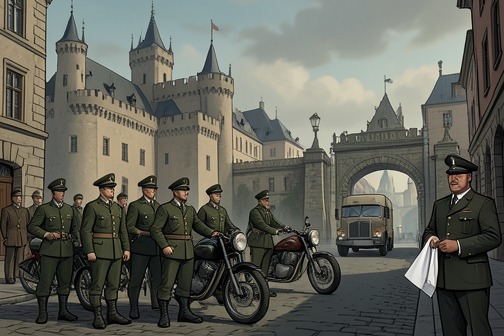
The [German occupation of Saint-Malo](entity:event-recall-event-german-occupation-of-sa-b58b6d8696cf) turns a polished military arrival into a tightening system of control over the town’s streets, homes, communications, and inhabitants. Its force lies in that progression: the occupation first appears as an orderly presence amid familiar commerce, then as a succession of demands and restrictions that make ordinary life precarious, until evacuation, bombardment, and liberation expose the limits of German control.
## Arrival and the Occupation’s Public Face
[Marie-Laure LeBlanc](entity:character-recall-character-marie-laure-leblanc-3b40e20f4b28)’s father watches the arrival from the telegraph office. German motorcycles with sidecars pass through the Porte Saint-Vincent, followed by two trucks and a black Mercedes. Behind drawn shutters, residents watch through gaps in the town’s windows. The procession stops at the Château de [Saint-Malo](entity:location-recall-location-saint-malo-85b1c832a945), where the mayor waits with a white handkerchief in his large sailor’s hands; his wrists shake almost imperceptibly.
More than a dozen German soldiers climb out. Their boots gleam and their uniforms are tidy; two carry carnations, another leads a beagle, and several look up at the château’s façade. A short field captain emerges from the Mercedes, brushes at his sleeve, and speaks with an aide-de-camp, who translates for the mayor. The captain then disappears through the château’s doors. Minutes later, the aide opens an upstairs window and unfurls a crimson flag above the rooftops. The flag makes the change in authority visible, but the procession’s immaculate appearance also gives the arrival a composed, almost ceremonial surface.
That surface coexists with the immediate material presence of occupation. German weapons are described as if they have never been fired, and the soldiers’ clean boots and spotless uniforms make them seem to have stepped from comfortable train cars. In the days that follow, townspeople report that German soldiers buy postcards, straw dolls, candied apricots, cakes, shirts, lingerie, butter, cheese, and champagne. The purchases make the occupiers part of the town’s daily transactions even as their presence rearranges who can move, gather, speak, and keep property.
## Rules Enforced in Everyday Life
Restrictions accumulate across both public and private life. Curfews are imposed; music audible outdoors and public dances are banned. The mayor announces that the country is in mourning and residents must behave respectfully, although the extent of his remaining authority is unclear. The town’s quiet is not simply a spontaneous response to danger: it is demanded through official rules and reinforced by less formal prohibitions.
In Saint-Malo, residents can be fined for locking their doors, keeping doves, or hoarding meat. Truffles and sparkling wine disappear, and social habits narrow: people avoid eye contact and conversation in doorways; sunbathing, singing, and evening strolls along the ramparts cease. The details show how regulation reaches beyond major political acts into household security, food, leisure, and neighborly contact. [Etienne LeBlanc](entity:character-recall-character-etienne-leblanc-c0218becdb1a) barricades himself inside his brother’s old room. Marie-Laure passes the hours in his study, running her fingers over his seashells and sorting them by size, species, and morphology, then checking their order again. Her careful routine offers a measure of order while her father refuses to let her go out, haunted by the possibility that blind girls might be taken before disabled men.
The occupation also targets communications. Marie-Laure has to ask her father three times before he reads aloud an order requiring residents to surrender all radio receivers to 27 rue de Chartres by noon the following day. Anyone who fails to comply is threatened with arrest as a saboteur. The demand is not merely for equipment: it closes a route by which people might receive information outside the occupiers’ control and makes possession itself a potential accusation. When Marie-Laure asks whether someone is affected, [Madame Manec](entity:character-recall-character-madame-manec-624a3b197604) tells her that he is in her grandfather’s old room, connecting the public order to the concealed radio and the private danger inside the household.
## Arrest, Resistance, and Escalating Control
The occupation’s coercion is also visible in the arrest of [Daniel LeBlanc](entity:character-recall-character-daniel-leblanc-64966d3a1873), Marie-Laure’s father. Policemen in plain clothes seize him outside Vitré while a dozen train passengers watch. French interrogators question him first, followed an hour later by German interrogators. They produce his notebook, tool case, and key ring, counting seven skeleton keys and asking what the keys unlock, why he carries tiny files and saws, and what his architectural measurements are for. Daniel explains that he is making a model for his daughter and that the keys belong to the museum where he works, but the questioning does not resolve into a clear, intelligible process.
He is taken to a cell whose oversized, antiquated lock and hinges prompt him to imagine they might date from the reign of Louis XIV or Napoleon. He expects the museum director or someone from the museum to explain the misunderstanding. The next morning, German interrogators question him again while a typist works nearby. They appear to suspect a plot to destroy the château, though the reason for that suspicion is unclear. They deny him paper, linens, and a telephone, and they have photographs of him. Two days after his arrest, he is driven to a holding pen outside Strasbourg, where he sees other detainees sleeping on straw over frozen mud. The scene sets the occupation’s confident administrative posture against arbitrary suspicion, isolation, and the absence of practical means to challenge the authorities.
Resistance takes shape in small, risky interventions rather than open confrontation. [Madame Ruelle](entity:character-recall-character-madame-ruelle-978cb46c14c9), the baker’s wife, straps a stepladder to her husband’s car and drives at dusk along the Route de Carentan with Madame Guiboux. Using a ratchet set, they rearrange road signs, then return to the kitchen at [Number 4 rue Vauborel](entity:location-recall-location-number-4-rue-vaubore-c7c0adfb6034) drunk and laughing. Their altered directions turn an ordinary piece of road furniture into a means of disrupting the occupiers’ sense of control. The women’s laughter does not erase the danger; it marks a brief recovery of initiative within a town where rules otherwise dictate even the terms of public life.
## Siege, Retreat, and Liberation
As the military situation deteriorates, movement is controlled more directly. [Claude Levitte](entity:character-recall-character-claude-levitte-49f71026058c) tells Marie-Laure that evacuation orders have been issued and the city gates locked. Men between sixteen and sixty are to assemble at the château’s tower and be marched at low tide to [Fort National](entity:location-recall-location-fort-national-f36fa39b06df). The order assigns a whole category of civilian men a route and destination, while the apparently calm sounds in rue Vauborel—the swallows, doves, and passing bicycle—make the threat feel all the more difficult to verify from Marie-Laure’s position.
New orders posted on doors, market stalls, and lampposts forbid anyone to leave the old city or walk its streets without special authority. Soon afterward, a German corporal explains that troops are evacuating toward [La Cité Fortress](entity:location-recall-location-la-cit-cc828702b4f2). They are leaving everything behind; the Germans still hold the château and the Bastion de la Hollande, while other personnel are to fall back. The corporal warns that the entire town will be inside the bomb line. The announcement compresses the occupation’s final phase into a reversal: the power that had restricted civilian movement is now retreating, but its withdrawal places the city and its inhabitants in immediate danger.
In the days before the end, [Reinhold von Rumpel](entity:character-recall-character-reinhold-von-rumpel-0cc59346c3b4) understands that the last German-controlled port in [Brittany](entity:location-recall-location-66c17c26ffa8) is nearly lost, with the Atlantic Wall at stake. The occupation’s military collapse is therefore not separate from the town’s destruction: Saint-Malo has become both a strategic position and a battlefield. In the morning, American forces take the château and the last anti-air battery and free the prisoners held at Fort National. Madame Ruelle pulls Etienne out of the processing queue, and he embraces Marie-Laure. The German commander in his underground fortress across the river holds out for three more days, until an American Lightning aircraft drops napalm through an air vent. A white sheet raised on a pole ends the siege.
Afterward, sweep platoons remove incendiary devices, army photographers enter the ruins, and residents return from farms, fields, and cellars to move through the damaged streets. On August 25, Madame Ruelle is allowed back into Saint-Malo to inspect the bakery. Etienne and Marie-Laure instead travel to Rennes, where they find a hotel with a functioning boiler and take long baths. Their departure gives the occupation’s end a domestic measure: after rules, queues, confinement, and bombardment, hot water and the possibility of going to [Paris](entity:location-recall-location-657453741ed3) become signs of a life beginning again.
## Significance
The occupation is presented not as a single seizure of power but as a changing set of pressures, from the flag above the château to restrictions on radios, homes, food, movement, and public behavior. Its rules are encountered through their specific consequences: a family must decide what to do with a hidden receiver; a father’s ordinary tools become grounds for interrogation; older women turn road signs around; men face forced assembly and transport. These episodes distinguish formal orders from the unsettled, coercive ways they are applied, without making civilian experience uniform.
Saint-Malo’s occupation also binds local resistance to daily life. The resistance act is a rearrangement of signs; the household danger is a radio that must be surrendered; the town’s constrained sociability is registered in its silence and its vanished evening walks. The final evacuation and liberation do not restore the town intact. They end German control while leaving a ruined city, freed prisoners, and survivors who must leave or return to damaged homes. The arc from ceremonial arrival to white surrender flag makes occupation visible as both administration and force—and its end as release accompanied by loss.
Event 13
Werner enters Schulpforta
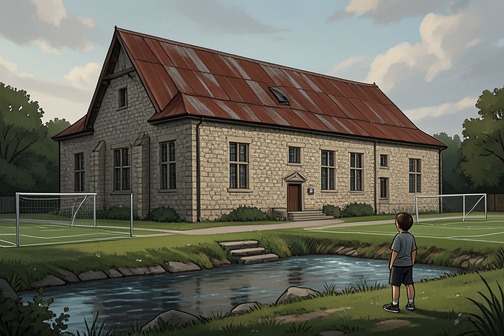
[Werner Pfennig](entity:character-recall-character-werner-pfennig-48150c6dbd60)’s entry into [Schulpforta](entity:location-recall-location-schulpforta-da30af1c87b7) is both a departure from his earlier life and an encounter with an institution designed to remake its students. The school’s storybook architecture and scientific promise draw him in; its rules, uniforms, and collective slogans set the terms of belonging. His response is not simple enthusiasm or resistance: amid exhaustion and confusion, he feels a hunger to become part of the school’s single-minded world.
## Arrival and setting
Schulpforta appears as a compact stone settlement beneath hills: eight or nine buildings with rust-colored roofs, narrow windows, spires, and turrets, with weeds between the roof tiles. A small river winds through the athletic fields. After the dust-filled air of [Zollverein](entity:location-recall-location-zollverein-8c9454be5c28), Werner notices how clean the air feels. The contrast makes the school seem not only distant from home but like a different kind of world, set apart by its grounds and its promise of order.
That first impression is sharpened by what the institution contains. On his first day, Werner passes an open laboratory door and sees a room filled with new sinks and glass-fronted cabinets. Inside are beakers, graduated cylinders, balances, and burners. He is urged onward by [Frederick](entity:character-recall-character-frederick-88469ba33ed9), but the glimpse stays with him. The laboratory becomes a concrete focus for his attention: Werner later holds in mind its nine tables and thirty stools, along with coils, variable capacitors, amplifiers, batteries, and soldering irons kept in the cabinets. The technical equipment offers a particular object of desire within the larger institution—not just a vague hope of advancement, but a room he can picture in detail.
## Rules and the school’s collective ideal
A one-armed bunk master announces the regulations in an aggressive rush. Cadets receive separate parade, field, and gym uniforms; suspenders must cross at the back and run parallel at the front, sleeves must be rolled to the elbow, and each boy must wear a knife at his right hip. They are to raise their right arms to be called on and form rows of ten. Books, cigarettes, food, and personal belongings are forbidden in the lockers; after lights-out, talking is prohibited. Letters home are posted only on Wednesdays.
The rules govern small physical habits as well as the boys’ larger sense of self. The bunk master describes the aim as stripping away weakness, cowardice, and hesitation, and presents the cadets as a force that will surge together toward one cause. Comfort is to give way to duty, and the nation is invoked as both sustenance and atmosphere. The boys answer that they accept this demand. Their shouted assent turns the announcement from a list of regulations into a public initiation: the school declares what it expects, and the assembled cadets affirm their entry into its collective discipline.
## A community Werner wants to join
The scale of that community is made explicit: four hundred boys, thirty instructors, and another fifty staff members, including noncommissioned officers, cooks, groomsmen, and groundskeepers. Cadets range from nine to seventeen. The group is described through recurring physical traits, including blue eyes and sharply defined faces, giving the assembly an imposed visual uniformity even before the rules make their behavior uniform.
Werner encounters a less uniform social world in the dormitories. Some boys speak of skiing, duels, jazz clubs, governesses, and hunting; others boast of polished manners or use coarse language with practiced ease. Some have connections to titled families, while some have been admitted because their fathers work in ministries rather than because of a particular ability. The details expose differences in privilege and background beneath the school’s promise of common purpose. Werner nevertheless feels that the starry nights, dew-soaked mornings, quiet corridors, and enforced austerity belong to a single-minded order he has never before experienced. He wants to belong to it.
## Redirection and later echoes
Werner’s response remains unsettled. He sways between exhaustion, confusion, and exhilaration, astonished that his life has been so completely redirected. To keep doubt at bay, he memorizes lyrics and routes between classrooms, practical acts of orientation that sit alongside his mental return to the laboratory. The scene therefore presents belonging as both attraction and discipline: the institution gives Werner a destination and a structure, but it also insists that he subordinate individual hesitation to a prescribed collective purpose.
Later correspondence offers a restrained view of life beyond the moment of entry. [Jutta Pfennig](entity:character-recall-character-jutta-pfennig-b4ccdeedb30a) writes to Werner about working in a laundry, mending clothing amid shortages and the demand to reuse whatever materials remain available. In a later letter to his sister, Werner refers to Frederick’s belief that a person’s path is predetermined and to his own mistake, but censorship marks obscure much of what he writes. These letters do not establish that the school alone caused the later hardships or decisions; they do show how the promise of direction at Schulpforta sits within a life increasingly shaped by shortage, separation, censorship, and the question of how much choice a person possesses. The entry scene’s central tension is already visible in Werner’s first response: the same strict order that offers him a place to belong requires him to accept the limits of that place.
Event 14
Werner is recruited into Hauptmann's radio project

[Werner Pfennig](entity:character-recall-character-werner-pfennig-48150c6dbd60)’s recruitment into [Dr. Hauptmann](entity:character-recall-character-dr-hauptmann-844538ac0542)’s radio project turns a cadet’s exceptional technical instinct into sustained military work. The turning point is not a speech about Werner’s future but a sequence of tests: he builds circuits faster than his classmates, solves a problem in triangulation, and is ordered to spend every evening in the laboratory improving a directional radio transceiver. The project gives his childhood fascination with radios a new scale—and binds his ingenuity to the military uses of communication and tracking.
## From salvage to technical aptitude
Werner’s ability predates his encounter with Dr. Hauptmann. At eight, rummaging through refuse behind a storage shed, he finds what appears to be a large spool of thread: a wire-wrapped cylinder between two pinewood discs, with frayed electrical leads and an earphone dangling from one. His six-year-old sister, [Jutta Pfennig](entity:character-recall-character-jutta-pfennig-b4ccdeedb30a), asks what it is. Werner recognizes the object as a radio. The discovery begins in discarded materials, not in a school laboratory, and establishes the alertness with which he sees a possible working device where others might see scrap.
Years later, at the cadet school, Dr. Hauptmann gives Werner’s class a formal test of that practical intelligence. The technical-sciences instructor opens a locked cabinet and distributes hinged metal boxes containing gears, lenses, fuses, springs, shackles, resistors, copper wire, a small hammer, and a large two-terminal battery. The assignment is to assemble a simple Morse-code practice circuit from a chalkboard schematic. While most cadets hesitate over the unfamiliar equipment, Werner draws on the questions and experiments of his earlier life at [Children’s House](entity:location-recall-location-children-s-house-c9d94d8f6faa). In less than a minute he builds an oscillator that matches the diagram, and Dr. Hauptmann tests it and finds that it works.
## The demonstration that secures Hauptmann’s attention
Dr. Hauptmann immediately raises the difficulty. He asks the class to use only a disk-shaped magnet, a wire, a screw, and the battery to build a simple motor. Although the challenge is addressed to the boys generally, his attention settles on Werner. Werner places the magnet on the screw, touches the screw’s point to the battery’s positive terminal, and connects the negative side to the screw’s head with the wire. The screw and magnet begin to spin; the construction takes about fifteen seconds.
The speed and effectiveness of the demonstration make Werner’s ability unmistakable. Dr. Hauptmann asks his name, and Werner identifies himself by his surname. The encounter is an assessment, but it also marks a shift in their relation: the instructor has seen a capacity that can be developed and put to work. Werner’s talent is not merely theoretical. He can read a schematic, select useful components, and make a functioning mechanism from a restricted set of parts.
## Triangulation and the laboratory assignment
Dr. Hauptmann next summons Werner to his office, where three hounds move around the room and [Frank Volkheimer](entity:character-recall-character-frank-volkheimer-616967a218e7), a much larger upperclassman, sits in a chair in the shadows. Among the books, scientific models, and instruments, Hauptmann tests Werner’s understanding of triangulation: using two known points to locate a third, unknown point. When asked whether he can draw the triangle if given the known points and the distance between them, Werner believes he can. Hauptmann invites him to the desk and provides a pencil, turning the exchange into a working mathematical problem rather than a routine classroom question.
Afterward, Dr. Hauptmann tells Werner that he will work in the laboratory after dinner every night, Sundays included, beginning the next day. This order is the concrete act of recruitment. Werner accepts without hesitation. The promise of intellectual work, the firelit office, and the shelves of books kindle his sense that important events take place in such rooms. At the same time, the assignment places his skill within an institution whose authority reaches well beyond the laboratory.
## The project and its military purpose
Werner’s nightly work combines mathematical calculation with engineering. Dr. Hauptmann wants him to improve the efficiency and power of a directional radio transceiver. The device must be quickly retuned to transmit on multiple frequencies and must measure the angle of incoming transmissions. Werner reconfigures nearly the entire design. The work therefore extends the skills displayed in his first circuit exercises: he is no longer simply making a mechanism function but changing a complex device to meet operational requirements.
The rhythm of the apprenticeship is uneven. On some evenings, Dr. Hauptmann explains the function of components such as a solenoid or resistor, identifies a spider on a rafter, or talks about scientific gatherings in [Berlin](entity:location-recall-location-769cdeac2511) and topics including relativity and quantum mechanics. He is willing, at those times, to follow Werner’s questions. On other nights he becomes closed and supervises in silence. Werner is impressed not only by the apparatus but by the reach suggested by Hauptmann’s telephone and connections to powerful men. The laboratory’s promise of scientific possibility is thus shadowed by the scale of the authority that may direct it.
## From laboratory design to wartime equipment
The transceivers Werner helps design later appear in a radio truck during his military service. Inside the truck are listening decks, an antenna that can be raised and lowered from within, headsets, maps, compasses, and two of the transceivers he designed with Dr. Hauptmann. The instruments are no longer classroom exercises or laboratory prototypes: they are equipment in a field setting. Werner finds one damaged, with a cracked meter, blown fuses, and a missing transmitter plug, and begins examining it with tools and copper wire. The earlier assignment has carried his work from a school laboratory into the material conditions of war.
The project’s significance also lies in the distance it opens between technical mastery and the uses to which that mastery is put. Werner’s introduction to radio begins with a salvaged set and a child’s recognition of what it might do; Hauptmann’s training refines that curiosity into circuits, triangulation, and directional reception. Later, Werner makes a tuning coil from wire wound around a shorn pipe while trapped beneath rubble, using improvised materials to restore a radio. Across these different circumstances, the same capacity to make connections work persists. Recruitment gives that capacity a military function, but the radio remains a device whose meaning can change with its use: it can be engineered for locating transmissions, improvised for survival, or made to carry a human signal across distance.
Event 15
Etienne reveals the attic transmitter
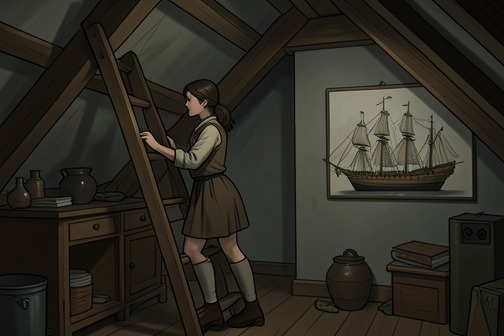
[Etienne reveals the attic transmitter](entity:event-recall-event-etienne-reveals-the-att-8cd4311022ed) to [Marie-Laure LeBlanc](entity:character-recall-character-marie-laure-leblanc-3b40e20f4b28) as a working machine and as the material remainder of a private promise to his dead brother, [Henri LeBlanc](entity:character-recall-character-henri-leblanc-cdf67e8de482). The discovery joins the sensory world Marie-Laure navigates by touch to a history of war, paralysis, music, and long-distance communication. Its later return during the siege of [Saint-Malo](entity:location-recall-location-saint-malo-85b1c832a945) gives this old apparatus a new urgency: what was built to speak to a ghost may still offer a living voice a way out.
## The Route to the Attic
Etienne takes Marie-Laure up the stairs to the sixth-floor landing and into the room that once belonged to her grandfather. She already knows its contents by repeated touch: an oar nailed to the wall, curtains at the window, a single bed, a model ship, and a wardrobe too large for her to reach its top or span with her arms. Beside the wardrobe, Etienne opens a small door and invites her to go through. Her fingers find a ladder in the dry, confined space; seven rungs bring her into the attic beneath the roof.
The route is an introduction through physical limits and remembered objects. Marie-Laure cannot survey the room visually, and the attic is not presented to her as a single picture. She learns it through the slope of the roof, the cables underfoot, and Etienne’s hand guiding her past dusty boxes and a sawhorse. He leads her to a piano bench and places her hands on a table. The scene makes the concealed room legible through direction, texture, sound, and scale before explaining its function.
## A Machine Heard Before It Is Explained
Metal boxes cover the tabletop: tubes, coils, switches, meters, and at least one gramophone. Etienne settles a headset over Marie-Laure’s ears and turns a crank. A piano begins to play as if located at the center of her head. A staticky voice follows, speaking to children about a piece of coal that was once a plant, perhaps a fern or reed, millions of years earlier; then the piano returns. The attic is not merely a hiding place but a functioning broadcast and recording station, and Marie-Laure encounters it first through its sounds.
When she asks how it works, Etienne identifies the apparatus as a radio transmitter. He guides her hand to the power switch for the microphone and explains the switch for the phonograph, the premodulation amplifier, vacuum tubes, and coils. The antenna telescopes up along the chimney for twelve meters. His account describes a chain of material operations: power, recorded sound or a microphone, electrical components, and an antenna extending above the roof. A voice is not sent by an abstract act of wishing; it depends on parts, connections, and a structure that can carry the signal outward.
## [Henri](entity:character-recall-character-henri-adb6da84571e)’s Voice and the First Purpose
The equipment opens a history that predates the transmitter. Etienne tells Marie-Laure that Henri had been admired for his singing voice, while Etienne himself supplied the technical ingenuity. They dreamed of making and selling recordings. A company in [Paris](entity:location-recall-location-657453741ed3) showed interest, and Etienne wrote ten science scripts for Henri to rehearse and record. [Daniel LeBlanc](entity:character-recall-character-daniel-leblanc-64966d3a1873), then a boy, used to come and listen. Etienne remembers that period as one of the happiest in his life, joining the brothers’ shared work to the presence of the next generation of the family.
The [First World War](entity:time-recall-time-82c88d06e845) interrupted that project. Etienne and his father served as signalmen, running telegraph wires from rear command positions to officers at the front. At night, enemy flares called very lights drifted over the trenches on parachutes, exposing the ground to view. Etienne recalls that eighty or ninety could go off in succession; soldiers froze beneath the glare, while the quiet might be broken by a sniper’s bullet. In that setting, Etienne sometimes became so paralyzed that he could not move, even his fingers or eyelids.
Henri stayed beside him and whispered the scripts they had recorded, repeating them through the night as a kind of protection until morning. Henri later died. After the war, Etienne spent years making the transmitter. The Paris recording company was no longer interested, so he played their ten recordings himself, night after night, until most wore out, along with Henri’s song. He says he was not trying to reach England or Paris: he hoped that, if the broadcast were powerful enough, Henri would hear it, find peace, and receive the protection Henri had once given him. The machine’s first audience is therefore an absent brother, not a public one.
## A Private Apparatus in a Wider Radio Story
The attic transmitter belongs to a recurring material history of radio in the novel. As a child, [Werner Pfennig](entity:character-recall-character-werner-pfennig-48150c6dbd60) finds a crude receiver behind a storage shed: a wire-wrapped cylinder between pinewood discs, with frayed electrical leads and an earphone. Its improvised construction gives the discovery an echo of the attic’s more elaborate apparatus. In each case, radio begins with physical components that make otherwise distant voices available, rather than with communication as a disembodied idea.
Later, trapped beneath the ruins of Saint-Malo, Werner makes another rough receiver from salvaged materials. He coils wire around a pipe, uses a diode and battery to complete the circuit, and connects an earphone. Elsewhere, a military radio truck holds listening decks, a folding RF antenna, headsets, maps, and transceivers Werner designed with [Dr. Hauptmann](entity:character-recall-character-dr-hauptmann-844538ac0542). These different uses place radio within childhood curiosity, improvised survival, and military equipment. The attic scene’s intimate origin does not erase the technology’s other functions; it shows how the same medium can carry a family’s memories as well as signals used in wartime.
During the siege, the transmitter again waits on the table beside the chimney, with two marine batteries below it. Marie-Laure crawls to the piano bench and considers who might still have a radio: the fire brigade, the Resistance, the Americans, German forces, or Etienne himself. She cannot know where he is or whether he assumes she is dead, but she imagines that he may need to hear a flicker of hope. She finds the lever by tracing the chimney stones and presses her weight against it; above the roof, the antenna begins to telescope upward with a faint grating noise. The earlier revelation thus becomes a practical possibility in a changed and dangerous present. The machine once built to send a brother’s voice toward the dead may now help a living family member reach someone who may be listening.
Event 16
Saint-Malo's mandatory radio surrender
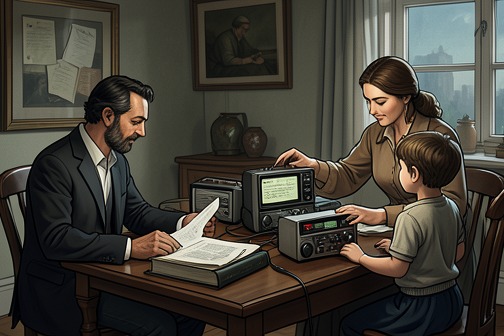
[Saint-Malo](entity:location-recall-location-saint-malo-85b1c832a945)’s mandatory radio surrender turns an administrative notice into a test of what can be silenced, what must be given up, and what can still be hidden. The order makes possession of a receiver punishable as sabotage; inside the LeBlanc house, its enforcement is heard one machine at a time, until the family’s collection is gone and the house settles back into silence. But the attic transmitter complicates the apparent completeness of that silence: it is a different kind of apparatus, and one that remains available for communication beyond the reach of the surrendered sets.
## The Order and Its Deadline
[Marie-Laure LeBlanc](entity:character-recall-character-marie-laure-leblanc-3b40e20f4b28) has to press her father three times before [Daniel LeBlanc](entity:character-recall-character-daniel-leblanc-64966d3a1873) reads the notice aloud. It requires members of the population to relinquish every radio receiver in their possession and deliver the sets to 27 rue de Chartres before noon the following day. Anyone who fails to comply is threatened with arrest as a saboteur. The notice does not merely demand equipment; by attaching a criminal label to noncompliance, it makes a household object evidence of possible political disobedience.
For Marie-Laure, the deadline lands amid a house unusually full of radio equipment. Half the house, she thinks, is occupied by receivers and the parts used to build them. The scale of the demand is therefore personal and immediate: this is not an abstract prohibition that can be satisfied by handing over one convenient set. It requires the household to dismantle a substantial collection before the next day’s noon deadline.
The first response is a pause. An old anxiety rises in Marie-Laure, who starts to ask whether someone is in her grandfather’s old room. [Madame Manec](entity:character-recall-character-madame-manec-624a3b197604) answers that [Etienne LeBlanc](entity:character-recall-character-etienne-leblanc-c0218becdb1a) is there. The concern remains unresolved: Madame Manec knocks on [Henri LeBlanc](entity:character-recall-character-henri-leblanc-cdf67e8de482)’s door, but receives no reply, and Etienne is still shut inside the room the next morning. The family has to act on the order while one of its members remains withdrawn and unreachable.
## Dismantling the Household’s Radios
That afternoon, Madame Manec and Daniel begin boxing the equipment in Etienne’s study. They unplug the sets and lower them into crates while Marie-Laure sits on the davenport and listens to each one go off. The order thus acquires a material sequence: not a single dramatic seizure, but the progressive disconnection of machines that had occupied the house and made radio part of its everyday life.
The surrendered collection includes an old Radiola Five, a G.M.R. Titan, a G.M.R. Orphée, and a Delco thirty-two-volt farm radio that Etienne had shipped from the United States in 1922. Daniel wraps the largest set in cardboard and uses an ancient wheeled dolly to thump it down the stairs. These distinct machines, gathered over time and suited to different uses, are reduced to loads that must be carried to the designated delivery point. Their variety gives the confiscation its weight: the family is not relinquishing one interchangeable possession, but a history of listening and collecting embodied in specific devices.
As the sets are removed, Marie-Laure thinks of another machine in the attic: a transmitter with cables and switches. She wonders whether it qualifies as a radio receiver and whether she should mention it. Daniel and Madame Manec seem unaware of it. The distinction matters because the order names receivers, while the attic apparatus is built to transmit. The scene does not establish that the transmitter is formally exempt from the order; it establishes the uncertainty that lets Marie-Laure recognize it as something different from the machines being boxed.
## Delivery and the House’s Silence
When Marie-Laure asks what will happen to the radios, Daniel thinks they will be sent to [Germany](entity:location-recall-location-a3c24dd56e42); Madame Manec suggests they might instead be thrown into the sea. Neither knows their destination. Their guesses register the family’s lack of control over what happens after the equipment leaves the house, even as they continue the work required to comply.
At ten the next morning, Daniel begins wheeling the loads to 27 rue de Chartres. He makes three trips. On the final one, Etienne has still not emerged from [Henri](entity:character-recall-character-henri-adb6da84571e)’s room. Marie-Laure holds Madame Manec’s hand as she hears the gate clang shut and the dolly’s axle bounce along rue Vauborel behind her father. After the cart has gone, silence reinstalls itself. The sequence gives the enforcement of the order a domestic aftermath: the sets are removed, their sounds cease, and the household is left listening to the absence they create.
That silence is not the same as the end of radio communication. The apparatus Marie-Laure recalled is later used as a transmitter: she finds its lever by the chimney and raises its antenna. The distinction between receivers surrendered under the order and a transmitter still in the house therefore has lasting narrative force. The order can empty rooms of listening sets without erasing the possibility of sending a signal.
## Significance
The surrender shows how occupation operates through deadlines, designated delivery, and the threat of arrest as well as through visible force. Its language turns failure to hand over a receiver into sabotage, making an ordinary object a point of contact between domestic life and political coercion. The family’s compliance is tangible in the crates, the dolly, and Daniel’s repeated journeys; the threat is tangible in the order’s stated penalty.
The episode also changes how the house’s radios are understood. They are at once a collection of machines, a source of sound, and equipment subject to state control. Marie-Laure’s attention to the attic transmitter keeps one crucial technical difference in view: receiving and transmitting are not identical acts, and an order aimed at the former does not automatically eliminate the latter. Against the measured removal of the radios, the surviving possibility of transmission gives the scene its unresolved edge: the household is made quieter, but communication has not yet been made impossible.
Event 17
Von Rumpel's search for the Sea of Flames at the museum
[Reinhold von Rumpel](entity:character-recall-character-reinhold-von-rumpel-0cc59346c3b4)’s search for the [Sea of Flames](entity:object-recall-object-sea-of-flames-fa38edaed37f) at the Muséum National d’Histoire Naturelle transforms a museum inspection into an exercise in coercion—and a first, inconclusive encounter with the stone he believes can secure his future. The museum’s concealment measures have divided the diamond’s trail among one real stone and three replicas, leaving even those carrying a specimen uncertain of its identity. Von Rumpel gains access to the hidden collection, but what he sees there proves to be a convincing copy, not the prize itself. The encounter begins a more methodical pursuit based on the replicas’ provenance and the people who made them.
## A Collection Under Protection
Before von Rumpel arrives, the museum has already moved into emergency preservation. As the threat of war sharpens, memos direct staff to protect the collections; couriers begin carrying objects to country estates, locks and keys become scarce, and [Daniel LeBlanc](entity:character-recall-character-daniel-leblanc-64966d3a1873) works late securing crates and transport manifests. Fossils, manuscripts, minerals, and precious objects are among the holdings being safeguarded. The Sea of Flames is only a possibility in Marie-Laure’s mind at this point, but the preparations establish the material stakes of the later search: the institution is trying to protect an immense collection while keeping its most vulnerable contents out of reach.
The diamond has been made especially difficult to track. The museum’s director arranges for three decoys to accompany the real stone into separate channels: one remains at the museum, while three others are sent in different directions, including one with Daniel LeBlanc. The rule is deliberate uncertainty: no carrier is to know whether the stone in their possession is genuine, and each is to behave as if it is. This security strategy protects the real object by multiplying plausible locations, but it also creates the problem that will occupy von Rumpel: a visible blue stone cannot be identified by appearance alone.
## The Inspection Becomes a Threat
Von Rumpel arrives at six in the morning, dressed formally and carrying the tools of his search, including a loupe and tweezers. The assistant director and Professor Hublin show him the Gallery of Mineralogy. Its length, emptied display cases, and surviving specimens make the collection’s breadth visible: among the minerals left on display are topaz, beryl, tourmaline, and many other stones. Hublin explains the collection’s history and the scale of its catalogue, while von Rumpel takes notes and gives the tour time to run its course.
His politeness is a tactic, not an acceptance of the limits set by his hosts. When the tour ends, he asks to see collections not on public display. The officials tell him they have shown him everything they can. Von Rumpel insists that he is interested in a recently retrieved specimen and waits while the assistant director describes the museum’s public duty to preserve mineral knowledge. The conflict is not simply between a collector and curators: the museum’s claim to protect a shared heritage meets an occupying officer’s ability to apply pressure until its safeguards give way.
He makes that pressure personal. Over bread and cheese, he tells the officials that he wants something small, then names the assistant director’s daughter’s school and Hublin’s twin sons’ school. He recalls the boys’ instruments and the streets they must cross on their way home. Neither man answers. Von Rumpel says he knows the diamond is not kept in the public galleries, but wants to see where the museum has hidden it. He then waits through the afternoon, refusing to let the officials end the encounter. His method is patient intimidation: rather than seize the collection in a display of force, he uses the vulnerability of the officials’ families and the hours of waiting to make refusal increasingly costly.
## Into the Hidden Rooms
The officials eventually take him below the galleries. A woman brings a ring of keys and a separate key on a chain; access requires both. The party descends a winding stone staircase, passes a second gate, and moves through a network of corridors into an ordinary storeroom of dropcloths, pallets, and crates. Behind a sheet of plywood is a combination safe. There are no elaborate alarms and only one guard. The route reveals a layered but limited security system: multiple doors and concealment protect the inner room, yet the officer’s coercion has turned its custodians into guides.
Inside the safe is another, heavier box, which the assistant director and Hublin must lift together. A felt bag contains a wrapped bundle. When it is opened, a blue stone as large as a pigeon’s egg appears in the mineralogist’s palm. For von Rumpel, this is the decisive sight of the visit: the hidden collection has yielded an object whose size and color make the Sea of Flames seem suddenly tangible. Yet the display does not resolve the question he came to answer. A convincing stone can still be a decoy, and the museum’s security plan has ensured that the officials themselves may not be able to tell him whether it is real.
## The Replica and the Unfinished Trail
Over the following three months, von Rumpel travels to [Berlin](entity:location-recall-location-769cdeac2511) and [Stuttgart](entity:location-recall-location-67fa01c7997b), assesses confiscated jewelry, and continues to pursue the diamond between other assignments. The museum stone returns to his thoughts as the pear-shaped specimen he examined through his loupe. At first he had almost persuaded himself that it was the legendary 133-carat Sea of Flames, associated with stories of a sultan’s son, blinding brilliance, and a keeper who could never die. The attraction is both professional and personal: the stone promises wealth, but its legendary power also gives his search an almost absolute significance.
Close inspection overturns his hope. The facet edges are not sharp enough, the girdle is slightly waxy, and the stone has none of the cracks or inclusions he expects in a real diamond. His father’s maxim—that a real diamond is never entirely free of inclusions—gives him a practical test against the seductive perfection of the specimen. The apparent treasure at the museum is therefore not the real Sea of Flames. The discovery does not end his pursuit; instead, it strengthens his conviction that the museum must possess the genuine stone somewhere, since it went to the trouble of commissioning so accomplished a fake.
Von Rumpel follows that reasoning to Dupont, a lapidary who had cut opal and, before the war, faceted spinels into imitation diamonds. In Dupont’s shop he finds repeated versions of a mold matching the size and pear shape of the stone kept in the museum vault. Under questioning, Dupont provides the number von Rumpel needs: in the two months before the invasion of [France](entity:location-recall-location-4f282e1af8a7), he made three replicas for the museum from a casting and never saw the real diamond. The resulting count is four stones in all—one real, three copies—with one held in the museum basement and three still to find. The museum search thus ends not with possession but with a more precise map of uncertainty: von Rumpel has disproved one candidate, established the replicas’ origin, and turned the search into a hunt for the people and routes that might connect each copy to its carrier.
Event 18
Daniel LeBlanc's arrest and deportation
[Daniel LeBlanc's arrest and deportation](entity:event-recall-event-daniel-leblanc-s-arrest-741efadb6f6e) begin when French and German authorities seize him from a train outside Vitré and treat the tools of his museum trade as evidence of possible sabotage. The arrest separates him from his daughter, [Marie-Laure LeBlanc](entity:character-recall-character-marie-laure-leblanc-3b40e20f4b28), and exposes the gap between orderly procedures and coercive power: Daniel is questioned, confined, and transported, but receives neither a lawyer nor a tribunal, and no official explanation or rescue arrives. His journey east proceeds through uncertainty, with the border approaching as a forced threshold rather than a destination he has chosen.
## Work, Suspicion, and Arrest
Daniel is a locksmith employed at a museum, and his professional equipment becomes the focus of the authorities’ inquiry. They display his notebook and tool case, inspect a ring containing seven skeleton keys, and question him about what the keys open and how he uses the small files and saws he carries. His architectural measurements attract suspicion as well. Daniel explains that he is making a model for his daughter and that the keys belong to the museum where he works. In the circumstances of the interrogation, these ordinary explanations do not restore his freedom; the objects associated with skilled work and family care are recast as possible signs of a plot.
The arrest takes place outside Vitré, hours from [Paris](entity:location-recall-location-657453741ed3). Two plainclothes policemen bundle Daniel off the train in front of a dozen passengers, whose presence makes the seizure public without making it answerable. He is questioned in a van, then in a cold office on a mezzanine, where the walls display poorly made watercolors of oceangoing ships. The personnel shift from French interrogators to German ones after an hour. The change of officials does not produce clarity: Daniel’s equipment is examined again, while the questions seem more fixed on suspicion than on his answers.
## Confinement Without Recourse
The authorities take Daniel to a cell whose imposing, old-fashioned lock and hinges prompt him to imagine them as relics from the reign of Louis XIV, or perhaps Napoleon. He expects that the institution’s director or someone from the museum will soon arrive to explain the mistake. That expectation persists even though the arrest has already shown how little his work and identity protect him. The next morning, German interrogators question him again while a typist records the exchange. They appear to suspect him of plotting to destroy the Château in [Saint-Malo](entity:location-recall-location-saint-malo-85b1c832a945), although the basis for the accusation remains unclear. Their French is limited, and they seem more engaged with their questions than with Daniel’s replies.
The barriers to ordinary recourse accumulate. Daniel is denied paper, linens, and access to a telephone; he has no officially appointed lawyer and no military tribunal. The museum director does not arrive, nor does a car come to take him away. He is not allowed to write letters, and when he demands a telephone, the guards do not treat the request as something requiring an answer. The arrest therefore becomes more than a brief interruption for questioning: without an announced process or contact with the outside, Daniel cannot establish when, or on what terms, he might leave.
## Separation from Marie-Laure
Daniel’s concern for Marie-Laure runs alongside the procedural uncertainty. He longs for cigarettes and lies on the floor imagining himself kissing her once on each eye while she sleeps. The image is a private measure of what the detention has taken from him: not merely his freedom of movement, but the ordinary closeness of a father able to return to his child. Every hour becomes bound to concern for her, while the authorities prevent him from writing to let her know what has happened.
The separation is reinforced by the failure of the institutions Daniel expects to help. His museum employment, which he offers as an explanation for his keys, does not bring the director to the cell. His role as Marie-Laure’s father gives him a reason to hope for contact, but no means of securing it. The arrest makes both relationships inaccessible at once: his professional affiliation cannot intervene, and his daughter remains beyond his reach. The narrative presents this absence through concrete withheld necessities—paper, a telephone, a letter—rather than through any formal announcement of what his family is to endure.
## Transport East and the Meaning of Deportation
Two days after the arrest, Daniel is driven to a holding pen a few miles outside Strasbourg. About thirty people sleep on straw laid over frozen mud. Most are French; the group also includes Belgians, four Flemings, and two Walloons. They have been accused of offenses that they discuss cautiously, wary that a question might conceal a trap. Their whispered expectation that they will be in [Germany](entity:location-recall-location-a3c24dd56e42) for only a few months, and then sent home, offers a fragile possibility rather than reliable information. Each prisoner entertains the hope despite recognizing how uncertain it is.
Daniel spends three days in the pen. On the fourth day, the prisoners are loaded into a cattle truck and driven east. They understand that they are nearing Germany when they glimpse the far side of a river, but the terrain does not look different to Daniel from the country on the near bank. That apparent sameness sharpens the force of the crossing: deportation is not marked by a visible transformation of place, yet for the prisoners it may as well be the edge of a cliff. The episode establishes the arrest’s immediate outcome as removal from [France](entity:location-recall-location-4f282e1af8a7) toward Germany; the evidence here does not specify Daniel’s eventual destination or subsequent fate.
## Occupation and Administrative Force
The episode sits within a wider pattern of orders and restrictions imposed on civilians. In Saint-Malo, the population is ordered to surrender radio receivers at 27 rue de Chartres before noon the following day, on threat of arrest as saboteurs. Later, residents are told that the city gates are locked and that men aged sixteen to sixty must assemble at the château’s tower before being marched to [Fort National](entity:location-recall-location-fort-national-f36fa39b06df) at low tide. These measures are distinct from Daniel’s arrest, but they echo its governing logic: an order defines the population as subject to control, and the threat of detention turns compliance into a matter of survival.
Daniel’s case makes that logic personal and unsettled. He is not shown receiving a clear judgment or a defined legal procedure; instead, suspicion follows his keys and tools from interrogation to confinement, while access to family and communication is denied. The movement from train to cell, holding pen, and cattle truck gives the event its progression: each transfer narrows his ability to choose or appeal. By the time he is carried east, the hope of a simple mistake being corrected has yielded to an uncertain forced departure, while Marie-Laure remains separated from her father.
Event 19
Frederick is beaten at Schulpforta
[Frederick is beaten at Schulpforta](entity:event-recall-event-frederick-is-beaten-at-525938d5b9a3) during a ritualized test of the cadets’ strength, after commandant [Bastian](entity:character-recall-character-bastian-72316b90dde8) turns an exercise into a public punishment. [Helmut Rödel](entity:character-recall-character-helmut-r-del-17f3307ab6e1) names [Frederick](entity:character-recall-character-frederick-88469ba33ed9) as the weakest, and Bastian makes Rödel carry out the beating while the other boys watch. Werner, Frederick’s friend, remains present but cannot act. Frederick survives the ordeal and returns to formation beside Werner, making the scene a stark measure of both the institution’s violence and the limits of Werner’s resistance.
## The test of the weakest
Every afternoon, regardless of the weather, Bastian whistles the fourteen-year-old cadets outside. With his medals and rubber hose, he lectures them about death and the difference between those who fight and those he calls nobodies. The exercise is not simply a lesson in physical endurance: it teaches the boys that weakness is a status the group may identify and punish. Bastian’s repeated question about who is weakest gives the cadets a role in enforcing the commandant’s hierarchy.
On a windy afternoon, Bastian singles out Helmut Rödel, a small boy from the south who habitually keeps his hands balled into fists. Asked to identify the weakest member of the corps, Rödel points directly at Frederick. Werner feels the choice land heavily, but he cannot change it. The episode makes the selection public before the punishment begins: Frederick is not merely tested against the others; he is designated by one cadet and exposed to the judgment of all.
## The pursuit and punishment
Bastian orders Frederick to run while the other cadets wait. Frederick is a decent runner, faster than Werner, but the conditions are against him: the commandant counts quickly, his head start is shortened, and snow hampers his progress. At Bastian’s signal, the boys pursue him. The fastest cadets run with unusual urgency, eager to discover what will happen when someone is caught. They pull Frederick down when he is still fifteen strides from Bastian.
Once the boys regroup, Frederick stands panting among them. Bastian asks whether he is the weakest. Frederick does not answer as Bastian demands, and the commandant’s manner turns openly hostile. He removes the hose from around his own neck and gives it to Rödel, instructing him to use it on Frederick. The order makes the commandant’s authority unmistakable while shifting the immediate act of violence onto another boy. Rödel hesitates only briefly before striking; Bastian orders him to continue.
Werner watches the punishment unfold and tries to keep his mind on home: the alleys and work crews of [Zollverein](entity:location-recall-location-zollverein-8c9454be5c28), his childhood with [Jutta Pfennig](entity:character-recall-character-jutta-pfennig-b4ccdeedb30a), and [Frau Elena](entity:character-recall-character-frau-elena-30fd83219873) moving among the beds at night. The memories sharpen his recognition that what is happening is wrong, but recognition does not become intervention. He opens his mouth and closes it again. The narrative stays close to that failure: Werner’s inward protest persists alongside his outward silence, while Bastian’s command defines what the boys are expected to accept as right.
## Frederick returns to formation
After the beating ends, Werner kneels beside Frederick and turns him onto his side. Frederick’s attention is fixed on the sky, where a hawk circles in the wind. The bird briefly draws Werner’s gaze upward too, interrupting the school’s demand that every face attend to the spectacle on the ground. Frederick’s ability to notice what is above him recalls the attention he gives to birds: he can identify warblers at a distance by their calls and can walk for hours in the woods. The contrast is not a claim that the ordeal leaves him untouched; it shows the inward life that the school’s judgment cannot fully define.
Bastian asks again whether Frederick is the weakest. Frederick says no. The cadets then run into the forest, and Frederick runs beside Werner, his face visibly marked by the ordeal. His place in the formation is restored without any sign that the institution has reconsidered its punishment. The boys sing together as they go, turning coercive discipline into collective performance. Frederick’s return is therefore both a limited refusal of the label imposed on him and evidence of how completely the school absorbs the incident into its routine.
## What the episode reveals
The punishment exposes [Schulpforta](entity:location-recall-location-schulpforta-da30af1c87b7)’s method of discipline: Bastian makes the cadets participate in identifying and policing weakness, then treats their obedience as part of the lesson. Rödel is made the instrument of the order, while Frederick bears its consequences and the watching boys are drawn into complicity through their presence. The routine of afternoon drills gives the violence an institutional setting rather than presenting it as an isolated quarrel.
For Werner, the decisive conflict is between what he understands and what he does. He knows Frederick is strong in ways the exercise cannot measure and experiences the scene as morally wrong, yet he remains among the pursuing cadets and does not stop the blows. The episode thus becomes an early, concrete instance of the pressure to conform that shadows Werner’s later choices. Its ending offers no rescue or public correction: Frederick runs on with the others, and the formation continues.
Event 20
The prisoner-freezing ordeal at Schulpforta
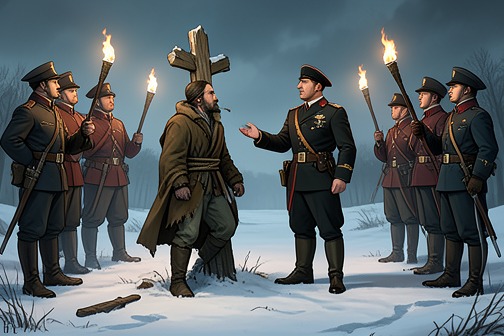
[The prisoner-freezing ordeal at Schulpforta](entity:event-recall-event-the-prisoner-freezing-o-46425b3a987c) is a staged act of violence that makes obedience visible: cadets are ordered to soak a bound prisoner in winter cold, and [Frederick](entity:character-recall-character-frederick-88469ba33ed9)’s refusal to join them becomes a test of conscience under coercion.
## Setting and Staging
One February morning at two o’clock, the cadets are roused from their beds and driven into the glittering cold of the quadrangle. Torches burn in its center. [Bastian](entity:character-recall-character-bastian-72316b90dde8) waddles out with his bare legs showing beneath his coat, while [Frank Volkheimer](entity:character-recall-character-frank-volkheimer-616967a218e7) emerges from the shadows dragging a tattered, skeletal man in mismatched shoes. A stake has been driven into the snow. [Volkheimer](entity:character-recall-character-volkheimer-afd0fa9f03aa) sets the prisoner beside it and methodically ties his torso to the wood as the cadets’ breath gathers above them in the night air.
The commandant presents the captive not as a person but as an enemy category, calling him “a creature,” “a foul beast,” “a centaur,” and an “Untermensch.” The prisoner’s ankles are cuffed and his arms bound; his thin shirt has split at the seams, and he gazes into the distance with the slackness of hypothermia. He appears to be Polish, perhaps Russian. Bastian tells the cadets that the man escaped from a work camp and was stopped after attempting to violate a farmhouse and steal a liter of fresh milk. He warns that the prisoner would tear out their throats if allowed. The accusations and racialized language turn his exposure to the cold into a demonstration of authority, while the man’s weakened body stands before the school as its prescribed image of an enemy.
## The Ritual of Collective Participation
Volkheimer returns with a clattering raft of buckets, while two senior cadets uncoil a hose across the quadrangle. Bastian explains that the instructors will go first, followed by the upperclassmen, until every man in the school has filed past and soaked the prisoner. The first instructors throw their buckets from only a few feet away. Cheers rise after each splash. For the first two or three dousings, the prisoner seems to wake, rocking on his heels; vertical creases appear between his eyes, as if he is struggling to remember something vital. The procedure turns cruelty into an organized school exercise, with each participant’s small act incorporated into a prescribed sequence.
The upperclassmen disappear inside the castle, and the buckets clank as they are refilled. The sixteen-year-olds finish, then the fifteen-year-olds; as the cheers fade, Werner feels an urgent longing to escape. While he waits, he tries to summon other images, but his mind returns to the hauling machine above [Pit Nine](entity:location-recall-location-pit-nine-2d543a690134) and the hunched miners, to the boy trembling during the entrance examination, and to people trapped in roles: orphans, cadets, Frederick, Volkheimer, the old Jewish woman upstairs, and [Jutta](entity:character-recall-character-jutta-678e69fe3386). When his turn arrives, Werner throws his water like the others. It strikes the prisoner in the chest, drawing a perfunctory cheer. Werner joins the cadets waiting to be released, his boots and cuffs wet and his hands so numb they seem not to belong to him.
## Frederick’s Refusal and Its Cost
Five boys after Werner, Frederick reaches the prisoner. He can scarcely see without his glasses, has not cheered as the buckets struck, and now frowns at the captive as though he recognizes something in him. Nudged forward by the boy behind him, he takes the bucket and empties it onto the ground. Bastian orders him to take another. Frederick again pours the water onto the ice at his feet and says, “He is already finished, sir.” Given a third pail and commanded to throw it, he refuses: “I will not.” The small, repeated gesture interrupts the school’s carefully ordered procession. Frederick does not free the prisoner, but he declines to make his own hands part of the punishment.
The refusal does not stop the ordeal or protect Frederick from the institution around him. For a week the prisoner’s corpse remains tied to the stake, frozen gray. Boys ask it for directions; someone dresses it in a cartridge belt and helmet. Crows stand on its shoulders and pick at it before the custodian and two third-year boys hack its feet from the ice with a maul, tip it into a cart, and roll it away. The casual uses of the corpse extend the violence beyond the prisoner’s death: the school turns the remains into scenery and an object of mockery before removing them.
In the following nine days, Frederick is chosen three times as the weakest during field exercises. Bastian walks farther out and counts faster, forcing Frederick to run four or five hundred yards, often through deep snow, while the other boys chase him; each time they catch and beat him as Bastian watches. Werner does nothing to intervene. Frederick lasts seven blows, then six, then three. He neither cries out nor asks to leave, and his endurance only intensifies the commandant’s frustration. Set beside the earlier refusal, these repeated punishments show the cost of resisting the school’s demand for conformity, while Werner’s inaction sharpens the contrast between seeing the cruelty and acting against it.
## The Refusal’s Uneasy Afterlife
Bastian gives the prisoner’s depleted appearance a schoolroom label, calling it “circling the drain.” The phrase turns a person’s visible suffering into a contemptuous category, continuing the lesson in which the captive is made into an object to be judged rather than someone whose exposure might demand care. The ordeal’s moral contrast is therefore not simply between the prisoner and his tormentors: it also lies between the institution’s ready-made descriptions and Frederick’s refusal to treat the man as already beyond concern.
Much later, when Werner visits Frederick, the scene offers no simple image of the defiant cadet restored to triumph. Frederick still wears his black-framed glasses; porridge clings to his whiskers and to the place mat as Franny feeds him by the spoonful and wipes his chin. Werner cannot look at the mess, and realizes that Frederick now needs to shave—or someone must shave him. The visit does not establish the ordeal as the cause of Frederick’s later condition, but it changes the scale on which his refusal can be remembered: one small act of conscience remains distinct from the long, painful life that follows, and does not cancel the vulnerability the school’s violence exposed.
Event 21
Marie-Laure's first visit to the beach
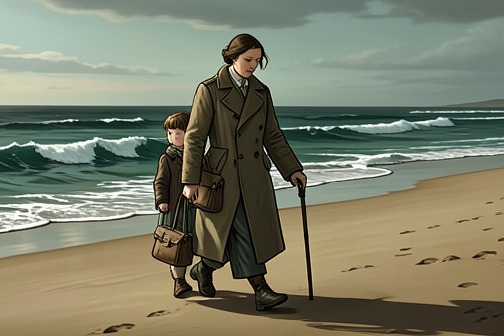
[Marie-Laure LeBlanc](entity:character-recall-character-marie-laure-leblanc-3b40e20f4b28)’s first visit to the beach is a decisive crossing from guarded streets into a larger world she can discover for herself. [Madame Manec](entity:character-recall-character-madame-manec-624a3b197604) takes her beyond the walls of [Saint-Malo](entity:location-recall-location-saint-malo-85b1c832a945) and down to the shore, where the ocean’s sound, the sand’s texture, and the objects left by the tide make a place that Marie-Laure had not been able to imagine from maps or models. The visit lasts three hours; its consequence is not simply that she has seen the sea by other means, but that she returns carrying pieces of it to share.
## The decision to leave
Marie-Laure’s father has been missing without word for twenty-nine days. One morning in late February, Madame Manec climbs the stairs to her room, despite [Etienne LeBlanc](entity:character-recall-character-etienne-leblanc-c0218becdb1a)’s warning outside his study. He insists that Marie-Laure is his responsibility; Madame Manec answers that she cannot stand by any longer. Her decision to take the girl out of the house is an act of care that also challenges the protection keeping Marie-Laure indoors. She enters the bedroom, lays a hand on Marie-Laure’s forehead, and tells her, “I’m taking you out. Bring your cane.”
Madame Manec makes the outing possible through practical gestures rather than elaborate reassurance. Marie-Laure dresses herself; at the bottom of the stairs, Madame Manec gives her a heel of bread, ties a scarf over her head, buttons her coat to the collar, and opens the front door. Before they set off, Marie-Laure hesitates and listens, her heart beating in a counted rhythm. The ordinary preparations mark a change in scale: the girl who has been kept inside is now being helped to meet the city directly, step by step.
## Through the city and beyond its walls
The street initially confirms Marie-Laure’s sense of Saint-Malo as a maze. Her cane catches against the uneven cobbles and vibrates; rain runs through the streets and beads on her scarf, while sound ricochets between the high houses. Madame Manec guides her through turns, including a leftward turn Marie-Laure does not expect, and toward a gateway in the moss-covered city walls. The route makes the threshold tangible: they pass out of the city, descend steps, and reach the shore.
The ocean is not a view but an overwhelming field of sound. Its sucking, booming, splashing, and rumbling exceed the scale Marie-Laure had imagined, surpassing in her mind the [Jardin des Plantes](entity:location-recall-location-jardin-des-plantes-4d8f3a747deb), the Seine, and the galleries of the museum. The encounter also rearranges the distances she knows: the labyrinth of Saint-Malo opens onto something far larger than its streets. Rain touches her face as she listens to the sea, Madame Manec’s raspy breathing, and a caller on the beach. Madame Manec identifies the distant voice as Monsieur Radom calling his dog, then offers her arm and helps Marie-Laure sit down to remove her shoes.
## Learning the shore by touch
When Marie-Laure asks what to do, Madame Manec answers, “Just walk.” Marie-Laure moves over cold, rounded pebbles, crackling weeds, and wet sand that feels smooth beneath her fingers. She bends to explore it, finding its texture like cold silk, while the tide has left pebbles, shells, barnacles, and small slips of wrack. Her knowledge of the beach accumulates through contact: rain on her hands and neck, sand drawing heat from her fingertips and feet, and the varied things her fingers can find along the shore.
As she follows the tide line, a months-old knot inside her begins to loosen. At first she moves almost crawling; then she imagines the beach extending around the promontory, enclosing the outer islands and continuing along the Breton coastline. She pictures the walled city behind her, with its ramparts and puzzle of streets, reduced to the size of her father’s model. But what lies beyond that model now matters most. The contrast is not a rejection of the small, familiar map: it is Marie-Laure’s discovery that the world it represents exceeds what the model could convey.
## Return with the sea’s offerings
The outing lasts three hours, and no occupation soldier comes to arrest them; no one even speaks to them. During that time Marie-Laure finds a stranded jellyfish, an encrusted buoy, and many polished stones, and she wades to her knees, soaking the hem of her dress. Madame Manec eventually leads her back to rue Vauborel, where Marie-Laure climbs all five flights and knocks at Etienne’s study. He tells her he worried because she had been gone so long.
Marie-Laure answers by emptying her pockets for her uncle: shells, barnacles, cowries, and thirteen lumps of quartz still gritty with sand. The small collection makes the journey shareable. She has returned not only with the memory of an immense sound and a newly imaginable coastline, but with particular things she can place in Etienne’s hands. The scene’s movement—from a girl protected indoors, through unfamiliar streets, to a shore explored under her own feet—gives the beach visit its force: the world becomes accessible not all at once, but through each step and each object she brings back.
Event 22
The women of Saint-Malo organize resistance
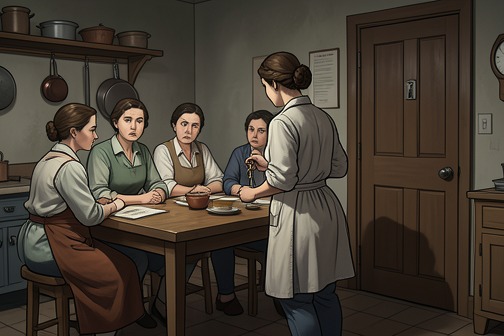
[The women of Saint-Malo organize resistance](entity:event-recall-event-the-women-of-saint-malo-c7cdad265a9b) through practical, coordinated acts that turn the routines of occupied life into opportunities for disruption. The effort begins in [Madame Manec](entity:character-recall-character-madame-manec-624a3b197604)’s kitchen, where grievances about prices and duplicity give way to a direct proposal: the women should do something, and first she needs to know whether they are willing. What follows is not a single dramatic operation but a series of actions fitted to the skills, objects, and everyday routes already available to them.
## From Complaints to a Proposal
Marie-Laure sits in her customary place in the kitchen, near the fireplace, listening as Madame Manec’s friends complain. Their concerns are concrete: the exchange rate is a farce, carrots cost too much, and duplicity seems to be everywhere. The conversation establishes the pressures of daily life as the immediate setting for resistance, rather than treating opposition as separate from ordinary concerns.
Madame Manec changes the meeting’s direction by deadbolting the kitchen door and clearing her throat. Once the women fall quiet, she proposes that they act. She does not assume their participation: she says she first needs to know whether they are willing. This small sequence gives the organization a recognizable beginning. A private gathering becomes a decision about collective action, with willingness made an explicit condition of the work to come.
The group is identified as the Old Ladies’ Resistance Club. Its informal, domestic setting contrasts with the reach of its interventions. The kitchen at [Number 4 rue Vauborel](entity:location-recall-location-number-4-rue-vaubore-c7c0adfb6034) serves as a place where neighbors can talk, plan, and return after their actions; the evidence presents the women’s network through that recurring meeting place and through the practical tasks they undertake.
## Disrupting Occupation in Everyday Ways
[Madame Ruelle](entity:character-recall-character-madame-ruelle-978cb46c14c9), the baker’s wife, and Madame Guiboux take a stepladder and a ratchet set onto the road. At dusk, Ruelle straps the ladder to her husband’s car and drives along the Route de Carentan with Guiboux; together they rearrange road signs. The action uses a familiar vehicle and tools for a covert alteration of the road’s instructions. They return to the kitchen laughing, bringing the act of interference back into the group’s shared domestic space.
Other actions exploit information gathered through local knowledge. Three days after the road-sign episode, Madame Fontineau overhears that the German garrison commander is allergic to goldenrod. Madame Carré, a florist, then places large bunches of the plant in an arrangement intended for the château. The episode connects neighborhood observation with the florist’s ordinary work: information about the commander becomes useful because someone in the group can act through a delivery.
The women also interfere with the movement of goods and information. They send a shipment of rayon to the wrong destination and deliberately misprint a train timetable. Madame Hébrard, the postmistress, removes an important-looking letter from [Berlin](entity:location-recall-location-769cdeac2511) and takes it home, where she uses it to start her evening fire. These are distinct forms of disruption—misdirecting supplies, corrupting travel information, and keeping a letter from its expected course—carried out through access the women possess in their daily lives.
## A Message on Ordinary Money
Madame Manec’s proposal also gives the group a way to place a political message into routine exchange. She asks the women to give their money to Madame Blanchard and tells them they will get it back. Blanchard is to use [Etienne LeBlanc](entity:character-recall-character-etienne-leblanc-c0218becdb1a)’s fountain pen to write Free [France](entity:location-recall-location-4f282e1af8a7) Now on every five-franc note. Madame Manec’s plan depends on money continuing to circulate: because people need to spend the bills, the inscription can travel from hand to hand rather than being destroyed or confined to the meeting.
The proposed reach is wider than the kitchen or the immediate neighborhood. Madame Manec expects the message to go out across [Brittany](entity:location-recall-location-66c17c26ffa8) once the notes have been spent. The plan makes an ordinary payment carry a second meaning. A bill remains usable as money, yet its movement also distributes a call for a free France. The political purpose is therefore built into the object’s everyday use, not separated from it.
## Collective Action and Its Form
The women’s resistance is presented as cumulative rather than as one decisive confrontation. Road signs are altered; a shipment is misdirected; a timetable is printed incorrectly; a letter is diverted; a political phrase is written onto circulating currency. Each action has its own means and immediate setting, but together they show a group converting local familiarity, occupations, and routine exchanges into ways of obstructing or challenging German authority.
The gathering’s progression—from complaints, to a proposal, to a question of willingness, and then to separate acts—also defines the group’s method. Madame Manec initiates and coordinates, while the other women contribute through what they know and can do: a route, a ratchet set, a florist’s arrangement, a post office, handwriting, or money. The resistance is consequently shown not as an abstraction but as cooperation embedded in ordinary life. Its small scale does not make its actions identical: some alter movement, some redirect materials or correspondence, and the banknote plan carries an explicit political message into circulation.
Event 23
Werner's field test of the tracking transceiver
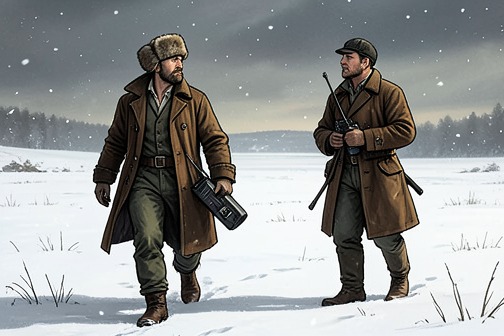
[Werner's field test of the tracking transceiver](entity:event-recall-event-werner-s-field-test-of-3330e6821b73) is both a practical demonstration of radio direction-finding and a moment when technical success collides with moral danger. In the frozen darkness near [Schulpforta](entity:location-recall-location-schulpforta-da30af1c87b7), Werner locates [Frank Volkheimer](entity:character-recall-character-frank-volkheimer-616967a218e7) by calculation; at the end of the search, [Dr. Hauptmann](entity:character-recall-character-dr-hauptmann-844538ac0542) points a pistol at the hidden cadet, and Werner must confront what the experiment’s language of triangles and numbers can conceal.
## The test and its apparatus
At midnight, Dr. Hauptmann’s hounds run through the frozen fields beside the school, with Hauptmann following in a fur cap and Werner bringing the pair of transceivers they have tested for months. The scene begins as a field exercise, but its scale is deliberately unsettling: Hauptmann has sent [Volkheimer](entity:character-recall-character-volkheimer-afd0fa9f03aa) ahead with a KX transmitter in an ammunition box and told him to broadcast steadily until he is found or the battery dies. The search area covers ten square kilometers, and even Hauptmann does not know where Volkheimer is.
Hauptmann presents the uncertainty as part of the pleasure of the exercise. He tells Werner to set up in a place with good sight lines and explains that teams would not normally know which band to search; for this first field test, however, they will use eighty meters. The distinction matters: Werner is testing not simply whether a receiver can detect a signal, but whether a team can use measurements to locate a concealed transmitter across an unfamiliar landscape.
Werner stamps no clearing into the snow himself; instead, Hauptmann makes a place to work, and Werner establishes two receiving positions two hundred meters apart. He uncoils the grounding wires, raises the aerials, switches on the equipment, and adjusts the receivers while his fingers grow numb. With the headset filling his ears with static, he increases the radio-frequency gain and adjusts the filter until both receivers pick up Volkheimer’s signal. The transmitter’s faint, repeatable ping turns the empty snowy field into a problem that can be measured.
## From signal to landscape
Hauptmann insists that Werner do the calculations on the radio casing, reasoning that field teams may not have paper. Werner sketches the equation on the metal, enters the figures, and uses a slide rule supplied by Hauptmann. Within two minutes, he has a vector and a distance: two and a half kilometers. Then, with a protractor and compass, he draws the lines onto a map. The transceivers do not reveal Volkheimer directly; they give Werner bearings and distance, which he must translate into a route through the terrain.
The physical search makes that translation visible. Werner folds the map into his coat, packs the receivers, and carries one in each hand. The school and its outbuildings soon look like toys on the white plain below. He and Hauptmann descend into a ravine and climb out again, covering one kilometer and then two. The measuring instruments have sent them away from the familiar buildings and into a landscape where the only tracks are their own.
On a later climb, Werner checks the bearings again. The new triangulation places them less than half a kilometer from the earlier estimate. He packs the equipment and quickens his pace. The figures have become direction and distance, and the search now takes on the physical urgency of pursuit: the dogs sense something ahead, Hauptmann raises a hand, and Werner finally sees a man lying faceup in the snow, with the transmitter at his feet and its antenna rising into the low branches.
## The human stakes of the experiment
At this close range, Hauptmann draws his pistol and tells Werner that he cannot hesitate. Volkheimer’s breath is visible in the cold as Hauptmann aims directly at him. For a long moment, Werner believes his teacher is about to shoot the cadet, and the technical exercise becomes a credible threat to a human life. The account brings back [Jutta](entity:character-recall-character-jutta-678e69fe3386)’s earlier question about whether it is right to do something merely because everyone else is doing it. Werner’s success in solving the problem has brought him to a moment in which following the exercise’s logic seems inseparable from obeying authority.
Hauptmann fires into the sky. Volkheimer drops into a squat as the dogs rush toward him, but they know him; their charge becomes play, and he throws them off as if they were housecats. The release of tension is immediate, yet the preceding danger is not erased. Werner’s heart seems to have been blown apart, while Hauptmann laughs, drinks from his flask, and passes it to him. The transceivers work, and Werner has pleased his professor, but the success has unfolded beside a drawn weapon and a moment of genuine fear.
## Numbers, distance, and responsibility
Afterward, Hauptmann identifies the exercise as what they are doing “with the triangles.” Volkheimer approaches carrying the KX transmitter and rests a large mittened hand on Werner’s cap. Quietly enough that Hauptmann cannot hear, he says, “It’s only numbers.” Werner answers by imitating Hauptmann’s clipped accent: “Pure math, cadet. You have to accustom yourself to thinking that way.” The exchange links the successful method to a habit of thought. Measurement is what lets Werner find Volkheimer across the snow, but the same abstraction can make a person seem like only a position to locate.
The scene also makes the test a threshold in Werner’s experience: he thinks he has found “a way in,” and the calculations are becoming real through movement, terrain, and discovery. Yet the apparent triumph remains morally unsettled. Hauptmann’s pistol exposes the coercive possibility inside the exercise, while the “only numbers” exchange shows how Werner and Volkheimer use their teacher’s language to frame what has happened. In that tension, the field test demonstrates both the power of Werner’s technical skill and the danger of treating its human consequences as merely mathematical.
Event 24
Frederick is removed from Schulpforta after a severe injury
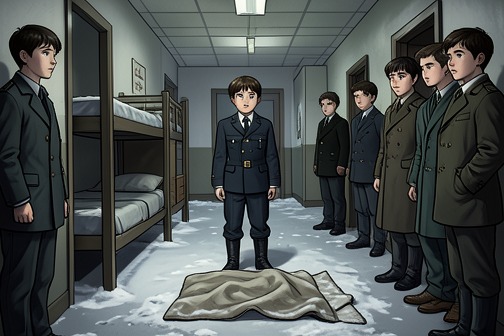
[Frederick is removed from Schulpforta after a severe injury](entity:event-recall-event-frederick-is-removed-fr-ed828613d2fb) in an episode defined by uncertainty, institutional silence, and the lasting change it brings to Werner’s life at school. [Frederick](entity:character-recall-character-frederick-88469ba33ed9)’s absence first arrives as a gap in the ordinary routine: he is not in his bunk one April morning, and no account of what happened can be established with confidence. The school’s response offers Werner neither a clear explanation nor a visible reckoning. Frederick leaves for surgery and does not return to his former life there.
## Disappearance and conflicting accounts
The first fact Werner can confirm is Frederick’s absence. He has vanished from his bunk after a night when three inches of slush have settled on the ground. He does not appear at breakfast, poetics, or the morning field exercises. His missing place in each successive activity makes the absence harder to treat as temporary, but it does not explain what has happened to him.
The accounts reaching Werner contradict one another. In one version, boys take Frederick outside, set up torches in the snow, and make him shoot at them to demonstrate that his eyesight is adequate. In another, they test his eyes with charts and force the charts on him when he cannot read them. The details differ, and the narrative presents neither as a confirmed account. Werner is left with rumor rather than testimony: competing explanations whose disagreement does not make Frederick’s fate less urgent.
The uncertainty is part of the event’s meaning. Werner cannot know whether [Bastian](entity:character-recall-character-bastian-72316b90dde8) exacts a final vendetta or whether Frederick seeks his only way out. Those possibilities remain possibilities, not established causes. The episode therefore refuses the comfort of a single, verified account of how the injury occurred. What Werner can establish is the disappearance, the evidence in the infirmary, and the departure that follows.
## Werner’s search at the infirmary
Werner skips lunch and walks to the school infirmary, risking punishment by leaving his expected routine. The movement there is rendered as slow and dreamlike: even in bright noon, he experiences himself as distanced from his own actions. The shift from scheduled school life to this solitary search shows how completely Frederick’s absence has disrupted his attention. Werner does not wait for an official explanation; he goes to find what the school has not told him.
In the infirmary he sees a bed marked by blood, pink rags in a basin, and a bandage on the floor. These objects establish that Frederick has suffered a serious injury without revealing its precise circumstances. The nurse, the only woman at the school apart from the women who work in the kitchens, approaches Werner with a grim expression. When he asks about the blood, she places four fingers across her lips. Her gesture leaves open whether she is weighing what to say, does not know, or is constrained by the school’s silence; the scene gives no definitive answer.
Werner then asks where Frederick is. The nurse tells him that Frederick has gone to Leipzig for surgery. When he asks what happened, she does not provide an account; instead, she asks whether he should be at the midday meal. The exchange gives Werner a destination and a medical explanation for Frederick’s absence, but no account of responsibility. The answer redirects him toward the school’s timetable just as his concern has carried him outside it.
## Departure and what follows
Frederick’s removal becomes definitive later in the year. Werner is fifteen, and a new boy now sleeps in Frederick’s bed. That replacement makes the school’s continuity visible: the empty space is occupied, while the injured boy remains absent. At night, Werner sometimes sees Frederick where he is not. The apparitions are presented as Werner’s perceptions, not as a return or recovery; Frederick’s absence persists in his memory even as the institution has assigned his bed to someone else.
The later account clarifies the outcome. Frederick did not die, but he did not recover. He sustained brain trauma, and his mother came to the school in a blue automobile. She entered the commandant’s residence and emerged carrying the weight of Frederick’s duffel bag, looking small; then she climbed back into the car, which drove away. The narrative shows her taking him from [Schulpforta](entity:location-recall-location-schulpforta-da30af1c87b7), but does not explain what arrangements followed or how he lived afterward.
No one was punished, and no one questioned. This is not merely a lack of information for Werner: it is the reported institutional aftermath of the injury. The nurse’s guarded gesture and the contradictory stories are followed by a silence that extends beyond the infirmary. The school absorbs the event into its routines, replacing Frederick in the bunk and continuing its life without an account of accountability.
## Significance in Werner’s story
Frederick’s departure marks the difference between physical survival and restoration. He is alive, yet the later description makes clear that he cannot resume his place at school or return to the boy Werner knew. His absence is repeated through concrete substitutions and remnants: another cadet in his bed, Werner’s nighttime visions, and the duffel bag his mother carries away. None supplies the missing explanation of the injury; together they show how completely the event changes what remains for Werner to remember.
The episode also connects the school’s everyday order with its capacity to leave violence unexamined. Werner takes a risk to seek Frederick, but the information he receives is fragmentary, and no authority is shown investigating what happened. The story preserves the limits of Werner’s knowledge instead of converting rumor into certainty. Frederick’s removal thus becomes both a personal loss for Werner and a defining absence at Schulpforta: a boy is taken away, the school continues, and the cause and responsibility remain unresolved.
Event 25
Operation Typhoon
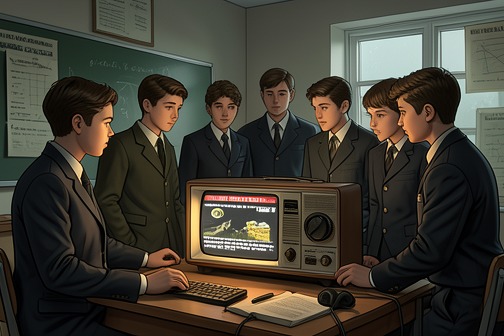
[Operation Typhoon](entity:event-recall-event-operation-typhoon-008bd23f679e) enters the narrative through a wireless broadcast heard by students in October. As news of German advances circulates, the cadets gather around a large radio to hear the operation declared. The report that German companies have planted flags miles from Moscow turns a distant campaign into an immediate claim of victory, though the certainty of the broadcast belongs to the regime’s presentation of events, not to an independently confirmed outcome.
## The Announcement and Its Claim
The scene links the name Operation Typhoon to the German advance toward Moscow. The student body hears that [Russia](entity:location-recall-location-e36341713c23) is collapsing and that German forces have reached positions only miles from the city. The broadcast concludes with the assertion that Russia will be theirs, converting a report of military movement into a confident prediction of possession. The scene records what the cadets are told; it does not establish that the prediction will come true.
## The Wireless as a Public Medium
The announcement is one instance of radio’s reach in the novel. In a letter to the absent professor, [Frau Elena](entity:character-recall-character-frau-elena-30fd83219873) wonders whether his broadcasts still reach their listeners and describes a powerful transmitter in Brandenburg, Deutschlandsender 3, that overwhelms much of the dial. Her account of a neighbor who imagines hearing broadcasts through her tooth fillings carries the signal’s apparent ubiquity into ordinary life. Set beside the cadets gathered around a single wireless, the letter suggests how radio connects dispersed listeners while leaving them dependent on the stations and signals available to them.
That reach also makes radio a target of official control. In [Saint-Malo](entity:location-recall-location-saint-malo-85b1c832a945), residents are ordered to surrender their radio receivers at 27 rue de Chartres by the following noon, under threat of arrest as saboteurs. The order is not presented as a consequence of Operation Typhoon; rather, it shows the wider wartime stakes attached to listening and access to broadcasts. Radio can carry an authorized declaration to a gathered audience, but possession of a receiver can also become grounds for coercion.
## Technical Knowledge and Military Use
The larger narrative places the broadcast within a world where radio is also a technical and military tool. In [Dr. Hauptmann](entity:character-recall-character-dr-hauptmann-844538ac0542)’s laboratory, [Werner Pfennig](entity:character-recall-character-werner-pfennig-48150c6dbd60) quickly makes a screw and magnet spin using a battery and wire, demonstrating a facility with electrical principles. He later works on a directional radio transceiver designed to be retuned across multiple frequencies and to measure the angle of received transmissions. During a calculation exercise, he uses a slide rule to find a vector and a distance of two and a half kilometers; on a field search, he scans for voices that are not sanctioned.
These episodes do not describe the planning or course of Operation Typhoon. They do, however, set the public wireless announcement against the more specialized work of locating and controlling signals. The same medium that delivers a declaration of military momentum can be engineered for directional measurement and used to search for unauthorized voices.
## Narrative Significance
The event is brief and mediated: the cadets encounter the campaign through a radio, not through direct observation of the battlefield. That distance matters. Flags planted near Moscow and the confident forecast of German possession arrive together as a message designed to make advance sound inevitable. Elsewhere, letters are marked by censorship, and radio receivers in occupied Saint-Malo are subject to compulsory surrender. Across these distinct episodes, communication is not merely a background technology; it shapes what people can hear, what they are permitted to hear, and how official claims enter everyday life.
Event 26
The 1944 bombardment of Saint-Malo
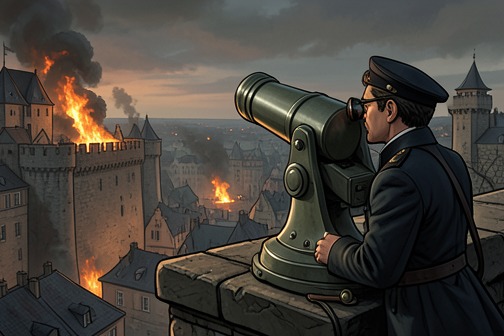
[The 1944 bombardment of Saint-Malo](entity:event-recall-event-the-1944-bombardment-of-da1c83bd0413) is seen from across the water by [Reinhold von Rumpel](entity:character-recall-character-reinhold-von-rumpel-0cc59346c3b4), who watches the city burn from a periscope turret inside [La Cité stronghold](entity:location-recall-location-la-cit-40cc6c658486). At dawn on [8 August 1944](entity:time-recall-time-1944-8-8-80be5dad398e), the bombardment pauses, but the fires continue. The cathedral spire is gone; [Number 4 rue Vauborel](entity:location-recall-location-number-4-rue-vaubore-c7c0adfb6034) still stands. For von Rumpel, the city’s destruction is at once a battlefield spectacle, a measure of his army’s dwindling hold, and an obstacle between him and the house he means to search.
## Setting and Immediate Background
The scene opens at the fort of La Cité, where von Rumpel climbs a ladder toward the turret despite the swollen lymph nodes pressing against his throat and windpipe. Two gunners keep watch beneath their helmets. The turret’s steel dome is used to range guns farther below, but from its position it also commands a view of the western sea, the cliffs tangled with wire, and [Saint-Malo](entity:location-recall-location-saint-malo-85b1c832a945), burning half a mile away. The city is visible as a target and as a landscape of ruined homes; the fort’s elevated view offers distance from the destruction without making its consequences abstract.
The pause in artillery fire does not mean safety or an end to the attack. Predawn fires continue inside the walls, spreading across the western edge of the city. Smoke rises in several columns, the largest swelling above the rooftops. From the turret, documents from ordinary civic administration—utility plans, purchase orders, and tax records—flutter through the smoke and ash. These fragments make the destruction legible in a particular way: the bombardment consumes not only buildings but the paper traces of the city’s working life.
## The Burning City
Von Rumpel watches through binoculars as shapes that might be bats flare and careen over the ramparts. Deep within a house, a sudden eruption of sparks could come from an electrical transformer, hoarded fuel, or a delayed-action bomb; from his distant position, the cause remains uncertain. The blast makes the town appear to be struck by lightning from within. A gunner comments on the smoke, a dead horse near the walls, and the changing intensity of the fires, treating the view almost like a spectacle staged for spectators. Their detached observations stand against the violence they are watching: the city burns while men in the turret discuss its visible features.
As the moon sets and the eastern sky lightens, the flames’ orange glow gives way to black smoke. The second gunner reports that the church spire is gone. Only a day earlier, it had risen above the zigzag rooftops, taller than the surrounding buildings. Now smoke blows along the western walls and across the citadel. The missing spire provides a stark measure of how much can change in a day: a familiar landmark that once ordered the city’s skyline has been erased, even as the fire continues to obscure what remains.
For a few seconds, the smoke parts enough for von Rumpel to search the maze of rooftops. He finds the upper portion of a tall house with a broad chimney. Its glass is gone from two visible windows; one shutter hangs loose, while three remain in place. He recognizes it as Number 4 rue Vauborel, the house he wants to enter. The smoke closes over it again, but the glimpse establishes a precarious distinction between the city’s general devastation and the one building that matters to his immediate purpose: the house is damaged, yet still intact.
## The Occupation and the Search
The siege takes place amid the coercive rules of occupation. Earlier, residents were ordered to surrender their radio receivers at 27 rue de Chartres, with arrest threatened for anyone who disobeyed. [Daniel LeBlanc](entity:character-recall-character-daniel-leblanc-64966d3a1873) is seized outside Vitré while travelling toward [Paris](entity:location-recall-location-657453741ed3); his keys, locksmith’s tools, and architectural notebook prompt questioning by French and then German interrogators. The episode of the bombardment does not establish that these measures cause the fires, but it places the burning city within a larger system in which German authorities regulate communication, movement, and suspicion through orders and detention.
The military outlook from the fort is also deteriorating. Von Rumpel recalls speeches promising that German forces will break the American line at Avranches and that reinforcements will arrive. Those assurances contrast with what he sees from La Cité: the fort is cut off from retreating lines, and he expects [Allied forces](entity:organization-recall-organization-757f4f13ccd7), including Canadians, British troops, and the American Eighty-third Division, to reach the city and search its homes. He does not treat the speeches as proof that relief is coming. Instead, his attention turns to his own worsening illness, imagined as a black vine spreading through his body and consuming him from within. The approach of the enemy and the progress of the disease make waiting feel finite.
## Aftermath and Significance
In the underground commissary, soldiers eat oatmeal from their helmets beneath electric lights that alternate between brightness and shadow. Von Rumpel sits on an ammunition box and squeezes cheese from a tube. The small, practical acts of eating and waiting contrast with the immense destruction above ground, while the fort remains a temporary refuge rather than a secure position. When he drops the empty tube, the house is still standing and the German army still holds the city. He expects the fires to burn for hours, then anticipates German troops returning to their positions to fight another day. He decides to wait until the smoke clears before going into the city.
That decision makes the scene a pause in his search, not its conclusion. The bombardment has transformed Saint-Malo’s skyline and exposed the weakness of the occupying force, but it has not yet removed the house he is pursuing. Later, smoke and ash still hang over the rooftops, and von Rumpel believes the model he seeks will be inside the locksmith’s house. His fixation survives the change from distant surveillance to entry into the ruined city. The episode’s central contrast is therefore between large-scale destruction and narrowly focused desire: while fires erase landmarks and Allied forces close in, von Rumpel keeps measuring the catastrophe by whether Number 4 rue Vauborel remains accessible.
Event 27
Marie-Laure shelters in the cellar during the bombardment
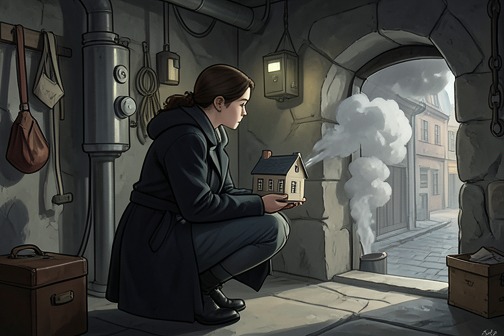
After the bombardment of [Saint-Malo](entity:location-recall-location-saint-malo-85b1c832a945), Marie-Laure survives in the cellar of [House at 4 rue Vauborel](entity:location-recall-location-4-rue-vauborel-6f965918daed) by waiting, rationing what little she has, and trying to decide when it is safe to emerge. Her refuge is at once practical shelter and a chamber of uncertainty: she cannot tell whether the fighting has ended, whether the city has been liberated, or whether the person she hopes will reach her is alive. When she finally climbs upstairs to find food, a trip wire rings behind her and someone enters the house, turning her cautious attempt to survive into a new, unresolved danger.
## The Cellar and the Uncertain End of the Fighting
When Marie-Laure wakes, the little model house is pinned beneath her chest, and she is sweating through her great-uncle’s coat. The miniature, an object she has carried with her into hiding, anchors the scene in the middle of larger destruction: she is still physically sheltered, but she has no reliable account of what has happened outside. At the trapdoor, she listens for signs of danger. The sirens have stopped; that silence could mean that the house has burned down around her, or that she has slept through the war’s final hours and Saint-Malo has been liberated. Volunteers, gendarmes, fire brigades, or American soldiers might be in the streets. None of these possibilities is confirmed.
The alternative is more frightening. [Germany](entity:location-recall-location-a3c24dd56e42) may still hold the city, with soldiers moving from house to house and shooting people at will. Marie-Laure decides to wait rather than risk the stairs. In her mind, [Etienne LeBlanc](entity:character-recall-character-etienne-leblanc-c0218becdb1a) might be struggling toward her, or crouched somewhere in terror, or dead. The possibilities remain possibilities: the cellar offers no way to learn which is true. Her father is also beyond reach. Earlier, [Daniel LeBlanc](entity:character-recall-character-daniel-leblanc-64966d3a1873) had been seized outside Vitré and taken into detention, and in the cellar Marie-Laure longs for the chance to speak to him. The family’s separations make the silence outside more than a question of military control; it leaves her without news of the people whose survival matters to her.
## Hunger and the Search for Food
Waiting does not remove the body’s demands. Marie-Laure tells herself to save the bread, but hunger defeats the plan, and she eats the entire loaf as it grows stale. When she searches the cellar, she finds traces of ordinary domestic life alongside the ruins of scarcity: a rolled rug with what seems to be a nest of mice, a crate of old papers, an antique lamp, and [Madame Manec](entity:character-recall-character-madame-manec-624a3b197604)’s canning supplies. Near the back of a high shelf, she discovers two heavy cans. The kitchen above has almost nothing left—cornmeal, lavender, and a few bottles of spoiled Beaujolais—so the cans matter as a possible meal, though she cannot tell what they contain.
She imagines that one might hold the white peaches Madame Manec used to buy by the crate, peel, quarter, and boil with sugar. The remembered fruit is sharply unlike the unknown contents of the cans and the nearly empty house: it carries the particular pleasure of a kitchen filled with color and sweetness. But hope itself feels risky. The cans might contain peas or beans, and either would be welcome. Marie-Laure puts one in each pocket of her great-uncle’s coat, checks that the little model house is still in the pocket of her dress, and sits with her cane clasped in both hands. The small acts of securing these objects become a way to impose an order on a situation she cannot otherwise control.
## A Memory That Measures Time
In the cellar, Marie-Laure recalls a visit to the Panthéon in [Paris](entity:location-recall-location-657453741ed3) when she was eight or nine. Daniel LeBlanc described Foucault’s pendulum: a golden sphere, shaped like a child’s top, suspended from a wire sixty-seven meters long. As its trajectory changed, he explained, the pendulum demonstrated that the earth rotates. What stayed with Marie-Laure was not only the scientific proof but the idea that the pendulum would keep swinging after she and her father left, after she had slept, forgotten it, lived her life, and died.
Now she seems to hear that immense bob continuing to swing in the air before her, its motion engraving the same truth again and again. The recollection does not tell her whether the war is over or whether Etienne will come. Instead, its scale sets her brief, frightened wait against a movement that persists beyond any one person’s knowledge. The remembered lesson also belongs to her relationship with her father: in the absence of conversation with him, the explanation he once gave her remains present, available to be recalled and considered.
## The Ascent and the Trip Wire
Eventually Marie-Laure climbs the cellar steps, holds her breath, and listens at the trapdoor. She counts thirty heartbeats, then forty, before pushing it open. No one shoots at her, and she hears no explosions. In the damaged kitchen, she crosses fallen shelves into Madame Manec’s small apartment, carrying the cans in her coat. She uses a bedpan, pulls up her stockings, and rebuttons the coat. The smoke is thinner there, but the house is still a place of wreckage rather than safety.
Hunger makes her legs feel unsteady. Unable to find a can opener, she takes a paring knife from Madame Manec’s drawer and the coarse brick Madame used to prop open the fireplace grate. Before opening a can, she drinks from the bathtub upstairs, using a practical habit learned with Etienne during many insufficient meals: water first, so that less food will make her feel full. She means to eat and then wait longer for her uncle, for passersby, or for some sign of help; if no one comes, she will go out into what remains of the street.
Seated on the third-floor landing, she braces a can between her thighs and sets the knife against its lid, raising the brick to strike the handle. Before she can bring it down, the trip wire jerks, a bell rings, and someone enters the house. The episode ends at that threshold. The visitor’s identity is not disclosed here, and the warning arrives before Marie-Laure can open even one of the cans. After surviving the bombardment and making her way out of the cellar, she is once again forced to wait for knowledge of what has entered her world.
Event 28
Von Rumpel returns to ruined Saint-Malo
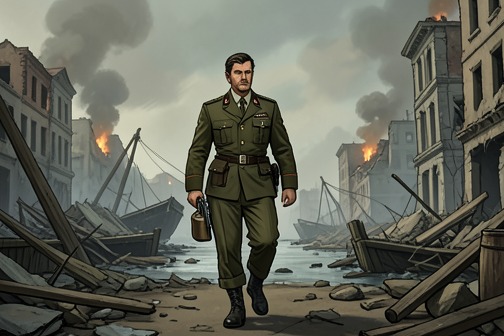
[Reinhold von Rumpel](entity:character-recall-character-reinhold-von-rumpel-0cc59346c3b4) returns to ruined [Saint-Malo](entity:location-recall-location-saint-malo-85b1c832a945) after the shelling has paused, making his way to [Number 4 rue Vauborel](entity:location-recall-location-number-4-rue-vaubore-c7c0adfb6034) in pursuit of the diamond. The city around him has been violently broken, but the house he seeks remains nearly unscathed. That contrast gives the journey its tension: amid public devastation, von Rumpel narrows his attention to one private object, and to the risks he is willing to take for it.
## The Pause After the Bombardment
The shelling has resumed sporadically after breakfast and, around six in the evening, has ceased. Its silence is not complete: somewhere a machine gun fires, its sound likened to a chain of beads passing through fingers. Von Rumpel carries a canteen, several ampules of morphine, and his field pistol as he crosses the seawall and causeway toward the smoldering bulk of Saint-Malo. In the harbor, the jetty has been shattered in several places, and a fishing boat drifts half submerged, stern up.
The city’s destruction is not presented as a single distant panorama. On the rue de Dinan, heaps of stone blocks, sacks, shutters, branches, iron grillework, and chimney pots have filled the street. Flower boxes are smashed; window frames are charred; glass lies broken. Some buildings still smoke. Von Rumpel presses a damp handkerchief over his mouth and nose, yet must stop repeatedly to catch his breath. The physical damage constrains his progress as much as it records what the bombardment has done.
## A City of Dislocated Remnants
The route through the old city passes objects stripped of their ordinary use and setting: a dead horse beginning to bloat, a chair upholstered in striped green velvet, and the torn canopy of a brasserie. Curtains swing from broken windows. Swallows search for lost nests, while a distant sound might be a person screaming or might be the wind. Shop signs have been blasted from their brackets, leaving their supports hanging. These details place fragments of ordinary urban life among the ruins without suggesting that the city has returned to normal.
A schnauzer follows von Rumpel, whining. No one calls from a window to warn him about mines, and in four blocks he sees only one person: a dazed woman standing outside what had been the movie-house, holding a dustpan. Through the open door, rows of seats have collapsed under slabs of ceiling, but the screen remains unstained by smoke. The woman tells him, “Show’s not till eight,” an incongruously matter-of-fact remark amid the wreckage. Her words preserve the trace of a public routine even as the ruined auditorium shows how thoroughly that routine has been interrupted.
## The Search at Number 4
On rue Vauborel, roof slates have slid into the street and detonated; scraps of burned paper drift overhead. Von Rumpel continues toward the house because he believes the diamond will still be there, imagining that he will pluck it from the ashes like a warm egg. His confidence is directed not toward the safety of the city or its residents but toward the survival of the object he wants.
The tall, slender house is nearly unscathed. Eleven windows face the street, most without glass; the frames are blue, and the granite is gray and tan. Four of the six flower boxes still hang from the façade. On the front door, the mandated list of occupants remains in place, naming M. [Etienne LeBlanc](entity:character-recall-character-etienne-leblanc-c0218becdb1a), aged sixty-three, and Mlle [Marie-Laure LeBlanc](entity:character-recall-character-marie-laure-leblanc-3b40e20f4b28), aged sixteen. In a street of blasted roofs and burned paper, the list is a surviving record of who is supposed to be inside. Its presence connects von Rumpel’s search for the diamond to the people whose address he has reached, without implying that he has yet found them.
## Risk and Suspense
No one stops von Rumpel, and no shells whistle in as he approaches. The temporary lull makes the route seem passable, even safe; the narration compares such shelter to the eye of a hurricane. But it is only a pause within continuing danger, not evidence that the danger has ended. The house’s relative survival likewise offers no guarantee about what waits inside.
The scene’s force comes from the mismatch between scale and attention. Saint-Malo is a landscape of shattered infrastructure and displaced domestic things, while von Rumpel measures the journey by the possibility of recovering a single diamond. He accepts the dangers he encounters both for the Reich and for himself. The ruined streets make that double allegiance stark: public catastrophe surrounds him, but his purpose remains personal and specific.
Event 29
Daniel LeBlanc’s arrest and imprisonment
[Daniel LeBlanc’s arrest and imprisonment](entity:event-recall-event-daniel-leblanc-s-arrest-6229eae11ddb) expose how, under occupation, the practical skills and protective work that had served a museum could be recast as evidence of conspiracy. Arrested in January 1941 after a local informant’s tip, Daniel is taken from a train, questioned over his locksmith’s tools and architectural measurements, and held through a process whose destination and legal basis remain unclear. His separation from [Marie-Laure LeBlanc](entity:character-recall-character-marie-laure-leblanc-3b40e20f4b28) becomes not a brief interruption but an absence that his family cannot resolve through official channels.
## Background: A Locksmith Carrying More Than Tools
Before his arrest, Daniel works to protect the collections of the [Muséum national d’Histoire naturelle](entity:location-recall-location-mus-um-national-d-hi-61442eea4d22) as war approaches. The museum’s preparations involve crates, padlocks, manifests, and couriers moving objects toward country estates. Among the threatened treasures is the [Sea of Flames](entity:object-recall-object-sea-of-flames-fa38edaed37f), whose whereabouts the museum tries to obscure by making three replicas. The real stone and its decoys are sent in different directions, with each carrier meant to behave as though he has the original. Daniel, the museum’s principal locksmith, carries a tool case containing one of the stones, but he tells himself it cannot be the real diamond; the director’s uncertainty leaves him unable to be sure.
That mixture of legitimate work and deliberate secrecy becomes dangerous. Daniel’s case holds small saws and files as well as keys, and his notebook contains architectural measurements. The items have ordinary professional explanations: he is a locksmith employed by the museum, and he has made a model for his daughter. But to interrogators looking for a plot, tools, drawings, and measurements can be rearranged into incriminating signs.
## Arrest and Interrogation
Daniel is seized outside Vitré, hours from [Paris](entity:location-recall-location-657453741ed3), when two plainclothes policemen bundle him off a train in front of staring passengers. He is questioned first in a van and then in an ice-cold mezzanine office. The French interrogators display his notebook and tool case, count seven skeleton keys on his ring, and ask what the keys open and how he uses the tiny files and saws. They also question the architectural measurements. Daniel answers that the drawings are a model for his daughter and that the keys are for the museum where he works, but the explanations do not secure his release.
After an hour, the interrogators are German. The next morning they question him again while a typist records the exchange. They appear to accuse him of plotting to destroy the Château de [Saint-Malo](entity:location-recall-location-saint-malo-85b1c832a945), though the reason for that suspicion is unclear. Their French is barely adequate, and they seem more intent on putting questions than hearing his answers. Daniel is denied paper, linens, and access to a telephone. The authorities have photographs of him, including evidence that he had been taking measurements in Saint-Malo.
He is frog-marched into a cell with an imposing old lock and hinges. Daniel still expects the museum director or someone from the museum to arrive and explain the situation, but no one comes to clarify it. He longs for cigarettes and lies on the floor imagining himself kissing Marie-Laure once on each eye while she sleeps. The domestic tenderness of that image stands against the impersonal machinery of questioning and confinement.
## Detention and the Uncertain Legal Process
Two days after the arrest, Daniel is driven to a holding pen a few miles outside Strasbourg. Around thirty other detainees sleep on straw over frozen mud. Most are French; others are Belgians, Flemings, and Walloons. They have been accused of crimes they discuss guardedly, wary of what an innocent question might reveal. At night they trade rumors, including the hope that their stay in [Germany](entity:location-recall-location-a3c24dd56e42) will last only a few months. The rumor offers a timeline, not a guarantee.
Later, two French policemen tell Daniel’s family that he has been convicted of theft and conspiracy. They say that all prisoners, whether political or otherwise, are forced to work, even if they have not been sentenced to labor. The museum has written to wardens and prison directors across Germany in an effort to find him, but the policemen do not know exactly which prison holds him. They believe it could be Breitenau and say they are certain no proper tribunal took place. The language of conviction thus coexists with the absence of a known prison and an acknowledged lack of regular judicial procedure.
## The Family Left Without Answers
The arrest’s consequences reach Marie-Laure, [Etienne LeBlanc](entity:character-recall-character-etienne-leblanc-c0218becdb1a), and [Madame Manec](entity:character-recall-character-madame-manec-624a3b197604) as incomplete reports rather than a clear account of Daniel’s fate. The family is told that he has been convicted and subjected to forced labor, yet cannot establish where he is being held. Much later, information traced through the arrest identifies a local Malouin, [Claude Levitte](entity:character-recall-character-claude-levitte-49f71026058c), as the informer whose tip led to Daniel’s detention. The report also connects the case to the drawings, skeleton keys, and Daniel’s measurements in Saint-Malo, tying his ordinary work to the suspicion that had engulfed him.
The unresolved destination matters as much as the arrest itself: the family has no confirmed prison to contact, while the museum’s search extends across a dispersed system of German custody. Daniel’s imprisonment makes bureaucratic uncertainty part of the punishment. His professional objects remain legible to him as tools of repair and protection; to the authorities, the same objects can be made to signify conspiracy, leaving his absence to govern the family’s hopes without providing a reliable answer.
Event 30
Madame Manec's Death
[Madame Manec](entity:character-recall-character-madame-manec-624a3b197604)’s death occurs in late June 1942, after a fever, and is confirmed only after [Marie-Laure LeBlanc](entity:character-recall-character-marie-laure-leblanc-3b40e20f4b28) discovers her missing from the kitchen and finds her gravely ill. The episode turns a household routine into a vigil: [Etienne LeBlanc](entity:character-recall-character-etienne-leblanc-c0218becdb1a) summons help, women gather, and a doctor comes and goes. Madame Manec is carried out of the house by horse cart; afterward, Etienne tells Marie-Laure that she is dead. The loss also makes his responsibility for his niece newly explicit.
## Discovery and Alarm
For the first time since her fever, Madame Manec is not in the kitchen when Marie-Laure wakes. The date is late June 1942. Marie-Laure considers that she might already have gone to the market, taps at her door, and waits. When there is no answer, she opens the rear door and calls into the alley. The morning outside is ordinary; the absence inside the house is not.
Marie-Laure lets herself into Madame Manec’s room and first hears her breathing. She finds Madame Manec in bed and realizes that her condition is serious. Her response is immediate: she hurries upstairs, calls for her uncle, and the household’s familiar spaces become, in her perception, threatened by disaster. The scene is told through Marie-Laure’s movement and alarm rather than through a medical explanation. The narrative supplies no diagnosis for Madame Manec’s illness, only the fever that preceded the discovery and the gravity of what Marie-Laure finds.
## The Household Becomes a Vigil
Etienne crouches beside Madame Manec, then goes to the telephone and speaks briefly. He returns to her bedside. Over the next hour, the kitchen fills with women, including [Madame Ruelle](entity:character-recall-character-madame-ruelle-978cb46c14c9), Madame Fontineau, and Madame Hébrard. Their arrival makes the domestic space crowded, and Marie-Laure paces the staircase while the doctor comes and goes. The focus remains on the household’s response: a call for help, neighbors assembling, and the wait for what can be done.
Madame Ruelle’s presence connects this gathering with the women’s wider everyday life under occupation. Elsewhere, she is shown taking part with Madame Guiboux in the nighttime rearrangement of road signs, then returning with her companion to the kitchen at [Number 4 rue Vauborel](entity:location-recall-location-number-4-rue-vaubore-c7c0adfb6034). That episode does not establish that the sign-changing activity causes or directly surrounds Madame Manec’s death. It does, however, place one of the women who arrives at the sickroom within a neighborhood network that carries on both domestic and resistant work.
The account marks the decisive transition by the cathedral bells: at exactly two o’clock, the doctor returns with an unnamed man. The man says little, lifts Madame Manec, carries her out to the street, and sets her on a horse cart. The description records the practical sequence without explaining the man’s role or giving a medical judgment. The horse cart moves away; the doctor strips the bed. The actions signal an ending before anyone states it aloud.
## Confirmation and Immediate Aftermath
Marie-Laure finds Etienne in a corner of the kitchen. He whispers that Madame Manec is dead. The news reaches her not through the doctor or the man who carried Madame Manec away, but through her uncle, in the house where the women had gathered. The understated confirmation closes the uncertainty of the vigil and changes the meaning of the earlier absence from the kitchen: Madame Manec will not return to her place in the household.
Etienne withdraws after the death. Four days later, he comes out of his room and descends the stairs. The women in the kitchen fall silent. He asks them to leave, explaining that he needed time to say goodbye and now has to look after himself and his niece. His words link private grief to a practical consequence: with Madame Manec gone, he must resume life in the house and take responsibility for Marie-Laure. The women’s presence, which had filled the kitchen during the illness, gives way to his request for privacy and his return to that responsibility.
## A Changed Household
The death’s consequences continue in a later encounter between Etienne and Marie-Laure. He comes down the seven ladder rungs, passes through the back of the wardrobe, and takes her hands before telling her that her father had asked him to keep her safe. The scene does not present this promise as a substitute for Madame Manec or as a new event in her illness. Instead, it shows the family obligation that remains after the loss: Etienne’s care for Marie-Laure is grounded in her father’s request, and Madame Manec’s death leaves that care to be carried forward by him.
The episode’s structure moves from absence, to a crowded vigil, to removal and whispered confirmation, and finally to the altered life of the household. Madame Manec’s death is not accompanied by an account of its medical cause or by a description of a funeral. Its significance is conveyed through what others do around it: Marie-Laure searches and calls for help, the women gather, Etienne withdraws and then returns, and his duty toward his niece becomes explicit. The kitchen that first registers Madame Manec’s absence becomes the place where her death is acknowledged and where the survivors begin to reckon with what follows.
Event 31
Werner's transfer to the Wehrmacht and deployment to the Eastern Front
[Werner's transfer to the Wehrmacht and deployment to the Eastern Front](entity:event-recall-event-bf21236e9018) turns the radio expertise he developed under [Dr. Hauptmann](entity:character-recall-character-dr-hauptmann-844538ac0542) into military service. Presented by the authorities as an opportunity to serve, the transfer is also a coercive reassignment: an age discrepancy becomes the means by which the state removes Werner from [Schulpforta](entity:location-recall-location-schulpforta-da30af1c87b7) and sends him toward a devastated front, with his own transceivers waiting there for him.
## From Schulpforta to the commandant's office
Werner's reassignment begins with a summons, not an offer. An eleven-year-old in full regalia brings him to the commandant's office, where Werner waits on a wooden bench in mounting panic. He fears the authorities may have uncovered something ruinous about his parentage. His anxiety recalls an earlier conviction: that the instruments of the Reich could see through walls and skin into the soul of every subject. The scene makes the state's power feel both bureaucratic and almost supernatural to the boy it is about to redirect.
After several hours, the commandant's assistant tells Werner that his age has been recorded incorrectly. The official version is that he is eighteen, not sixteen as he has claimed. Werner puzzles over the assertion; his small stature, he knows, makes the claim seem absurd beside boys younger than he is. Yet the discrepancy is not treated as a question for him to resolve. The assistant presents it as an established fact and immediately links it to a new destination.
Dr. Hauptmann, formerly Schulpforta's technical sciences professor, has drawn attention to the age discrepancy and arranged for Werner to be sent to a special technology division of the [Wehrmacht](entity:organization-recall-organization-wehrmacht-60c3b53ea39f). The commandant had urged disciplinary action, but Dr. Hauptmann argued that Werner would be eager to offer his abilities to the Reich. The contrast is consequential: what might have become punishment is recast as service, while Werner's technical skill supplies the rationale for removing him from the school. The assistant's assurance that service is an honor cannot disguise how little control Werner has over the decision.
## The uniform and the journey east
The transfer is made tangible in the uniform the assistant produces: slate gray, marked with an eagle on the breast and Litzen on the collar, followed by a green-black coal-scuttle helmet obviously too large for Werner. The school band practices a triumphal march outside as the assistant speaks. Through the window, Werner watches a Nordic-looking boy stagger under a tuba's weight; the rehearsed pageantry of the school continues alongside the administrative act that sends him away.
The deployment begins in August 1942. A dangerously underweight corporal arrives on foot to collect Werner. Werner is almost fifteen, yet he is now equipped as a soldier, in a field tunic, an oversized helmet, and a regulation Gott mit uns belt buckle. The corporal's first assessment is simply that Werner is little. He searches Werner's duffel and finds three carefully folded NPEA uniforms, none remotely his size. The change of institution is registered in the clothes he carries as much as in the uniform he wears: the school garments remain packed, but they no longer determine where he is going.
[Neumann Two](entity:character-recall-character-neumann-two-6e920493d7ee) takes Werner by train into [Russia](entity:location-recall-location-e36341713c23). At dusk he leads him through ruined houses, where beams and bricks lie in charred heaps and the standing walls are crosshatched with machine-gun fire. The route delivers Werner to a musclebound captain dining alone on a sofa made of a wooden frame and springs. A cylinder of boiled gray meat steams in a tin bowl on the captain's lap. His tired amusement at Werner's size makes the boy's mismatch with military expectations visible even as he is accepted into the unit. The destination is not an abstract technology post: its surroundings are already marked by destruction and combat.
## The radio truck and Werner's technical role
Neumann Two brings Werner to the open back of an unwashed Opel Blitz, a three-ton cross-country truck with a wooden shell. Dented gasoline cans are strapped to one side; bullet trails perforate the other. He gives Werner a kerosene lantern and says only that the gadgets are inside, then disappears without explanation. For Werner, the arrival sharpens the distance from the life he has left behind. He longs for [Children’s House](entity:location-recall-location-children-s-house-c9d94d8f6faa), [Frau Elena](entity:character-recall-character-frau-elena-30fd83219873)'s songs, warmth from the potbelly stove, and the sight of [Jutta](entity:character-recall-character-jutta-678e69fe3386) drawing her imagined city at the far end of the table.
Inside, the truck is a mobile radio station. Its equipment includes grimy listening decks, a folding RF antenna that can be raised or lowered from within, three headsets, a weapon rack, storage lockers, wax pencils, compasses, and maps. In battered cases sit two transceivers Werner designed with Dr. Hauptmann. Their presence offers him a brief sense of recognition amid the strange camp: the devices are familiar objects, and his own work has arrived with him across the distance from Schulpforta.
That recognition does not mean the equipment is ready to operate. Werner removes one transceiver from its case and unscrews the back plate. Its meter is cracked, several fuses are blown, and the transmitter plug is missing. He searches for tools, a socket key, and copper wire, beginning with the concrete work of examining the damage. The passage establishes his technical function through the instruments themselves: the Reich has sent him east because of the knowledge embodied in devices he helped design, and the field unit now depends on that knowledge. The evidence shows him inspecting the broken set, not yet completing its repair.
## Coercion, usefulness, and the limits of the transfer
The official language surrounding the move repeatedly tries to turn compulsion into privilege. Werner is told he has been fortunate and that service is an honor; Dr. Hauptmann's intervention is framed as a chance to contribute his abilities. But the sequence gives those assurances an uneasy counterweight: Werner's panic in the commandant's office, the uniform and helmet chosen for him, the corporal's brusque collection, and the absence of any explanation when he reaches the truck. The transfer takes place through decisions made by adults and institutions, not through a choice Werner is shown making.
At the same time, the deployment confirms the practical value of Werner's earlier work. The transceivers have been carried to the Eastern Front, and his place in the truck is among listening equipment, maps, and military supplies. His technical talent has not been left behind at school; it has been absorbed into the war's machinery. That shift gives the transfer its decisive significance: Werner crosses from a controlled educational institution into a military unit where his abilities are immediately material, while the boy himself remains conspicuously small beneath the uniform and helmet intended to make him a soldier.
Event 32
Sunflower-field partisan raid

The [Sunflower-field partisan raid](entity:event-recall-event-9cacca957285) is a turning point in [Werner Pfennig](entity:character-recall-character-werner-pfennig-48150c6dbd60)’s work as a radio operator: a signal that first appears as noise becomes a location, and that location leads to a cottage where two men are dead. Werner’s calculations help his unit find the partisan transmitter, but the scene’s consequences are not reducible to the successful measurement. The equipment is salvaged, the cottage is set alight, and Werner must connect this mission to the path that brought him there.
## The signal in the sunflowers
Late in the afternoon, after a day spent moving through a region where the unit has seen nothing but sunflowers, Werner searches the radio frequencies. He runs the needle across the bands and retunes the transceiver, listening through static that seems to fill the air. The unit is conducting a search for partisan radio activity; the transmission Werner detects gives that search a specific target.
The signal is a Russian-language voice. Werner raises the volume and presses the headphones to his ears, then adjusts the fine-tuning dial until the speech comes through clearly enough to identify as a transmission, though not to understand its message. The change is immediate: what had been a field of interference now contains a distinct signal. Werner’s attention sharpens, and [Volkheimer](entity:character-recall-character-volkheimer-afd0fa9f03aa) watches him as if he, too, senses the importance of what has just been found.
The cottage transmitter is later described as poor equipment, operating at high frequency and probably salvaged from a Russian tank. Its ground-plane antenna might carry a transmission thirty miles. Those limitations help define the task: Werner is not locating a powerful, obvious broadcast, but working from a modest signal whose source must be inferred through measurement.
## From voice to coordinates
Volkheimer silences the other members of the unit while Werner relays the channel to [Walter Bernd](entity:character-recall-character-walter-bernd-b914dd594689) at the second transceiver. Bernd finds the signal and measures its angle, then sends the result back. Werner uses the measurements, a slide rule, trigonometry, and a map to determine a direction. The work depends on coordination: one operator detects and tunes the signal, another takes a bearing, and Werner turns the data into a navigable answer.
The method makes the transmission useful without making its content intelligible. Werner can locate the voice by treating it as a signal to be measured. He settles on a direction, and the exchange with Volkheimer turns next to distance. In this part of the scene, the radio’s human message recedes behind the practical sequence of tuning, relaying, measuring, and calculating. The unit can act on the signal even though Werner does not understand what the speaker is saying.
That distinction gives the raid its central tension. The calculations are precise, but their purpose is military: locating a partisan transmitter. The narrative first follows Werner’s technical attention, then places the result beside the deaths at the cottage. Radio work that might seem abstract in the truck has a destination, and that destination contains people rather than merely coordinates.
## The cottage and its aftermath
After the unit reaches the cottage, Volkheimer returns with blood on his face. He orders the men to set the house on fire, not to waste diesel, and to salvage the equipment. The sequence does not make the full course of the attack explicit, but it does establish its aftermath. Inside, Werner sees two dead men, neither wearing a uniform. One lies on the floor and the other on a table. Their clothing and the domestic setting distinguish them from the armed unit, while the radio equipment identifies the cottage as the source Werner’s calculations have led them to.
The men do not leave empty-handed. [Neumann One](entity:character-recall-character-neumann-one-f626d8f680c5) takes down a potato-sack curtain and carries it outside to soak in diesel; [Neumann Two](entity:character-recall-character-neumann-two-6e920493d7ee) removes the suspenders from one of the dead men, gathers shallots from the lintel, and leaves. Werner carries the battered transmitter, its leads, and its inferior microphone back to the Opel. The order to burn the cottage and the practical salvage of its radio gear occur together: the building is to be destroyed, but the technology that made the broadcast possible is retained.
The source of the signal is therefore revealed not as an abstract point on a map but as a small, exposed operation. Its equipment is makeshift, its antenna has limited reach, and its operators are dead by the time Werner sees the cottage. The evidence does not specify every action that led to their deaths. It does show the unit’s decision to destroy the site, take the transmitter, and continue its mission.
## Werner’s reckoning
As the Opel leaves, Werner watches the light from the burning cottage rise above the field. The fire follows directly from Volkheimer’s order, while the salvaged equipment travels with the unit. Werner’s success in finding the station has thus produced two linked outcomes: the destruction of the broadcast site and the recovery of the device that carried its signal.
Werner’s thoughts also widen beyond the immediate operation. He connects the moment to his father’s death, to listening with [Jutta Pfennig](entity:character-recall-character-jutta-pfennig-b4ccdeedb30a) to a crystal radio, to the risks taken by Hans and Herribert, to his years at [Schulpforta](entity:location-recall-location-schulpforta-da30af1c87b7) building transceivers for [Dr. Hauptmann](entity:character-recall-character-dr-hauptmann-844538ac0542), and to what happened to [Frederick](entity:character-recall-character-frederick-88469ba33ed9). These recollections gather the personal and institutional history behind his technical skill. They do not undo his participation in the raid; instead, they show how a chain of earlier experiences has brought him to a moment in which scientific competence serves a military purpose.
The scene’s force comes from the contrast between precision and consequence. Werner can separate a voice from static, establish a bearing, and carry a transmitter away, yet those capabilities do not keep the people at the signal’s source safe. The sunflower field frames an operation of detection, calculation, killing, and destruction without changing its military logic. By the end, the radio has moved from a means of hearing a distant voice to captured equipment in a truck, while Werner is left watching the cottage burn.
Event 33
Shootings during the Vienna apartment raid
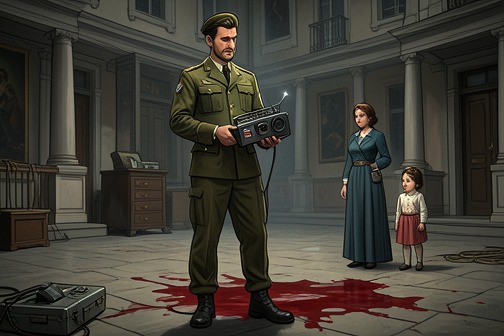
The [Shootings during the Vienna apartment raid](entity:event-recall-event-3b8857ae50dd) begin as a technical pursuit and end in the deaths of civilians. [Werner Pfennig](entity:character-recall-character-werner-pfennig-48150c6dbd60) follows a radio signal to an apartment that appears to be its source, but the expected equipment is absent. Inside, the raid yields no transmitter and no clear explanation; it instead exposes a woman and a child to lethal violence. For Werner, the child’s death does not remain contained within the operation: her image pursues him after the unit leaves, making the raid a turning point in how its violence registers.
## Signal and Target
The operation is set in motion by a broadcast Werner catches in the static. It is a simple message in Swiss German, identifying a time and a transmitter, and Werner does not understand all of it before the signal disappears. He crosses the square, tunes a second transceiver, and uses the renewed transmission to triangulate its position. The calculations seem to acquire a physical confirmation when he sees what looks like a wire antenna descending along an apartment house beside the square.
The apparent match between mathematical location and visible object gives the search an air of certainty. Werner has a signal, a direction, and something that resembles an antenna. The operation therefore proceeds on the assumption that the apartment contains a clandestine radio installation. The raid’s outcome dismantles that assumption piece by piece: there is no radio equipment in the flat, and the supposed antenna is only a painted rod attached to a pilaster, probably intended to support a clothesline. Werner has heard a transmission, but what he sees cannot account for it.
The contrast touches a broader wartime reality in which radio is both a means of connection and a target of control. [Frau Elena](entity:character-recall-character-frau-elena-30fd83219873)’s earlier letter to a professor wonders whether broadcasts are still reaching their listeners and imagines signals travelling through unlikely materials. In another occupied setting, [Marie-Laure LeBlanc](entity:character-recall-character-marie-laure-leblanc-3b40e20f4b28) has to ask her father repeatedly before he reads aloud an order requiring residents to surrender radio receivers. Those episodes are not causes of the [Vienna](entity:location-recall-location-8daae28d814e) raid, but they clarify the stakes surrounding listening and transmission: a signal can sustain contact across distance, while authorities and armed units treat radio activity as grounds for pursuit.
## The Apartment and the Gunfire
The unit enters the apartment. Werner hears no shots at first. Five minutes later, he is called up to a fifth-floor flat whose walls are covered in a dense floral pattern. He expects to inspect radio equipment, as he has on other searches, but finds none. The room contains domestic furnishings rather than a listening station: ornate lamps, an embroidered sofa, and patterned wallpaper. The ordinary interior sharpens the discrepancy between the military purpose of the raid and the evidence available inside the flat.
Werner goes into a bedroom, opens a window, and looks over an iron balcony. From there he can see that the supposed antenna is not an antenna at all. Before he can settle the contradiction, the raid turns violent elsewhere in the apartment. [Neumann Two](entity:character-recall-character-neumann-two-6e920493d7ee) cries out; a shot follows, then a woman’s scream and further shots. [Frank Volkheimer](entity:character-recall-character-frank-volkheimer-616967a218e7) and the others move toward the adjoining room. Neumann Two is standing by a closet with his rifle, while a woman lies on the floor and a child is inside the closet. The child is the girl Werner recognizes from the swings, and she is not yet seven years old.
The scene reveals the human cost concealed by the language of a search. The unit had entered looking for a transmitter; it has instead reached a home where the available evidence does not establish why Werner heard the broadcast. The woman and child are dead, and the child’s presence in the closet makes the raid’s consequences impossible to reduce to a mistaken technical reading. The source does not provide an explanation for the signal or resolve precisely how the false lead arose. That uncertainty remains beside the certainty of the deaths.
## Werner’s Response and the Aftermath
Werner waits for the child to blink. His attention fixes on the possibility of a movement that will not come, even as the others begin to close the closet and cover the woman. He watches the unit continue its routine: Frank Volkheimer moves on, and [Walter Bernd](entity:character-recall-character-walter-bernd-b914dd594689) covers the woman. The sequence places Werner’s stunned attention beside the group’s practical responses, without suggesting that those responses undo what has happened.
His thoughts widen from Neumann Two to the whole unit, the army, and the surrounding world. He sees a pattern in which people obey orders, become afraid, and act with their own safety in mind. That judgment is not presented as a formal refusal or a change in the unit’s conduct; the operation continues. But the raid makes the cost of such conduct concrete for Werner. The scene’s focus on his waiting and on the small, domestic details of the apartment interrupts the procedural rhythm of tracking and entering a target.
Afterward, Werner sees the child again in the landscape beyond the truck’s cracked rear window. She appears to float above the road, moving past trees and road signs and around bends. Werner curls under the bench, wrapped in a blanket, and refuses tea and tinned meat while [Neumann One](entity:character-recall-character-neumann-one-f626d8f680c5) drives west. The account presents the child’s recurring image as Werner’s experience, not as an independently verified apparition. Its persistence carries the raid beyond the apartment: the mission is over, but its consequence remains with him.
## Significance
The raid turns a technical failure of identification into a moral and psychological rupture. Werner can locate the apparent source of a signal with instruments and calculations, yet neither the apartment nor the painted rod gives him a satisfactory explanation for what he heard. Military procedure offers a path to the building but cannot make the deaths intelligible or harmless. The gap between apparent certainty and actual knowledge is central to the event’s force.
The child’s return in Werner’s perception also changes the scale of the story. She is no longer only an unseen civilian caught in a raid; she becomes the image that accompanies the soldiers’ departure and interrupts Werner’s attempt to retreat beneath a blanket. The event thus links the unit’s obedience to consequences that continue after the immediate action has ended. It is a decisive contrast between the abstraction of a transmission to be tracked and the singular lives found at the supposed source.
Event 34
The Siege of Saint-Malo
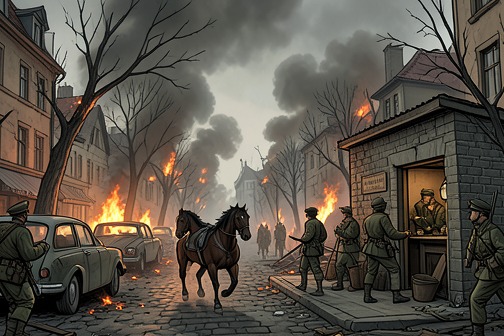
[The Siege of Saint-Malo](entity:event-recall-event-af04d33a6010) turns the city into a place where military violence and occupation rule press upon ordinary life at once. Its clearest dated scene falls on 9 August 1944: on the third afternoon of the siege, shelling pauses amid burning trees, cars, and houses. The lull does not bring safety. German soldiers drink in blockhouses, a priest tends the walls of a cellar, and two frightened horses break out of a garage and run through the smoldering streets. Around this scene, the narrative traces a wider system of restrictions, searches, and resistance that gives the siege its human scale.
## Occupation and the Conditions of the Siege
Before the shelling scene, occupation authorities impose a direct restriction on communication. [Marie-Laure LeBlanc](entity:character-recall-character-marie-laure-leblanc-3b40e20f4b28) must press her father, [Daniel LeBlanc](entity:character-recall-character-daniel-leblanc-64966d3a1873), three times before he reads aloud the notice ordering residents to surrender every radio receiver in their possession. Sets must be delivered to 27 rue de Chartres by noon the following day; failure to comply is punishable by arrest as a saboteur. The notice makes listening and possession matters of official control, and places the threat of arrest behind an apparently administrative demand.
The wider account shows that such control is enforced through uncertain and intimidating procedures. Daniel LeBlanc is seized outside Vitré while traveling toward [Paris](entity:location-recall-location-657453741ed3). Plainclothes policemen remove him from a train in front of its passengers and question him first in a van, then in an office. French interrogators give way to German ones, who examine his notebook, tool case, seven skeleton keys, miniature tools, and architectural measurements. On the following morning, he is questioned again; the Germans appear to suspect a plan against the Château de [Saint-Malo](entity:location-recall-location-saint-malo-85b1c832a945), but the basis for their suspicion remains unclear. They withhold paper, linens, and telephone access. The episode does not establish this arrest as a result of the siege; it places it within the coercive machinery surrounding the city.
## The Shelling and Its Lull
The dated scene is striking for the contrast between a temporary pause and the damage already in progress. On 9 August, the shelling lulls as if the artillerymen had abruptly fallen asleep at their guns. Yet trees, cars, and houses are burning, and the movement of people and animals through the streets remains governed by fear. German soldiers drink wine in blockhouses while, in a college cellar, a priest scatters holy water on the walls. The detail sets military occupation, religious practice, and civilian refuge side by side without suggesting that any offers protection from the bombardment.
From a cellar, [Werner Pfennig](entity:character-recall-character-werner-pfennig-48150c6dbd60) hears shells pass overhead and imagines the American artillerymen responsible for them. His thoughts assemble the attack as a sequence of tasks: observers with scopes, firing officers calculating conditions, and radio operators relaying targets. The imagined coordination contrasts with the confusion and immediate danger experienced below. The shells are not merely distant sounds in Werner’s account; they prompt him to picture the organized system producing them, even as he remains trapped in the cellar with the consequences.
Elsewhere, the search for an illicit broadcast continues through the occupied area. Werner and the soldiers accompanying him travel through Saint-Malo, Dinard, Saint-Servan, and Saint-Vincent in a battered Opel whose sides scrape narrow streets. They pass damaged crêperies, shuttered bakeries, empty bistros, conscripted Russian laborers, and women carrying water from wells. Werner can receive BBC broadcasts and propaganda stations, and sometimes picks up stray Morse code, but he finds none of the local announcements or music the colonel’s aides described. The search records how military surveillance persists amid damaged streets and unsettled civilian life; it does not identify the elusive signal as a cause of the siege.
## Civilian Restrictions and Acts of Resistance
The occupation’s orders extend beyond radio possession. Residents are told that every man aged sixteen to sixty must assemble at the château tower and then be marched to [Fort National](entity:location-recall-location-fort-national-f36fa39b06df) at low tide. The instruction presents mass detention as a scheduled movement of people through designated places. Its brief, matter-of-fact wording contrasts with the gravity of removing a broad group of men from the city, and shows how military authority turns civilian life into an object of organized control.
Resistance appears in a smaller, practical form in the actions of [Madame Ruelle](entity:character-recall-character-madame-ruelle-978cb46c14c9), the baker’s wife. At dusk she drives along the Route de Carentan with Madame Guiboux, carrying a stepladder and ratchet set, and rearranges road signs. They return to [Number 4 rue Vauborel](entity:location-recall-location-number-4-rue-vaubore-c7c0adfb6034) laughing and drunk. The account gives no claim that this act changes the course of the siege; its significance lies in the contrast between the authorities’ control of roads and the women’s quiet alteration of the signs that guide movement through them.
## Wider Human Consequences and Narrative Significance
The siege sits within a longer history of separation and strain. On the twentieth morning without news of her father, Marie-Laure stays in bed, stops asking to go to the station or prefecture, and withdraws from ordinary routines. [Madame Manec](entity:character-recall-character-madame-manec-624a3b197604) has tried to help her search and petition the occupation authorities, but the absence of news continues to weigh on the girl. This earlier stretch of uncertainty is not identified as a consequence of the shelling; it shows the vulnerability that the wider occupation has already created before the siege’s destruction becomes the narrative’s immediate landscape.
Letters from [Germany](entity:location-recall-location-a3c24dd56e42) offer another, distinct view of wartime pressure. [Jutta Pfennig](entity:character-recall-character-jutta-pfennig-b4ccdeedb30a) writes to Werner about cold, fuel scarcity, shortages of fabric, and laundry work repairing clothes for reuse. In a later letter to his sister, Werner describes hardship but much of the text is censored. These separated voices do not supply a direct account of the siege; they widen the novel’s frame beyond Saint-Malo, showing how wartime control and deprivation reach characters far from the bombardment. Much later, [Jutta](entity:character-recall-character-jutta-678e69fe3386) hesitates to accept a letter brought by [Frank Volkheimer](entity:character-recall-character-frank-volkheimer-616967a218e7) and has kept memories of Werner and the war largely sealed away. Against that long aftermath, the siege’s brief lull is not a resolution: it is a suspended moment in a conflict whose effects continue through absence, memory, and silence.
Event 35
Hotel of Bees collapse and Werner trapped
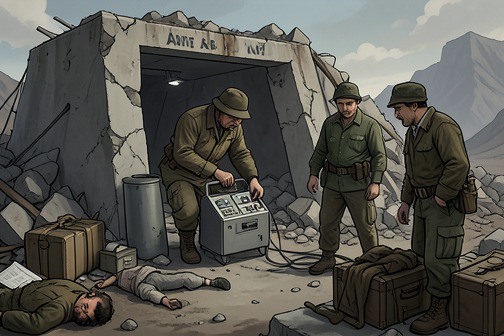
The collapse of the [Hotel of Bees anti-aircraft strongpoint](entity:location-recall-location-4aefcd1a6231) turns [Werner Pfennig](entity:character-recall-character-werner-pfennig-48150c6dbd60)’s technical skill into a means of enduring confinement: beneath the rubble, he repairs a transceiver while [Frank Volkheimer](entity:character-recall-character-frank-volkheimer-616967a218e7) and [Walter Bernd](entity:character-recall-character-walter-bernd-b914dd594689) wait with him. The days bring dwindling supplies and Bernd’s death, but the repaired radio eventually carries a girl’s voice through the static, opening a connection beyond the wreckage.
## Setting and Circumstances
In April 1944, Werner’s unit arrives in [Vienna](entity:location-recall-location-8daae28d814e), a city marked by empty windows and disruption. Werner imagines [Dr. Hauptmann](entity:character-recall-character-dr-hauptmann-844538ac0542)’s earlier life there as one of scientific conversation in lively cafés, a sharp contrast with the damaged city he encounters. The commander is unavailable, and Frank Volkheimer is told of reports of resistance broadcasts in Leopoldstadt. The men drive around the district in cold fog. This episode places Werner within a military search for illicit transmissions before the later crisis at the Hotel of Bees anti-aircraft strongpoint; it does not establish that the Vienna assignment caused the collapse or the entrapment.
When the hotel lies in ruins, Werner, Frank Volkheimer, and Walter Bernd are trapped beneath it. Werner’s later attempts to receive a signal make the obstacle plain: the rubble may be too deep, the building may be blocking transmission, or the radio may still have a fault. The confinement is measured in immediate practical limits. The men have a field light and a small supply of water, and the prospect of keeping the light working becomes part of Werner’s effort to keep the radio usable. The narrative does not offer a clear view of the destruction from outside; it holds close to what the men can do under the debris.
## The Men Beneath the Rubble
Bernd’s condition shifts unexpectedly. After murmuring incoherently for an hour, he falls silent, then sits up and asks for light. The men give him the last water in their first canteen. His brief return to speech turns toward a memory from leave: he had visited his elderly father, who repeatedly told him that he could leave if he wished, though he wanted him to stay. Bernd did leave. He remembered going down into the street with nowhere to go and no friends to meet, after travelling all day to see his father.
The memory ends without reconciliation. In the darkness, Frank Volkheimer switches off the light, and Werner senses how much the story holds back. Bernd becomes quiet again. Frank Volkheimer settles him on the floor and covers him with Werner’s blanket; not long afterward, Bernd dies. His recollection gives the death an intimate measure: alongside the immediate deprivation under the hotel, it discloses a regret that cannot now be answered. The account stays with what the men say and do, rather than enlarging the moment with an explanation of Bernd’s unspoken feelings.
## Werner’s Work on the Radio
Werner turns to the damaged equipment. He gathers a small hammer, jars of screws, and electrical cord from a broken desk lamp. In a warped drawer he finds an eleven-volt zinc-carbon battery, marked with a black cat and an American slogan promising nine lives. The battery still holds a charge. Werner thinks of it as a reserve for when the field light’s battery fails, linking the work on the radio to the practical problem of preserving light in the confined space.
He rights a capsized table and places the crushed transceiver on it. At first he is unsure the equipment can be made useful. Working gives him a problem to solve while hunger, thirst, his impaired hearing, Bernd’s death, and thoughts of people elsewhere crowd his attention. He tries to keep his mind on the components: antenna, tuner, capacitor. The effort is not presented as a guaranteed escape; it is a task that can briefly order his attention when the circumstances offer little control.
Later, Werner threads the antenna through the broken ceiling and touches it to a twisted pipe. He carries it around the cellar, trying different positions, then presses the headset to his good ear and moves the tuning needle across the coil. The result is only static. He considers several possibilities: the men may be buried too deep, the hotel’s rubble may obstruct the signal, or some part of the radio may still be broken. These are possibilities, not confirmed explanations. The uncertainty keeps the radio’s failure from becoming a settled verdict: Werner cannot know from the cellar whether the silence belongs to the equipment, the building, or the distance between them.
## A Voice Through the Static
On the morning of Werner’s fourth day trapped beneath what remains of the hotel, he is listening to the repaired transceiver and adjusting its tuning when a girl’s voice reaches his good ear. He initially suspects hunger, fever, or his own mind imposing a pattern on static. The voice continues in quiet, precisely enunciated French, reading from [Twenty Thousand Leagues Under the Sea](entity:object-recall-object-efa1e7f04e66). Its arrival answers none of Werner’s questions about the rubble or the fate of the outside world, but it changes the meaning of his work: the radio is not only an object to repair or a distraction from confinement; it has brought another person’s words into it.
The sequence holds two forms of isolation together. Bernd’s memory concerns a departure from a father whose invitation he did not accept; beneath the hotel, the living men cannot leave at all. Werner’s patient efforts with salvaged parts do not undo either loss, but the voice that reaches him establishes a fragile link across the distance. The transmission’s significance lies in that limited achievement: after days of confinement and failed reception, the repaired set carries a human voice where Werner had heard only static.
Event 36
Marie-Laure sends a clandestine broadcast
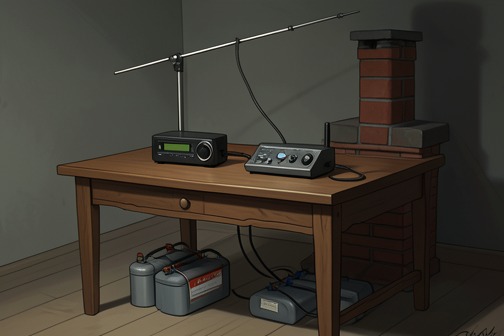
[Marie-Laure sends a clandestine broadcast](entity:event-recall-event-8aea5b51c22b) from a transmitter in the LeBlanc house during the siege of [Saint-Malo](entity:location-recall-location-saint-malo-85b1c832a945). Using equipment installed by her uncle, [Etienne LeBlanc](entity:character-recall-character-etienne-leblanc-c0218becdb1a), she reads aloud into a microphone, unaware that [Werner Pfennig](entity:character-recall-character-werner-pfennig-48150c6dbd60), trapped beneath the [Hotel of Bees](entity:location-recall-location-hotel-of-bees-869876b756f5), is listening. The transmission turns a fragile radio signal into an unexpected link between two people separated by rubble, darkness, and immediate danger.
## The Transmitter and Its Setting
The transmitter waits on a table beside the chimney, with two marine batteries beneath it. Marie-Laure knows that someone might have a radio: perhaps the fire brigade, the resistance, American forces, German soldiers, or Etienne himself. These are possibilities rather than confirmed listeners. She imagines her uncle turning the dials of another radio and considers that he may need a sign of hope, but she cannot know who will receive her signal.
To bring the apparatus into use, she feels along the chimney stones until she finds the lever Etienne installed. She presses it, raising the antenna above the roof. After pausing to listen for any response from downstairs, she reaches under the table and operates the switches. She cannot remember which controls the microphone and which the transmitter. The vacuum tubes begin to thrum, and she proceeds without certainty that the equipment is working as intended or that the signal will reach anyone.
The material construction of the scene matters: a lever, an antenna, batteries, switches, and tubes make communication possible, but none guarantees a reply. The transmitter had been built years earlier to speak to a ghost; now Marie-Laure puts it to practical use in a city filled with smoke and fires. Her cautious pauses and uncertain handling show that the act depends not on mastery of every control, but on attempting to send a message despite the risk and the unknown audience.
## Werner's Receiver
Werner's presence at the other end of the signal has its own history. As a child, he found a crude radio in refuse behind a storage shed with his sister, [Jutta Pfennig](entity:character-recall-character-jutta-pfennig-b4ccdeedb30a). The discovery began a relationship with radio as a device assembled from parts and as a means of reaching voices beyond immediate surroundings. Later, he designed transceivers with [Dr. Hauptmann](entity:character-recall-character-dr-hauptmann-844538ac0542). In wartime, those instruments become part of military equipment: a radio truck carries listening decks, an antenna, headsets, maps, and two transceivers he had designed.
At the moment of Marie-Laure's broadcast, however, Werner is not in a functioning truck or a secure station. He is listening on the fourth day after becoming trapped beneath what remains of the Hotel of Bees. He has repaired a transceiver and moves its tuning knob back and forth, searching through the signal. The contrast is sharp: the equipment that once belonged to organized military operations is now being used in a damaged, improvised setting, where a single voice must emerge from interference to be understood.
## The Reading and the Warning
Marie-Laure opens a novel in her lap, finds the lines by touch, and brings the microphone to her lips. She reads from [Twenty Thousand Leagues Under the Sea](entity:object-recall-object-efa1e7f04e66). The passage describes the Nautilus colliding with something and the dangers of being caught between walls of ice. Werner hears her in French. At first he thinks hunger, fever, or the strain of isolation may be making him imagine a voice, but he presses the headphones against his good ear and keeps listening.
The choice of reading supplies the broadcast with a sequence of words rather than a direct announcement of who she is or where she is. Werner follows the narrated danger beneath the ice while the static threatens to swallow the voice. The novel does not tell him plainly that the speaker is near; for a time, its imagined world offers a fragile structure for listening, just as his tuning and repair work have made reception possible.
Then Marie-Laure stops reading. When she speaks again, the tone of the transmission changes: she urgently reports that someone is there, directly below her. The warning reveals that danger has reached the space beneath her, but Werner cannot establish the person's identity from what he hears. The signal cuts out. He searches other bands and finds nothing, then removes the headset and tries to alert [Frank Volkheimer](entity:character-recall-character-frank-volkheimer-616967a218e7), who does not respond.
## Connection Without Rescue
The broadcast creates contact, but not a conversation. Marie-Laure cannot hear Werner's response, and Werner receives no further transmission after her warning. Her earlier hope that someone might hear her becomes true in a limited, consequential way: Werner does hear her, but the signal does not provide him with a clear location or a means to answer. The connection is real and temporary, not a rescue plan.
The scene also brings together two different uses of radio. Werner's childhood discovery and technical work have taught him how to build, repair, tune, and listen; Marie-Laure's transmission depends on the apparatus Etienne installed and her decision to speak into it. Neither side can control the full path of the signal. Its reach is demonstrated by Werner's reception, while its limits are made plain by the static, the abrupt interruption, and the silence that follows.
As a turning point in the siege narrative, the broadcast connects two characters who are physically close yet cut off from one another. Werner learns that a living person is speaking nearby, and Marie-Laure's warning reaches him at the instant her situation becomes more dangerous. The episode ends not with an exchange or a confirmed rescue, but with Werner holding onto the brief evidence that the voice was real and trying, unsuccessfully, to make contact through the darkness.
Event 37
Werner conceals the source of the Saint-Malo broadcast
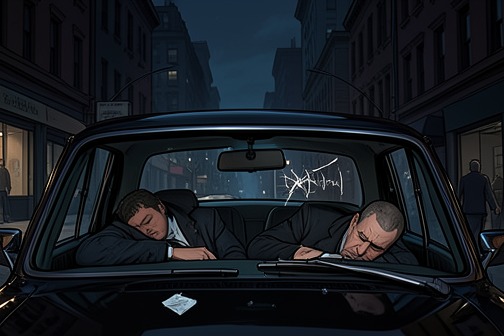
[Werner conceals the source of the Saint-Malo broadcast](entity:event-recall-event-fe81d8c443e8) at the moment his military search brings him back into contact with the radio world of his childhood. Hearing the French transmission and the familiar piano music, he recognizes the broadcaster but tells [Frank Volkheimer](entity:character-recall-character-frank-volkheimer-616967a218e7) that he has heard nothing. The lie protects the secret for a time; the scene makes its cost visible in Werner’s recollection of earlier choices and in his joy at hearing the signal again.
## The patrol and the signal
The scene unfolds at night in the old city of [Saint-Malo](entity:location-recall-location-saint-malo-85b1c832a945), where Werner and [Volkheimer](entity:character-recall-character-volkheimer-afd0fa9f03aa)’s crew are searching for a transmitter. They work a section of the city tucked against the southern ramparts. Rain falls so lightly that it seems almost indistinguishable from fog. Werner sits in the back of an Opel while Volkheimer dozes on the bench behind him; [Walter Bernd](entity:character-recall-character-walter-bernd-b914dd594689) is supposed to monitor a transceiver from the parapet, but has not keyed his handset for hours. In the vehicle, the amber filament of Werner’s signal meter is the only light.
At first the spectrum holds only static. Then a burst parts it, and fragments of a Breton-accented voice come through, including the announcement of a Thursday broadcast at 2300. Werner recognizes the voice: its sound and the quality of the transmission match the French broadcaster he used to hear. The recognition is immediate, and the familiar music that follows confirms the force of the return. A piano plays three notes and then two; as the melody develops, Werner remembers listening with six-year-old [Jutta](entity:character-recall-character-jutta-678e69fe3386), with [Frau Elena](entity:character-recall-character-frau-elena-30fd83219873) kneading bread behind them and a crystal radio in his lap. The signal does more than identify a transmitter. For a moment it restores an earlier life, before he felt its bonds had been severed.
## The choice to lie
Werner waits for Bernd to report hearing the broadcast, but nobody responds. Volkheimer remains asleep, and the men visible through the partition do not move. The music ends; static returns. Werner’s private recognition has not become shared knowledge. He could disclose what he heard, but instead removes his headset, slips past Volkheimer, and opens the back door.
Volkheimer opens one eye and asks whether there is nothing. Werner answers that there is nothing. The answer is a deliberate concealment, not a failure to identify the signal: the narration has already established that he recognized both the broadcaster and the music. Later, the account states the contradiction plainly—Werner heard the voice the crew was seeking, and lied. He understands that his concealment may put men in danger, yet remembering the broadcast makes him tremble with joy. The scene holds those responses together rather than resolving one into the other: the transmission gives him an intimate connection to the past, while his silence implicates him in the military operation against it.
## Memory, guilt, and repetition
The broadcast also releases a reckoning with Werner’s previous conduct. In the rain beside the vehicle, he remembers [Frederick](entity:character-recall-character-frederick-88469ba33ed9)’s insistence that they did not own their lives or have choices. Werner sees the claim as an excuse he himself had used: he watched Frederick tip the pail of water at his feet and fail to intervene, then watched the consequences fall. He also remembers Volkheimer moving from house to house in a recurring nightmare. These memories place the lie in a longer pattern. Werner’s present silence is a choice made under military pressure, but the scene refuses to let that pressure erase his responsibility for choosing it.
After answering Volkheimer, Werner looks toward the stone houses: their windows are dark, no lamps or antennas are visible, and rain that falls almost soundlessly seems to roar to him. This contrast between an invisible signal and a seemingly silent city gives the concealment a physical setting. The broadcast has reached him, but its source and the people behind it remain hidden from the patrol. His short denial closes the exchange without ending his awareness of what he has heard.
## The antenna and the house
The search continues amid the wider war. In Normandy, beaches consume soldiers and bombers pulverize towns, while Saint-Malo’s dune grass grows and German sailors drill in the harbor. At the [Hotel of Bees anti-aircraft strongpoint](entity:location-recall-location-4aefcd1a6231), an Austrian anti-aircraft lieutenant installs eight men; the Austrians use a crane to lower an 88-millimeter cannon onto a bastion on the ramparts. Against this military activity, the task of locating a small radio antenna seems modest, but the transmitter remains the object of the patrol’s search.
Werner suspects the broadcaster may be using one of the city’s many chimneys. He walks the rue des Forgeurs and rue de Dinan, studying shutters and gutter lines for cables fixed to brickwork. At 2300, close to where the Opel is parked, he sees an antenna rise beside a chimney. It is about twelve meters high and unfolds into a simple T, nearly invisible from street level. The house is tall and narrow, with eleven windows, orange lichen, and moss at its foundation: [Number 4 rue Vauborel](entity:location-recall-location-number-4-rue-vaubore-c7c0adfb6034). Werner returns quickly to the hotel, without disclosing what the discovery means.
The location gives the earlier lie a sharper consequence: Werner has not merely kept a moving signal from his crew; he has found the fixed place from which the broadcasts come. The episode therefore turns recognition into a test of allegiance. The music momentarily reconnects him with Jutta and Frau Elena, while the search and his false answer bind him to a force that would silence the transmission. Its tension lies in that unresolved interval between hearing, knowing, and deciding what to reveal.
Event 38
Marie-Laure’s confrontation with von Rumpel at the grotto
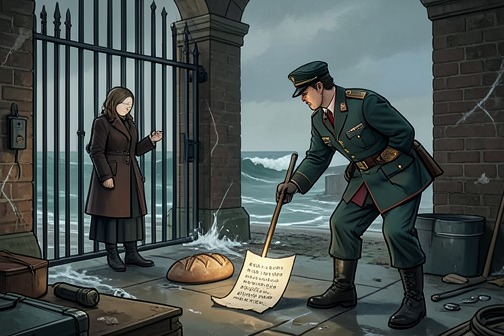
Marie-Laure’s confrontation with [Reinhold von Rumpel](entity:character-recall-character-reinhold-von-rumpel-0cc59346c3b4) at the grotto brings the war’s distant pressures to a confined, physical encounter: a blind girl stands behind a locked gate while a German officer searches for what her imprisoned father may have hidden. With the tide rising and a coded message concealed in bread on her back, she protects the secret by swallowing it and refuses to give von Rumpel the answer he wants.
## Background and Stakes
The encounter grows out of the wartime dispersal and concealment of museum collections. As the threat to [Paris](entity:location-recall-location-657453741ed3) intensifies, [Daniel LeBlanc](entity:character-recall-character-daniel-leblanc-64966d3a1873) works late to secure objects and transport records. The director arranges for three decoys as well as the real diamond to be moved in different directions, without telling the couriers which stone they carry. Daniel leaves with one of the stones in his tool case, but does not know whether it is genuine. The uncertain identity of the object gives its pursuit a practical danger: neither the courier nor the men searching for the stone can rely on appearances alone.
Reinhold von Rumpel’s search is fed by that uncertainty. During his examination of the museum, he sees emptied display cases and learns how the mineral collection has been catalogued over generations. He is led through a locked door and a second gate, down to a storeroom where a combination safe contains another box. Later, a museum doctor tells him that the three replicas were made from a casting and that he never saw the real diamond. The search therefore has no simple chain of identification to follow; the stone’s whereabouts remain unknown, while Daniel’s work and family make him a possible source of answers.
The authorities’ treatment of Daniel makes that possibility personal for Marie-Laure. When the order to surrender radio receivers is read aloud, her anxiety turns immediately to her father, whom [Madame Manec](entity:character-recall-character-madame-manec-624a3b197604) says is in his grandfather’s old room. Later, plainclothes policemen seize Daniel outside Vitré, take his notebook and tool case, and count seven skeleton keys on his ring. German interrogators question him about his tools and architectural measurements, then deny him paper, linens, and telephone access. By the time Marie-Laure meets the German at the grotto, von Rumpel can use the fact of Daniel’s imprisonment as leverage: he tells her that her father is hundreds of kilometers away.
## The Encounter at the Gate
Marie-Laure has been exploring the tidal pool, touching barnacles, an anemone, and a Nassarius snail. As she climbs out, steps through the gate, and prepares to lock it, a male voice greets her. The speaker’s body blocks the alley. Although he speaks proper French, she recognizes him as German; the narrow passage, sheer walls, and echoes make his closeness difficult to judge. Her wet shoes squelch, her dress drips, and one fist grips a spar of the open gate.
The questions quickly turn from what she has collected to what lies behind her and what she knows about her father. The officer mocks her expectation that Daniel will arrive soon, invoking his imprisonment to unsettle her. He reaches toward her; she hears and smells his approach and feels something graze her wrist as she jerks away. She clangs the gate shut in his face. When he slips, she turns the key in the lock and retreats into the low space of the kennel, leaving him outside it. The gate is a small defense, but it changes the immediate balance: he can question and threaten her, yet cannot simply reach her in that moment.
## The Coded Note and Her Refusal
Von Rumpel remains at the gate and uses the newspaper against its bars while questioning Daniel’s movements and measurements. Marie-Laure recalls what her father taught her about the mechanism: an iron rod runs through three rusted loops, and the old mortise lock has a rusty cam. Her attention to the lock is practical rather than abstract; she is considering what it can withstand and what options she has while trapped inside the grotto.
The danger is not only to her. [Madame Ruelle](entity:character-recall-character-madame-ruelle-978cb46c14c9)’s loaf presses against her back, with a coiled slip of paper hidden inside. The numbers on it could spell a death sentence for Marie-Laure, her great-uncle, and Madame Ruelle. Crouched against the wall as water surges to her knees, Marie-Laure opens her knapsack, breaks the loaf, finds the paper, and puts it in her mouth. It dissolves between her teeth, and she swallows the pulped remains. The tide, the locked gate, and the fragile paper make the choice immediate: she destroys the message rather than allow the officer to find it.
Von Rumpel tries to cast himself as a weary functionary, complaining about the other works he has been assigned to search for and promising to leave if she answers. Marie-Laure responds not with information but with anger at her father’s absence and the losses surrounding her. She says that Daniel left her nothing, naming the model of the town, his broken promise, the dead Madame, and her frightened great-uncle. Her words do not disclose where the stone is or what Daniel entrusted to her. Instead, they turn her pain into a denial convincing enough to make von Rumpel fall quiet for a moment. She then insists that he keep his word and go away.
## Consequences and Significance
The scene places [Marie-Laure’s blindness](entity:state-recall-state-marie-laure-s-blindness-2c663f206256) within a contest over access and knowledge, not as a reason she is helpless but as part of how she navigates danger. She uses touch to reconstruct the lock, sound to track the man outside, and the spatial barrier of the gate to buy herself time. Against von Rumpel’s questions, her knowledge of the grotto and the hidden loaf gives her a means of action, though it cannot make the encounter safe.
The confrontation also gathers several strands of occupation into one narrow passage: Daniel’s detention, the search for the museum’s missing treasure, restricted movement, and the clandestine circulation of coded information. Von Rumpel’s appeal to Daniel’s whereabouts shows how imprisonment extends coercion to family members; Marie-Laure’s act of swallowing the note prevents the coercion from producing the information he seeks. She is left with no certainty about her father and no restoration of what she has lost. What she achieves is more limited and more exact: the message is no longer available to be discovered, and she does not tell the pursuer what he came to learn.
Event 39
Etienne rescues Marie-Laure trapped in the grotto
[Etienne rescues Marie-Laure trapped in the grotto](entity:event-recall-event-24270d970c4b) when her unexplained absence draws him out of a house he has scarcely left in nearly twenty-four years. The rescue is both a physical recovery and a reversal of the roles between them: the uncle who has relied on Marie-Laure’s resourcefulness must cross the town himself, while she waits in the place where she once played as a boy. The scene measures his fear in minutes and heartbeats, then answers it with a remembered route and the sound of Marie-Laure telling him he came.
## The Delay and the Decision
Etienne knows Marie-Laure’s usual rhythm. The walk to the bakery takes four minutes each way; the extra time she spends out of sight has often been thirteen or fourteen minutes, and he has reassured himself that she goes to the sea, returning with wet shoes and traces of seaweed or other coastal plants on her sleeves. But the intervals now exceed his experience of her absences. Thirty minutes should be longer than her usual journey; at thirty-two, he looks from his fifth-floor windows and sees no one. His fears accumulate without confirmation: she may be lost, injured, drowned, abducted, or exposed through the bread, the numbers, or the transmitter.
At thirty-four minutes, Etienne puts on shoes and a hat that belonged to his father and stands in the foyer to summon his resolve. His last attempt to go out had been almost twenty-four years earlier. The attacks, he recalls, could make light excruciating, his own footsteps thunder, and the cobblestones seem to hold blinking eyes; afterward, he would retreat to the darkest corner of his bed and try to shut out his pounding pulse. Now his heart seems distant, his vision threatens to fill with vermilion spots, and he nevertheless opens the gate. His decision comes not because the danger has become manageable, but because Marie-Laure’s absence has made remaining inside unbearable.
## Finding the Way to the Grotto
At the bakery, Etienne reaches [Madame Ruelle](entity:character-recall-character-madame-ruelle-978cb46c14c9) in an icy sweat. When she learns that Marie-Laure sometimes goes to the sea, she points out that the beaches and ramparts are closed. Etienne insists that the sea is where she has gone. Their exchange brings the personal emergency into the dangerous circumstances around them: Madame Ruelle warns that if the Germans find the bread, everyone involved could die. Etienne, watching the minutes pass, has to act without knowing whether Marie-Laure is merely late or whether their clandestine activity has exposed her.
A memory supplies the route that panic cannot. Etienne sees the rusted gate and ruined kennel beneath the ramparts, a place where he played as a boy with his brother, [Henri LeBlanc](entity:character-recall-character-henri-leblanc-cdf67e8de482), and [Harold Bazin](entity:character-recall-character-harold-bazin-b5028f074938). Its small, dripping cavern had been a place for a boy to shout and dream; now it is the destination he can reach by instinct, along paths from his youth. He runs down the rue de Dinan with Madame Ruelle following, turns onto the rue du Boyer, and reaches the angled base of the ramparts. Passing through the swinging ivy and entering behind the locked gate, they find Marie-Laure crouched in the grotto, wet to her thighs but intact, with the remains of a loaf in her lap.
## The Reunion and Its Immediate Aftermath
Marie-Laure’s first words acknowledge the essential fact of the rescue: “You came.” Etienne takes her face in his hands. The reunion makes visible what the countdown had concealed: while he imagined her lost somewhere beyond his reach, she had been waiting in a place he could still find by memory. Madame Ruelle’s presence also makes the recovery a shared action, though Etienne is the one who has crossed the distance he had long been unable to face.
The bread remains beside Marie-Laure, linking the rescue to the risk that brought the three of them into the street. Etienne’s fear is not only that she may have been harmed; the bread, numbers, and transmitter could betray their activity. His question about the lost minutes is answered by the grotto, but the discovery does not dissolve the danger surrounding them. The closed beach and ramparts had not prevented Marie-Laure from going to the sea, and the place that had sheltered her also left her exposed to the advancing water and the limping man outside.
## A Reversal of Their Roles
Afterward, Etienne says he should never have let Marie-Laure take on so much or placed her in such danger, and he tells her she can no longer go outside. Marie-Laure is relieved by the restriction: the German now inhabits her nightmares as a gigantic spider crab asking the same simple question. Yet the change is not only a tightening of her confinement. When she asks what will happen to the loaves, Etienne says, “I will go. I should have been going all along.” On the mornings of August 4 and 5, he stands at the front door speaking to himself, goes out, and soon returns to lock both bolts, breathing as though he has passed through a gauntlet.
The rescue therefore changes who bears the immediate risk of obtaining bread. Marie-Laure, who had gone out while Etienne stayed behind, is told to remain indoors; Etienne takes on the errand despite the panic that follows his first steps beyond the gate. The narrative has made that change costly rather than effortless: his fear is described at close range, and his success in finding her depends on the remembered geography of childhood. The grotto joins those two times. A childhood refuge beneath the ramparts becomes, in the present emergency, the place where Etienne’s return to the outside world begins with bringing Marie-Laure home.
Event 40
Etienne carries out a resistance mission and is arrested
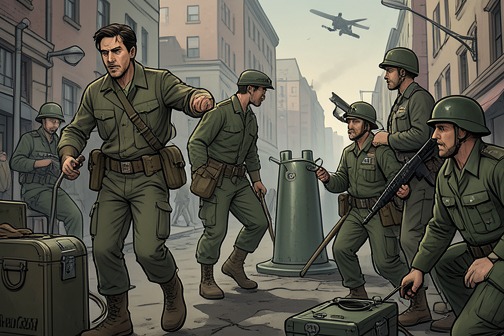
[Étienne LeBlanc](entity:character-recall-character-tienne-leblanc-9e0f6772960b)’s resistance mission turns his technical knowledge into an urgent, dangerous act of service during the siege of [Saint-Malo](entity:location-recall-location-saint-malo-85b1c832a945). Asked to locate German air-defense guns and transmit their coordinates, he manages to report one position and goes out to survey two more. Before he can complete the work, the occupation authorities detain him with other men and send him to [Fort National](entity:location-recall-location-fort-national-f36fa39b06df). There, his pleas to reach his blind niece and great-niece meet the helplessness of a city under bombardment.
## The assignment and its stakes
The mission begins as Allied bombs demolish the rail station and German forces disable the harbor installations. News reaching Étienne suggests that liberation may be close: wounded German troops are arriving in Saint-Servan, and Americans have captured Mont Saint-Michel, about twenty-five miles away. At the bakery, [Madame Ruelle](entity:character-recall-character-madame-ruelle-978cb46c14c9) tells him that the resistance needs the locations of anti-aircraft batteries, together with precise coordinates that can be broadcast. Her request makes the task concrete: information about the guns could help save lives, but finding them requires someone to move through the city and expose himself to danger.
Madame Ruelle explains the work in terms that match Étienne’s particular abilities. He must find the guns, plot their positions, and transmit the resulting coordinates. He understands what that requires: walking around with a compass and notepad, with no safer way to gather the measurements. He warns that the Germans may shoot him. The assignment is therefore not a remote calculation; its accuracy depends on his presence in places where he can be seen and caught.
The danger is sharpened by the prospect of a mass arrest. Madame Ruelle has heard that men between eighteen and sixty may be interned the following day, with papers checked and anyone suspected of resistance imprisoned at Fort National. Later, the announced roundup is described as applying to every man between sixteen and sixty. The difference between those stated age ranges remains in the account, but both warnings make the immediate risk plain: Étienne must complete the work while the authorities are tightening their control over the city’s men.
## Surveying the batteries
Étienne approaches the assignment with a resolve that surprises him. As he steps outside, he feels strong and is glad that Madame Ruelle has given him this final task. He has already transmitted the location of one air-defense battery: a cannon on a shelf of the ramparts beside the [Hotel of Bees](entity:location-recall-location-hotel-of-bees-869876b756f5). Two more positions remain. For his calculations, he chooses the cathedral spire and the outer island of Le Petit Bé as known points from which to determine a third, unknown point. The simple geometry gives his mind a defined problem to hold onto amid the crisis.
The plan depends on taking bearings in person. Étienne needs to move around with a compass and notepad, identify the two remaining positions, and calculate where the guns are. He is nearing the dark ramparts when a uniformed man limps toward him out of the darkness. The account does not specify exactly how that encounter leads to his detention, or whether he finishes the survey. What it makes clear is that the mission is interrupted: one battery’s location has been sent, while the two further bearings are still outstanding when danger closes in.
## Detention and the plea to return
The roundup sweeps Étienne into the authorities’ detention of the city’s men. They are told to assemble at the tower of the château and then to be marched to Fort National at low tide. At the fort, Étienne begs his jailers, its guardian, and fellow prisoners to let him go. His appeal is specific: his niece, his great-niece, is blind and alone. He says he is sixty-three, rather than sixty, and protests that his papers were unfairly taken and that he is not a terrorist.
His words do not change his situation. Étienne tries a few German phrases to persuade the Feldwebel in charge to help him, but the officer shrugs and looks back toward the burning city across the water. The gesture marks the distance between the personal urgency of Étienne’s plea and the larger machinery of occupation and war: he is asking to resume responsibility for his family, while those holding him act as if nothing can be done.
A stray American shell strikes the fort. The wounded cry out below in the munitions cellar, and the dead are buried under rocks above the tide line. After this, Étienne stops talking. The scene does not show his release or a return to his niece; instead, his appeal ends in silence as the siege reaches the prison itself.
## Resistance under occupation
The episode places Étienne’s mission within a broader system of restrictions and resistance. Earlier, Marie-Laure had to press her father to read aloud an order requiring residents to surrender their radio receivers at 27 rue de Chartres by noon the next day, under threat of arrest as saboteurs. In the besieged city, radio remains both an object of official control and a means of transmitting information the resistance needs. Étienne’s task—to send gun coordinates—uses communication not as private listening, but as a way to make local knowledge operational.
The mission also shows the costs of turning ordinary skills into resistance work. Étienne’s knowledge of maps, bearings, and calculation gives the network something useful; it also requires him to expose himself to surveillance and detention. His one successful transmission is a tangible result, while the unfinished survey and his imprisonment show the limits imposed by the occupation. The episode’s decisive movement is from purposeful action to enforced confinement: Étienne leaves the bakery feeling strong, fixes his attention on a triangle of known points, and ends at Fort National, unable to reach the family member whose safety gives his plea its urgency.
Event 41
The Siege and Liberation of Saint-Malo
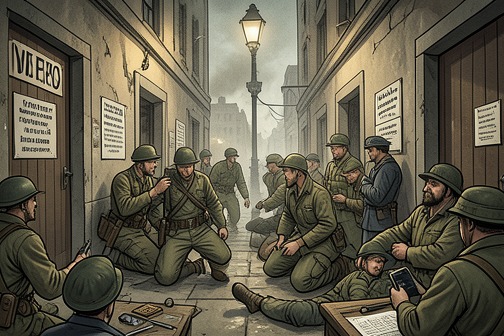
[The Siege and Liberation of Saint-Malo](entity:event-recall-event-9b03f166ea05) is the August 1944 crisis in which occupation authorities tightened their control of the old city, bombardment drove residents and soldiers into shelter, and American forces ultimately freed prisoners and ended the siege. Its course is marked not by a single decisive assault but by successive restrictions, military danger, and the slow unravelling of German control.
## Occupation Controls and the Closing City
The siege takes place against a background of rules that made ordinary life subject to military authority. An earlier order required residents to surrender their radio receivers at 27 rue de Chartres by the following noon, threatening arrest as saboteurs for noncompliance. The demand made possession of a household device a matter of state enforcement, and it belongs to the same pattern of occupation measures that narrowed the population’s freedom of movement.
As the crisis escalates, the garrison commander posts new orders on doors, market stalls, and lampposts: no one is to leave the old city, and no one may walk in its streets without special authority. The posted notices turn the city itself into a regulated space. On [7 August 1944](entity:time-recall-time-1944-8-7-9dc4a6e2bb26), residents are told that every man between sixteen and sixty is to be detained, assembled at the tower of the château, and marched at low tide to [Fort National](entity:location-recall-location-fort-national-f36fa39b06df). The order identifies its targets by age and sex and assigns them a route and destination; the men’s removal is presented as an administrative procedure, though its effect is to place them in military custody.
The occupation’s pressure also appears in the treatment of individuals caught in its enforcement machinery. [Daniel LeBlanc](entity:character-recall-character-daniel-leblanc-64966d3a1873) is seized outside Vitré while traveling toward [Paris](entity:location-recall-location-657453741ed3), bundled from a train by plainclothes policemen as passengers watch. French interrogators question him first, then German interrogators take over. They examine his notebook, tool case, seven skeleton keys, tiny files, saws, and architectural measurements, suspecting him of a plan to destroy the Château de [Saint-Malo](entity:location-recall-location-saint-malo-85b1c832a945). The following morning, a second interrogation offers little explanation: the Germans deny him paper, linens, and telephone access, and appear more interested in their questions than his answers. His arrest is not itself the siege’s decisive military action, but it shows how suspicion and detention precede the more collective restrictions imposed on the city.
## The Garrison and the Civilians
Military routine continues inside the occupied city even as civilian movement is constrained. Before dark, Austrian soldiers eat pork kidneys and whole tomatoes from hotel china bearing a silver bee on each plate. They sit on sandbags or ammunition boxes; Bernd falls asleep over his bowl, while [Frank Volkheimer](entity:character-recall-character-frank-volkheimer-616967a218e7) discusses the cellar radio with a lieutenant. Around them, the soldiers eat beneath their steel helmets. The scene sets an ordinary meal against the improvised military setting, and the men’s settled routine contrasts with the uncertainty imposed on the city beyond their perimeter.
The rules do not remove civilian vulnerability; they organize it. Men are directed toward Fort National, and residents are forbidden to leave the old city or walk its streets without permission. These orders make staying put compulsory at the same time that the military situation makes the city increasingly dangerous. The siege is therefore experienced both as a battle around fortified positions and as a narrowing of the choices available to those who remain within them.
## Fort National and the Bombardment
On 12 August, the narrative places [Etienne LeBlanc](entity:character-recall-character-etienne-leblanc-c0218becdb1a) at Fort National. A stray American shell strikes the fort. The wounded call out from the munitions cellar, the dead are buried beneath rocks above the tide line, and Etienne stops talking. The account connects the attack not only to the fort’s military exposure but also to a lasting change in Etienne. The shell’s arrival is described as stray, a reminder that the effects of bombardment do not follow a neat distinction between intended targets and those caught nearby.
Elsewhere in the city, the air attack drives [Werner Pfennig](entity:character-recall-character-werner-pfennig-48150c6dbd60) and [Marie-Laure LeBlanc](entity:character-recall-character-marie-laure-leblanc-3b40e20f4b28) into the cellar of the house. Dozens of airplanes arrive; Werner shivers uncontrollably, and Marie-Laure leads him to the first floor, where ash and soot cover the furnishings. He pushes overturned furniture aside and opens the cellar door. They climb down as thirty bombers release their payloads overhead. From below, they feel the bedrock shake and hear detonations across the river. The scene gives the bombardment a domestic scale: the route to shelter passes through a damaged, ash-covered home, while the cellar offers protection without removing the force of the attack.
A cease-fire changes the immediate conditions in that cellar. Gritty summer light falls through the open trapdoor, and the guns are no longer firing. Werner watches Marie-Laure as she sleeps. The pause is brief in the account, but it marks a sharp contrast with the preceding explosions: the same underground shelter that had contained them during the attack now holds them in a moment of quiet, without making the wider outcome certain.
## Liberation and Aftermath
That evening, [Madame Ruelle](entity:character-recall-character-madame-ruelle-978cb46c14c9) finds Marie-Laure in a requisitioned school and holds her hand. Civil-affairs personnel have stacks of confiscated German chocolate in rectangular cartons; Marie-Laure and Madame Ruelle eat freely from them. The encounter brings a private reunion into the unsettled aftermath, with seized supplies serving as a small, concrete sign that control of the city is changing.
The next morning, American forces take the château and the last anti-aircraft battery and free the prisoners held at Fort National. Madame Ruelle pulls Etienne out of the processing queue, and he embraces Marie-Laure. Yet the siege does not end at once: a colonel in an underground stronghold across the river holds out for three more days. An American airplane called Lightning drops a tank of napalm through an air vent, and a white sheet is raised on a pole five minutes later. The account presents the strike as exceptionally unlikely, but makes the sequence clear: the remaining position capitulates, and the siege of Saint-Malo is over.
Afterward, sweep platoons remove as many incendiary devices as they can, army photographers enter with tripods, and a handful of civilians return from farms, fields, and cellars to move through the ruined streets. On 25 August, Madame Ruelle is permitted to return to check the bakery. Etienne and Marie-Laure travel in the opposite direction, leaving the city rather than joining those who return. The ending therefore pairs the formal end of the siege with two different movements through its aftermath: the cautious re-entry of residents and the departure of people whose lives have been altered by the fighting and occupation.
Event 42
Volkheimer rescues Werner trapped in the rubble
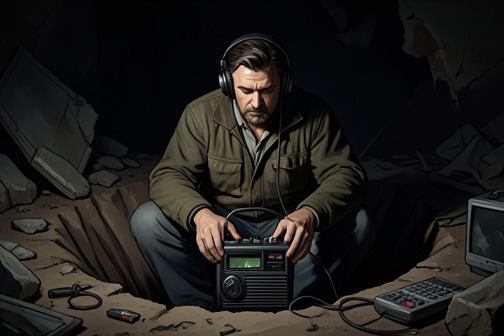
[Frank Volkheimer](entity:character-recall-character-frank-volkheimer-616967a218e7) rescues [Werner Pfennig](entity:character-recall-character-werner-pfennig-48150c6dbd60) from beneath the ruined [Hotel of Bees anti-aircraft strongpoint](entity:location-recall-location-4aefcd1a6231) by turning a faint radio signal into the means of escape. The sequence moves from enforced stillness to urgent action: while much of [Saint-Malo](entity:location-recall-location-saint-malo-85b1c832a945) sleeps, music reaches the buried men, Werner makes light from the radio battery, and [Volkheimer](entity:character-recall-character-volkheimer-afd0fa9f03aa) leads the effort to break through the rubble. Their escape is a narrow passage from darkness into the open night, followed by a parting that leaves Werner to go ahead alone.
## Setting and immediate circumstances
The scene begins with a city made quiet by sleep. Gunners, nuns, children and their mothers, a doctor, wounded German soldiers, and Etienne are all described as asleep in different parts of Saint-Malo. Against this broad inventory of sheltered or exhausted lives, snails and rats continue moving among the rocks and ruins. Werner, too, sleeps in a hole beneath the ruined hotel. Volkheimer alone remains awake, sitting with the radio Werner had placed in his lap and its dying battery between his feet.
Volkheimer has no expectation that the static will bring him anything useful. He keeps the headphones on because they are where Werner left them and because he cannot bring himself to remove them; he has also persuaded himself that moving might be dangerous. His immobility is therefore practical and psychological at once: he is buried in a damaged building, but his fear has made even a small movement seem threatening. The scene places the two men in a common danger while distinguishing their states—Werner sleeps, and Volkheimer keeps watch without a plan for getting out.
## The signal and the decision to act
The turning point is not a clear message but music emerging from the static. Volkheimer listens as the notes open into a remembered scene from his own life: leading horses through a snowy forest with his great-grandfather, who stops beside a pine and begins to cut into its bark. The memory gives the music a personal reach, but the immediate consequence is concrete. Volkheimer stands, finds Werner in the darkness, puts the headphones on him, and urges him to listen.
Werner recognizes the piece as [Clair de Lune](entity:expression-recall-expression-clair-de-lune-04c019f4a748). Volkheimer then tells him to connect the light to the battery. Werner responds without delay: before the music has ended, he disconnects the radio, removes the bezel and bulb from the dead field light, and touches them to the battery leads. The makeshift connection gives them a sphere of light. The radio’s failing power has thus become useful in another form, and the music’s brief arrival is followed by the practical cooperation needed to escape. The scene does not establish who is transmitting; it shows only that a signal reaches them through the static.
## Breaking through the rubble
With Werner able to see, Volkheimer moves masonry, timber, and sections of shattered wall at the rear of the cellar, stacking them into a barrier. He draws Werner behind it, prepares a grenade, and throws it toward the place where the stairwell had been. The blast shifts the building’s rubble and opens a route through it. Werner and Volkheimer are thrown into confusion by the detonation, but once Werner can clear debris from himself, he sees a single opening of purple light above them.
That opening changes the direction of the scene. A shaft of starlight reaches down through dust and rubble; Volkheimer climbs toward the damaged staircase and strikes at the edges of the gap with a piece of rebar. The hole widens until it is large enough for him to pass through. After climbing out, he reaches back for Werner, the canvas duffel, and the rifle, pulling each of them up. Escape is not a solitary feat by either man: Werner supplies the light and follows, while Volkheimer makes and then traverses the passage, returning to bring the other man and their belongings with him.
## Emergence and separation
Above ground, the men kneel amid what remains of an alley. The hotel is almost entirely destroyed: only two walls remain joined at a corner, while nearby houses stand open to the night and much of the surrounding area is rubble. The rampart behind the hotel still stands, although some of its upper openings have been shattered; beyond it, the sea is barely audible. The outward view makes clear the scale of destruction that their confined escape had kept out of sight. The men look over the ruins and consider how many dead may lie among them; Werner estimates nine or more.
They stagger toward the sheltered side of the ramparts. Volkheimer then asks whether, five blocks to the south, the girl is still playing her recording. The question links their immediate survival to the sound that reached them underground, without explaining the transmission’s source. Volkheimer gives Werner the rifle and tells him to go. When Werner asks about him, Volkheimer answers that he needs food. The rescue therefore ends not in a joint departure but in a division of what remains to be done: Werner leaves with the rifle, while Volkheimer stays behind.
## Narrative significance
The episode turns on the conversion of remnants into instruments of survival. A dying battery powers a field-light bulb; discarded building material becomes a barrier; the rubble itself, shifted by the grenade, yields an opening. The objects do not restore the ruined building or erase the danger. They make a passage possible, one limited action at a time, and the sequence gives each man a distinct part in it.
The music also creates a connection across distance without resolving its mystery. It first interrupts the static, then wakes Werner to the possibility of action, and finally leads Volkheimer to think of the girl whose recording may still be playing elsewhere in the city. Its effect is both intimate and practical: it briefly carries memory for Volkheimer and prompts the cooperation that enables the escape. The final exchange keeps the scene’s achievement modest and incomplete. Werner is out of the rubble, but the ruined city remains around them, and the two men separate as soon as they reach the open air.
Event 43
Werner confronts von Rumpel
[Werner Pfennig](entity:character-recall-character-werner-pfennig-48150c6dbd60)’s search through the ruined house in [Saint-Malo](entity:location-recall-location-saint-malo-85b1c832a945) brings him face to face with [Reinhold von Rumpel](entity:character-recall-character-reinhold-von-rumpel-0cc59346c3b4), the officer he had seen earlier near a bakery, and culminates in Werner finding [Marie-Laure LeBlanc](entity:character-recall-character-marie-laure-leblanc-3b40e20f4b28). The encounter pivots from mutual recognition and armed threat to a meeting made possible by a radio signal: Werner tells Marie-Laure that he has heard her broadcast, then helps her emerge from hiding. The scene binds the novel’s military violence to its quieter story of communication across distance, while its cross-cutting makes the shot and the meeting feel like parts of one suspended instant.
## The ascent through the ruined house
Werner enters a house whose damage makes stealth impossible. Shattered crockery covers the foyer; debris fills the kitchen, ash lies deep in the hallway, and a chair has been overturned. He judges that Marie-Laure, unless she has moved recently, must be high in the house near the transmitter. Carrying a rifle in both hands and a bag over his shoulder, he starts up the stairs, though darkness repeatedly disrupts his vision and he cannot tell how much noise he is making or whether concealment still matters.
The stairwell carries the signs of a broader destruction: books, papers, cords, bottles, and pieces that might be from antique dollhouses have been thrown down it. On the sixth floor Werner finds three partly open doors. The room to his right contains a broken window, a bed, a dress hanging in an armoire, small objects lined along the baseboards, and two buckets partly filled with water. He props [Frank Volkheimer](entity:character-recall-character-frank-volkheimer-616967a218e7)’s rifle against the bed and drinks from one bucket. Outside, a distant boat’s single light appears and disappears beyond the neighboring blocks and the ramparts. That brief view of the sea contrasts with the cluttered, enclosed ascent: Werner has reached the upper floors, but he has not yet found the person he came to reach.
## Recognition, fire, and the shot
A voice behind Werner announces another presence. The man before him is a German officer in field dress, identified by the insignia of a sergeant major. Pale, bruised, and visibly unwell, he moves toward the bed and remarks on the danger of mixing morphine with wine. Werner recognizes him from the bakery, where he had seen him with a newspaper. The officer, in turn, recognizes Werner as a private and treats their encounter as one between men who belong together—as comrades or accomplices who have each come to the house for the same thing.
That assumption gives the meeting its particular tension. Werner has arrived carrying a rifle, but the officer’s expectation of shared purpose does not make him safe. A curtain across the landing has caught fire, and the flames are already reaching toward the ceiling. The officer sits on the bed, with his pistol visible in the starlight, while a low table nearby holds a miniature city made of crowded wooden houses. Werner’s attention moves between the model, the spreading fire, and [Volkheimer](entity:character-recall-character-volkheimer-afd0fa9f03aa)’s rifle. Smoke begins to enter the hall, and he warns the officer about the burning curtain.
The fire does not immediately resolve the confrontation; instead, it develops alongside it. The officer handles his pistol and gestures for Werner to drink more from the bucket, then sits up and aims at Werner’s chest. A muted clatter from the direction of the burning curtain interrupts the moment. The officer turns toward the sound and lowers the pistol’s barrel. Werner lunges for the rifle. The narrative presents the shot through Marie-Laure’s simultaneous experience rather than by lingering on the instant between the men: she hears a brick strike the floor, then a scuffle, then the gunshot. The scene’s cross-cutting establishes the outcome of the confrontation through its consequences, as the shot divides the stillness and Werner is left to move through the house toward her.
## The hidden listener and the radio connection
Marie-Laure is concealed behind the false back of a wardrobe. After the shot, she half slides and half falls down a ladder, then presses her ear against the panel. Footsteps cross the landing and enter [Henri LeBlanc](entity:character-recall-character-henri-leblanc-cdf67e8de482)’s room; a splash and hiss follow, with smoke and steam in the air. The approaching steps are lighter and more hesitant than the officer’s had been. The person searches the wardrobe, opening its doors and working out where she might be hidden. Marie-Laure grips her knife as she hears fingers brush along the back panel.
The encounter is rendered as reciprocal listening. On opposite sides of the wood, Werner hears Marie-Laure inhale, and Marie-Laure hears him scrape three fingernails across the panel. Their faces are only an arm’s reach apart, but the barrier has not yet opened. Werner calls to ask whether she is there. For Marie-Laure, the voice brings back those who have left her, including [Daniel LeBlanc](entity:character-recall-character-daniel-leblanc-64966d3a1873), [Madame Manec](entity:character-recall-character-madame-manec-624a3b197604), and [Etienne LeBlanc](entity:character-recall-character-etienne-leblanc-c0218becdb1a); she imagines their return in the stranger’s voice before she understands who he is.
Werner explains that he has come because he heard her on the radio, and identifies the music as the song associated with the moonlight. The explanation gives the rescue its cause: he has followed a transmission that crossed the distance between them, rather than finding her by sight or by chance alone. Marie-Laure slides the wardrobe panel open. Werner takes her hand and helps her out onto the floor of her grandfather’s room. She says she cannot find her shoes. The exchange ends not with a description of escape or a final resolution, but with her return to the room and the practical fact of what she has lost amid the destruction.
## Structure and significance
The scene’s title, “The Simultaneity of Instants,” is enacted through its shifting attention between Werner’s confrontation and Marie-Laure’s hiding place. The reader experiences the clatter, the rifle lunge, and the shot across the interval separating the two characters; the sound joins their parallel actions before either can fully know what is happening to the other. That formal simultaneity turns the house into a space connected by listening as much as by floors, doors, and corridors.
The encounter also reverses the meaning of Werner’s arrival. The officer sees him as an accomplice, but the decisive relationship established in the scene is with the hidden girl whose broadcast he has heard. The rifle and the officer’s pistol mark the immediate danger; the water buckets, the burning curtain, the battered model city, and the concealed wardrobe establish the circumstances through which that danger unfolds. When Werner opens the panel and offers Marie-Laure his hand, the radio link becomes physical contact. Their meeting does not erase the violence around them, but it changes the scene’s direction—from an armed standoff in a ruined house to an act of recognition and help.
Event 44
Werner and Marie-Laure leave Saint-Malo during the ceasefire
[Werner and Marie-Laure leave Saint-Malo during the ceasefire](entity:event-recall-event-2160bbc6aca4) in a brief interval between bombardment and an uncertain future. The pause gives them a route out of the cellar, but not a shared destination: Werner guides Marie-Laure through the ruins, helps her reach the street, and finally parts from her so that she can continue without being seen with him. Before disappearing, she places a small wooden object in the sea and presses an iron key into his hand, turning their escape into a quiet exchange of separation, trust, and unresolved meaning.
## The Lull and the Decision to Leave
Gritty summer light enters the cellar through the open trapdoor. It may already be afternoon, and for a few heartbeats Werner watches Marie-Laure sleep without guns firing. The stillness is not safety so much as a chance to move. They hurry to prepare: Werner cannot find the shoes she asks for, so he helps her into men’s loafers; he pulls on Etienne’s tweed trousers over his uniform and wears a shirt with sleeves too long. His clothing becomes an improvised disguise, while his plans depend on whom they meet. If German soldiers stop them, he will speak French and claim to be helping Marie-Laure leave the city; if Americans stop them, he will say he is deserting.
Werner also anticipates the practical dangers of moving through a battle zone. He expects a place where refugees are being gathered, though he is unsure that he can explain this correctly, and finds a white pillowcase to serve as a visible signal. Marie-Laure asks for her cane, which he gives her. In the foyer, neither knows what waits beyond the door. Werner’s memory of an overheated dance hall during his entrance examinations four years earlier intrudes: a ladder bolted to the wall and a crimson flag marked with a white circle and black cross. The recollection gives the threshold of the house an older association with obedience and danger, even as the immediate choice is simply whether to step outside.
## Across the Ruined City
Outside, the scale of the destruction dictates their route. Rubble lies in heaps; the exposed bricks of chimneys catch the light, and smoke spreads across the sky. Werner knows that the shells have been coming from the east and that the Americans were almost to Paramé six days earlier, so he moves Marie-Laure in that direction. The streets offer no clear protection. They might be seen by Americans or by Werner’s own army and compelled to work, join, confess, or die. Yet in the lull, no shells fall and no rifles crack. The light is soft through the ash, a temporary quiet that makes movement possible without making the danger disappear.
Their passage is guided by Marie-Laure’s questions and Werner’s answers. When she asks for the cross street, he identifies the rue des Lauriers. She walks with her cane tapping back and forth, and they pass a walnut tree blackened like a charred toothpick, two crows picking at something unidentifiable, and civilians dragging bundles and luggage through the damaged streets. Werner sees three women carrying bundles; farther on, a woman struggles with an overstuffed suitcase while a boy follows her. The signs of flight make his offer to call to the other civilians seem practical, but Marie-Laure asks for a moment instead. She leads him toward an alley where ocean air reaches them through a gap in the wall.
## The Grotto and the Object in the Water
At the alley’s end, Marie-Laure produces a key and asks whether the tide is high. Werner can see water beyond the narrow gate and warns that they must hurry. She is already descending into the grotto, in the oversized shoes, feeling her way along its walls with confidence. The tide runs through the pool and washes over her shins, wetting the hem of her dress. From her coat she takes a small wooden object and sets it in the water. She repeatedly asks Werner to confirm that it is in the ocean; he answers that it is, and she climbs out, breathless.
This detour changes the immediate purpose of their escape. Werner has been steering her toward civilians leaving the city, but Marie-Laure insists on reaching the grotto before they go. She locks its gate behind them and returns to the alley, her shoes squelching as she walks. The action is deliberate, but its full meaning is not explained in the scene: the narrative shows the object entering the water and preserves the importance of the gesture without spelling out all that Marie-Laure intends by it. The route out is therefore also a last visit to a place she knows, where she leaves something behind before facing an unknown road.
## Parting and the Iron Key
Back among the refugees, Werner feels faint and thinks of the broken miners he had seen at [Zollverein](entity:location-recall-location-zollverein-8c9454be5c28), sitting motionless and waiting to die. Against that image he considers time as something fragile that must be protected and spent. He gives Marie-Laure the pillowcase, explains how to follow the wall and continue straight at an intersection, and tells her to hold the signal high. She asks what he will do. He says he will go in the other direction and that it will be better if no one sees her with him. When she asks how they will find each other again, he cannot say.
Marie-Laure turns her face toward him, though she cannot see him, reaches for his hand, and closes his fingers around something. They say goodbye. She moves away slowly, her cane testing the broken street, pausing to find a way around stones; the pillowcase remains raised as she passes the intersection and disappears from view. Werner waits for voices or gunfire, hoping that others will help her. When he opens his hand, he finds a little iron key. The scene ends not with reunion or certainty but with the key’s transfer and their separation. That evening, [Madame Ruelle](entity:character-recall-character-madame-ruelle-978cb46c14c9) finds Marie-Laure in a requisitioned school, where they hold hands and eat confiscated German chocolate. Werner and Marie-Laure have escaped the cellar, but they leave [Saint-Malo](entity:location-recall-location-saint-malo-85b1c832a945) separately, carrying different parts of an encounter whose meaning remains only partly disclosed.
Event 45
Werner’s death
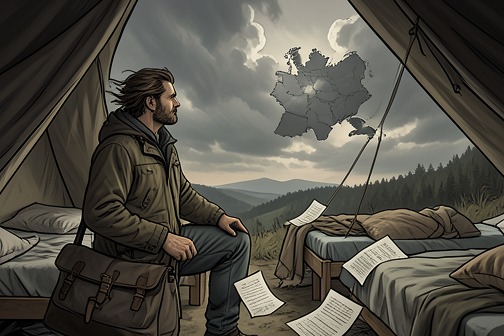
[Werner’s death](entity:event-recall-event-37ba763f3b44) comes not in a battle but in the quiet aftermath of combat, as he walks out of a sick tent and onto a mine planted by his own army. In the scene’s unstable passage between dream, memory, and waking perception, a September wind seems to lift him toward home; instead, it carries him beyond the field’s edge, where an American soldier’s warning comes too late.
## The Tent and the Night
Werner is among a few dozen sick or wounded men in a tent in the countryside. A warm September wind presses against its walls and strains the guy ropes. The tent flaps lift at either end, revealing trees bucking in the gusts. Werner has packed his old notebook and a little house into his duffel. His thirst has faded, and the sleeping men around him do not interrupt the force of the weather as he experiences it: wind, moving clouds, and moonlight falling across the tent.
The scene gathers details of home without making them a secure destination. Werner sees the clouds moving toward [Germany](entity:location-recall-location-a3c24dd56e42), toward home, while sheets of paper tumble between the cots. In images that surface in his mind, [Frau Elena](entity:character-recall-character-frau-elena-30fd83219873) banks the fire beside a coal stove, children lie in their beds, baby [Jutta](entity:character-recall-character-jutta-678e69fe3386) sleeps in her cradle, and his father enters an elevator. [Frank Volkheimer](entity:character-recall-character-frank-volkheimer-616967a218e7)’s remembered voice supplies the words “[What you could be](entity:expression-recall-expression-what-you-could-be-7671ce03e618).” These impressions mingle home, childhood, and the possibility of another life with the immediate physical fact of a tent opening onto the night.
## Leaving the Sick Tent
Werner’s body feels weightless beneath the blanket. As the trees and clouds move beyond the tent doors, he swings his legs off the bed. The man in the neighboring cot calls “Ernst” twice, but no one answers; the sleeping American soldier at the entrance does not stop Werner as he passes. Werner walks into the grass. The narration compares him to a kite or balloon, an image that makes his departure seem less like a deliberate escape than a body borne outward by the wind.
That sense of lightness is set against the danger of the ground he is crossing. The moonlight appears to Werner to pass through clouds and air in slow, unmoved rays, even as the wind drives leaves across the field and bends the grass. The contrast gives the night a deceptive calm: the light seems steady, but the landscape is in motion, and the field contains a concealed threat. Werner’s question, “Why doesn’t the wind move the light?” belongs to this gap between what he can see and what the terrain hides.
## Memory of Jutta and the Boat
The night also brings back a childhood episode with Jutta. The two children once made a sailboat from scraps of wood and carried it to a river. Jutta painted it purple and green and set it on the water ceremoniously, but the current caught the vessel, which sagged and drifted out of reach before the black water swallowed it. Werner reassured her that things rarely worked on the first try and that they could make a better boat.
Now, as he walks away from the tent, he cannot be certain whether they did make another one. He hopes they did and seems to remember a sturdier boat gliding down a river, turning a bend and leaving the children behind. The uncertain memory offers no clear resolution. Its movement away from the shore echoes Werner’s own departure, but the remembered boat remains only a possibility, not a recovered answer. The scene places a childhood attempt to build something seaworthy beside a final walk whose destination Werner cannot see.
## The Mine and the Warning
Across the field, an American watches Werner leave the sick tent against the trees. He sits up and raises a hand, calling “Stop,” then “Halt.” The calls make the danger legible to the reader just as Werner approaches it, but they do not reach him in time. At the field’s edge, he steps on a trigger land mine set by his own army three months earlier. The blast throws up a fountain of earth, and Werner disappears.
The mine turns the scene’s backward-looking images into a stark ending. Werner has imagined the warmth of the childhood home and the presence of Jutta; he has carried the notebook and little house out of the tent; and the night has seemed to offer an opening toward Germany. Yet the route out of the field terminates in an explosive device left by the forces to which he belonged. The warning is spoken, the danger is physically present, and still the outcome cannot be reversed.
## Narrative Significance
The death is structured around the distance between motion and knowledge. Werner moves under the pull of wind and memory, while the American sees him from across the field and understands enough to call out. The mine itself is invisible until it detonates. Against the luminous image of moonlight crossing the grass, the hidden explosive makes the landscape both beautiful and lethal without requiring the light to change.
The scene also closes Werner’s story by bringing its recurrent attachments into the last moments before his death: the home he imagines, Jutta’s childhood presence, the small house in his duffel, and the remembered words from Frank Volkheimer. None rescues him from the field. The final revelation—that the mine was laid by his own army—joins personal fate to the violence of the war he has served. His death arrives not as a chosen sacrifice or a battlefield victory, but as the consequence of a step across a boundary he cannot see.
Event 46
Soviet soldiers break in and assault Jutta and the women in Berlin
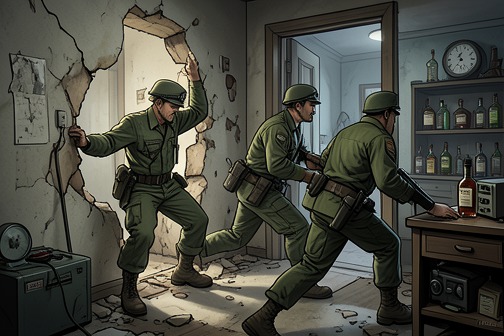
[Soviet soldiers break in and assault Jutta and the women in Berlin](entity:event-recall-event-3240d45d74e4) in a single visit to the apartment shared by [Jutta](entity:character-recall-character-jutta-678e69fe3386), [Frau Elena](entity:character-recall-character-frau-elena-30fd83219873), and several other girls. The episode begins with a search of a damaged building and ends with the soldiers leaving, but the apparent limits of that visit do not make it safe: inside the apartment, Frau Elena tries to manage the danger, and Jutta survives the assault without speaking. The scene makes the home a fragile refuge, not a protected one, and places the girls’ vulnerability beside the soldiers’ exhaustion and the destruction of the city around them.
## Setting and Approach
The soldiers arrive on a cloudless day in May. There are three of them, and they do not return after this visit. They break into the printing company below the apartment, looking for liquor. Finding none, they begin making holes in its walls. A shot strikes an old dismantled press, and the search moves upward into the rooms where Frau Elena and the girls are sheltering. The movement from the company below to the apartment above makes the intrusion feel continuous: the soldiers’ search of the building becomes a threat to the people who have been trying to remain out of sight.
Jutta is with Frau Elena, Hannah, Susanne, and Claudia Förster. None of the girls is older than sixteen. Before the soldiers reach the apartment, Jutta allows herself to think they may not climb the stairs. They do. Their entry follows a pause at the top of the stairwell and the breaking open of the apartment door. The scene thus gives the girls a brief interval in which escape or avoidance still seems possible, then closes it through the soldiers’ arrival.
## Frau Elena’s Attempt to Protect the Girls
Frau Elena tells the girls to stay calm, presenting composure as a way to reduce the risk of being shot. She says she will go first, hoping the soldiers will be gentler with the others afterward. Her reassurance does not remove the danger; it shows her trying to shape what little remains within her control. She leads the soldiers into another room, then Claudia follows. Jutta does not make a sound. The account records these differences in response without treating any one of them as a choice that could make the situation safe.
The objects in the apartment sharpen the contrast between ordinary life and immediate danger. Earlier, as the soldiers search the closet, mop handles are kicked aside and a crate of dictionaries is sent down the stairs. Frau Elena is wearing a striped ski parka, with an abridged New Testament zipped into its pocket. These details remain part of the household even as the soldiers force their way inside: practical belongings, books, and personal clothing cannot keep the violence out. When the soldiers leave, Frau Elena puts on her parka and rubs one arm with the other, an action the narration describes without turning it into an explanation of what she feels.
## The Assault and Its Uneven Responses
The soldiers are an officer and two boys who appear no older than seventeen. The account describes their filthy clothing and notes that they have splashed themselves with women’s perfume. One is extremely thin and wears a rope as a belt; the other laughs in apparent disbelief at the state of the city. The officer sits by the door while the girls are confronted, then assaults them in turn. This contrast between the soldiers’ youth and their power in the apartment does not soften what they do. Their age and disordered appearance coexist with their control over the people they have entered to terrorize.
The narration distinguishes the women’s and girls’ reactions without making their silence or speech a measure of consent or courage. Hannah screams briefly and muffles herself; Frau Elena makes a small sound as she leads the soldiers away; Claudia responds with moans. Jutta remains silent. These different responses are reported as part of the event, not as evidence that any of the girls can direct its course. The scene’s restraint keeps attention on the assault and its coercive circumstances rather than depicting it graphically.
Before leaving, the youngest soldier fires twice into the ceiling. Plaster falls, and the sound carries through the apartment as Susanne lies nearby, breathing quietly. The shots do not signal a change in the soldiers’ purpose or provide an escape; they extend the threat to the final moments of the visit. The soldiers then go out into the street. Their departure ends the immediate intrusion, but the scene does not present it as a restoration of security.
## Consequences and Narrative Significance
The episode is brief in the plot’s chronology, but its details establish a lasting wartime vulnerability around Jutta and the other girls. The soldiers come only once, yet that fact describes the limits of the event, not its harmlessness. The apartment’s locked door, household objects, and ordinary arrangements cannot protect its occupants once armed men enter. Frau Elena can try to guide the sequence and shield the girls, but she cannot prevent the assault; Jutta’s silence likewise marks survival under coercion, not control over what happens.
The scene also sets the damaged city and the threatened household in the same frame. Below, the soldiers search a workplace and break into its walls; above, they enter the girls’ home. The dismantled press, the fallen dictionaries, and the shots into the ceiling connect public destruction to private danger without suggesting that the two are identical. By ending with the soldiers outside and Frau Elena tending to herself, the narrative closes the immediate action while leaving the people who endured it inside its consequences. The episode is therefore not simply a scene of invasion: it shows how the collapse of safety reaches into daily life, and how care can persist even when it cannot stop violence.
Event 47
Jutta and Marie-Laure meet in Paris

[Jutta and Marie-Laure meet in Paris](entity:event-recall-event-f724f768bdc0) when a miniature wooden house brings the sisters of two former wartime adversaries face to face. The encounter joins histories that had remained separated by distance, silence, and death: Marie-Laure recognizes the house her father made, while [Jutta](entity:character-recall-character-jutta-678e69fe3386) learns that the blind girl her brother once helped is alive. Their exchange does not make the past simple, but it gives its scattered objects and memories a human context.
## The Journey to [Paris](entity:location-recall-location-657453741ed3)
Jutta’s visit begins with a decision to travel rather than remain inside the routines of her postwar life. Her son Max is off school, and she suggests that he could see another country, learn some French, and visit the ocean. She and Albert both understand that the decision is hers to make. Before dawn on June 26, Albert prepares six ham sandwiches, wraps them in foil, and drives Jutta and Max to the station in the Prinz 4. She boards the train carrying Werner’s notebook and the model house in her purse.
The journey carries a history Jutta has tried to keep contained. When [Volkheimer](entity:character-recall-character-volkheimer-afd0fa9f03aa) once came to deliver Werner’s letter, she did not want to take it or hear what he had traveled to say. In later years she has built a life in which the war is not constantly present: she can buy pork every day, and she can turn a dial to warm a cold house. She seldom allows herself to think of Werner, whose memory has become something to lock away. As a teacher in 1974, she does not speak of the brother who attended the National Political Institute of Education at [Schulpforta](entity:location-recall-location-schulpforta-da30af1c87b7). The trip therefore places a private memory back into motion, not by erasing Jutta’s distance from it, but by giving it a destination.
## A House Becomes an Address
At a museum in [Brittany](entity:location-recall-location-66c17c26ffa8), Jutta unwraps the partly crushed wooden house and tells the bearded man behind the counter that her brother had it and that she believes he found it there during the war. At first he shakes his head. Then he asks to see the model again, turns it beneath a lamp, and studies its recessed front door. Recognizing the house, he leads Jutta and Max through narrow, sloping streets, taking a dozen turns before they reach its real-life counterpart.
The address gives the model a specific history: it is the LeBlanc house at [Number 4 rue Vauborel](entity:location-recall-location-number-4-rue-vaubore-c7c0adfb6034), by then subdivided into holiday flats. Lichens mark the stone; mineral stains trace the walls, and geraniums spill from the flower boxes. Jutta asks whether a girl lived there. The museum worker knows from his mother’s stories that a blind girl had lived in the house during the war and moved away when the war ended. At that answer, Jutta sees green dots across her vision and feels as if she has been staring at the sun. The object has led her not just to a building, but to the trace of someone whose life had intersected with Werner’s.
## Recognition in the Laboratory
In July, at the museum where Marie-Laure works, an assistant tells her that a woman has come with her address from a museum in Brittany. Marie-Laure is at her Braille typewriter in a laboratory among bubbling aquariums and humming filters when the visitor arrives with Max. She recognizes that the woman learned French as a child; Max, by contrast, greets her in German. Their brief exchange about his French gives way to silence and recognition.
The woman has brought the model, wrapped in newspaper. Marie-Laure knows it by touch: the nicks along its sides and the slope of its roof are familiar from the times she held it. She says that her father made it. When Jutta asks how Werner acquired it, Marie-Laure sets it down suddenly, as if it were hot. The question makes the miniature more than a keepsake: it is an object that passed from Marie-Laure’s family into Werner’s possession, and now returns with his sister.
## What the Women Learn
Marie-Laure considers the sequence of what Werner did during the siege. Over time, she thinks, events that once seemed jumbled can settle into place. Werner saved her life three times: first by not exposing Etienne when he could have, then by removing a sergeant major from her path, and finally by helping her get out of the city. She tells Jutta that she spent less than a day with Werner. Their exchange establishes both the brevity of their direct acquaintance and the enduring consequence of his choices.
Jutta tells her plainly that Werner died. The news confirms what Marie-Laure could infer but had not heard from his family. Marie-Laure’s account, in turn, gives Jutta a view of her brother outside the categories that tended to shape postwar stories of Germans: neither a heroic figure nor merely a monster, but a boy whose kindness remained present in a faint, difficult-to-place way. Jutta also says that it was not easy to be good then. Neither woman claims that goodness was simple or that one brief encounter can explain a whole wartime life.
## The House and What Remains
Jutta says she wants Marie-Laure to have the little house, because it belongs with her more than with Jutta. As Jutta prepares to leave with Max, Marie-Laure asks her to wait. She tells her that, after the war, her great-uncle returned to [Saint-Malo](entity:location-recall-location-saint-malo-85b1c832a945) and salvaged the sole remaining recording of her grandfather, a recording about the moon. Jutta remembers it. Marie-Laure offers to mail it to her, thinking Max might like it, and asks her to leave an address.
The exchange leaves both the loss and the connection intact. Jutta brings back the model, but does not keep it; Marie-Laure offers a recording in return, another surviving object carried across the years. Their meeting cannot restore Werner or recover the whole story of the war. It does, however, allow each woman to receive something the other can provide: Marie-Laure learns that [Werner’s death](entity:event-recall-event-37ba763f3b44) is known to his family, and Jutta learns what his actions meant to the girl he helped. The little house makes that recognition possible, while the promise of the old recording carries their conversation beyond the meeting itself.
Event 48
Marie-Laure finds the iron key in the model house
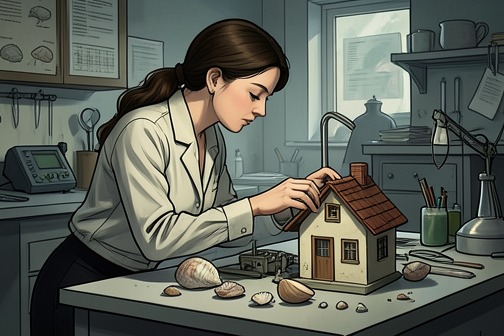
[Marie-Laure LeBlanc](entity:character-recall-character-marie-laure-leblanc-3b40e20f4b28) finds an iron key hidden beneath the roof of the model house, turning a long-running uncertainty into a tangible discovery without resolving the fate of the [Sea of Flames](entity:object-recall-object-sea-of-flames-fa38edaed37f). The scene moves between memory and careful physical investigation: she imagines what the boy who returned for the house might have done, then works its small mechanisms until something drops into her hand.
## Memory and the Unanswered Question
At her lab table, Marie-Laure touches the Dosinia shells in their tray, and memories arrive in brief, tactile flashes: clinging to her father’s trouser leg, sand fleas around her knees, and Captain Nemo’s submarine vibrating with its mournful song. The model house remains present in the scene, but it does not yield its secret simply because she remembers it. She shakes it, knowing it will not give itself away.
Her thoughts circle around the boy who went back for the house, carried it out, and died with it. She remembers him paging through a book belonging to [Etienne LeBlanc](entity:character-recall-character-etienne-leblanc-c0218becdb1a) and dwelling on its birds. These recollections sharpen the question of what the boy did with the stone, but do not answer it. Marie-Laure imagines several possibilities: he might have dropped the diamond into the pool among thousands of snails, returned it to the house, or slipped it into his pocket. Each remains a possibility rather than a recovered fact.
## The House Reconstructed in Memory
Marie-Laure sees herself leaving the smoking city with a white pillowcase trailing behind her. Once she is out of sight, the boy turns back through [Harold Bazin](entity:character-recall-character-harold-bazin-b5028f074938)’s gate. In her recollection, the rampart rises above him as a crumbling bulwark, with the sea beyond the grate. She imagines him solving the little house’s puzzle there, but even this sharply pictured sequence does not settle what he chose to do with the diamond.
A remembered thought from [Dr. Geffard](entity:character-recall-character-dr-geffard-0f9e440876b6) gives the uncertainty a human measure: something small can be beautiful and immensely valuable, and turning away from the feelings it awakens requires strength. The thought resonates with Marie-Laure’s several possible endings for the stone, but the scene does not identify one as true. The model house holds a question that memory can revisit without conclusively answering.
## The Key in Her Palm
The answer the house does provide comes through its construction. Marie-Laure twists the chimney ninety degrees; it turns smoothly, as if her father had only just built it. The first of the three wooden roof panels will not slide off, so she uses the end of a pen to lever the panels away one by one. Something drops into her palm: an iron key.
The discovery establishes that a key was concealed beneath the roof panels, but the scene does not say what it opens. Nor does it settle whether the boy put the Sea of Flames into the house, discarded it among the snails, or kept it. The difference matters: the key is newly certain, while the stone’s destination remains conjectural. The model house has yielded an object, not a complete account of its past.
## Significance
The scene’s movement from recollection to touch gives the discovery its force. Marie-Laure cannot make memory disclose which imagined fate is correct; she can, however, turn the chimney, pry at the stuck panels, and find what their arrangement has hidden. The iron key converts the model house from a container of speculation into a source of physical evidence, while leaving the larger mystery intact.
Event 49
Frederick speaks again after seeing an owl

[Frederick](entity:character-recall-character-frederick-88469ba33ed9)’s return to speech follows an owl’s sudden visit to the patio, turning an established, quiet routine into a brief encounter that changes what the woman can hope for. The scene does not claim that his condition is resolved: it records a moment of attention, recognition, and renewed language, then leaves its larger consequences open.
## The Evening Routine
After the dishes are finished, the woman leads Frederick to the elevated patio, as they routinely do. He sits with his bib still around his neck, staring into oblivion. Their efforts to reach him continue from one day to the next: she plans to try him again with a bird print tomorrow. The scene’s stillness is therefore not simply an empty pause; it is part of a repeated practice of keeping him company and offering him something to notice.
The evening already contains movement overhead. In fall, starlings pass above the city in large, pulsing swarms, and the woman sometimes thinks Frederick perks up at the sight of them—or at the sound of their wings. That uncertain impression prepares the scene for another bird, but does not guarantee what follows. The owl’s arrival will be more immediate, and Frederick’s response unmistakable.
## The Owl’s Arrival
As the woman looks through the trees toward an empty parking lot, a dark shape crosses the glow around a streetlamp. It disappears, reemerges, and lands silently on the deck railing less than six feet away. The owl is described as being as large as a child; it swivels its neck and blinks its yellow eyes. The woman’s thought that it has come for her gives the unexpected visitor a private, ominous charge, without changing the owl into anything other than the animal before them.
Frederick sits upright. The owl pauses to listen, while he watches it intently. The scene sets their acts of attention beside one another: the bird listens, and Frederick stares. When the owl leaves, its three audible wing beats mark its departure before darkness swallows it. Its appearance is brief, but it interrupts the patio’s familiar stillness and draws Frederick out of his previous posture.
## Frederick Speaks Again
After the owl has gone, Frederick keeps looking toward the shadows, where only plastic bags rustle in the branches and artificial lights glow across the parking lot. The woman asks whether he saw the bird. He calls to her twice, addressing her as his mother, and she answers that she is there. His fingers lock around the arms of the chair; his body stiffens and the veins in his neck stand out. These physical details make the moment tense rather than effortless: his renewed speech arrives alongside visible strain.
Frederick then looks at her without blinking and asks what they are doing. She replies that they are simply sitting and looking out at the night. The exchange is small and immediate, not a declaration of recovery. Its significance lies in the return of a question directed to the person beside him, after the passage has shown him staring into oblivion. The woman’s ordinary answer meets that change without explaining it away; the scene closes on the two of them still together in the night.