Chefone
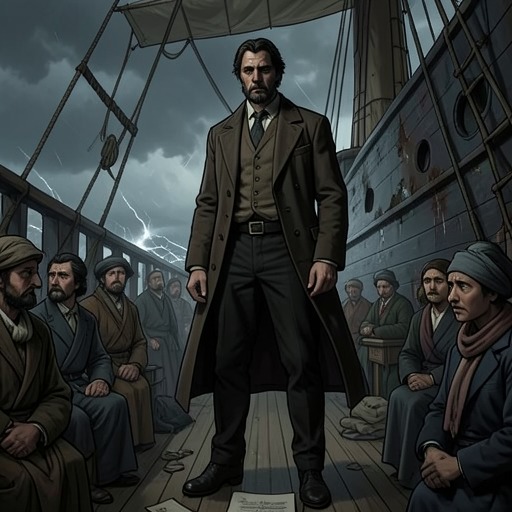
AniaraChefone is the commander whose authority shapes the Aniara’s passage from persecution toward an uncertain, late gesture of aid. Introduced as the “fierce lord of our craft,” he invokes law while using power to indulge cruelty: after Mima breaks down, he targets the Mimarobe and other technicians, and later orders people into hiding. His eventual fear and disappearance alter the meaning of his rule without erasing the violence by which he maintained it.
Authority and the Cosmic Way
Chefone’s position is both political and symbolic. The poem places him against the mystery of the Cosmic Way (the Way of the cosmos), a reality that exceeds divisions such as mind and matter or life and death. His command does not resolve that mystery. Instead, his insistence on law and control appears as a distorted human substitute for it: a claim to order that serves his own cruelty rather than the passengers’ safety.
The critical account accompanying the poems characterizes his rule as dictatorial and says that he sustains it by instilling fear in the Aniarans. He tells them, in effect, that without him they would suffer terribly in the Hell ahead, though his presence offers no convincing prospect of rescue. The gap between his posture as protector and the harm he causes is central to the portrait. His authority depends not only on formal command but on making the passengers imagine that resistance would leave them even more exposed.
Persecution of the Mimarobe and Others
Mima’s breakdown is the immediate context for Chefone’s pursuit of the technicians. Enraged by it, he accuses the Mimarobe and others of malfeasance. The accused are released on a technicality, a reprieve that does not restore confidence in reasoned judgment: the episode is presented as another sign that scientific argument has lost its force in the ship’s crisis. Legal procedure briefly limits Chefone’s action, but it does not undo the threat behind it.
The Mimarobe’s account makes the pressure personal and recurrent. Chefone enters every day to vilify him, and his schadenfreude is plainly visible. The account then records a wider escalation: Chefone orders persecutions, and the speaker and many others are hidden in shelters far down in the Goldonder. This movement from daily verbal abuse to concealment gives his rule a material consequence. People do not merely resent him; they must seek refuge within the vessel from the commander who controls it.
Retaliation and the Limits of Resistance
Chefone’s reprisals make organized opposition difficult. The poem observes that few people willing to resist sacrifice remain once he strikes back ferociously. It associates him with a “bullet-headed breaker of mankind,” an image that stresses blunt destructive force rather than dispassionate leadership. The scarcity of resisters is presented as an effect of retaliation, not as evidence that the passengers have accepted his rule.
His command also reaches into language and performance. In a taunt discussed in the translators’ commentary, he asks, “What do the birdies say?” The deliberately belittling question turns an image of birdsong into a sneer, showing how his speech can make even a nostalgic reference serve humiliation. The poem’s presentation of his rhetoric thus sits alongside the physical threat of persecution: mockery and force are complementary expressions of the same authority.
Dread, Aid, and Disappearance
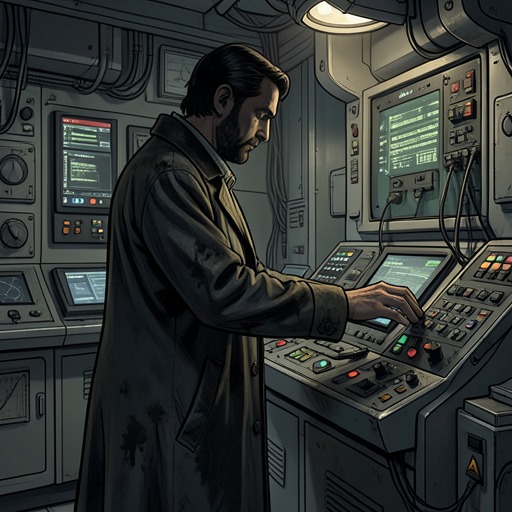
Late in the account, the prospect of the passengers’ final days becomes so bleak that Chefone himself succumbs to dread. He offers ways, displayed in lightscript on his screen, that are meant to alleviate those days. He also gives his enforcers Samaritan costume. These details mark a change in what he does, but they do not establish a full moral conversion: the proposed aid arrives after his reprisals, and the costume keeps the gesture entangled with spectacle and command.
Chefone then vanishes. The poem’s brief response is strikingly physical: the floor where he had been sitting seems to rejoice. His identity is given as Chefone of Xaxacal, a final naming that follows rather than explains his disappearance. No cause or destination is supplied in these passages, so the departure remains unresolved. What is clear is the change registered by those left behind: the space associated with his presence can at last be imagined as relieved of him.
Narrative Role
Chefone embodies the failure of coercive order in a world where neither technical expertise nor political authority can master the larger catastrophe. His appeal to law cannot prevent violence aboard the Aniara; his claim to shield the passengers is contradicted by the fear and concealment his rule produces. Even his late offer of practical relief comes under the shadow of his earlier persecution and his use of staged benevolence.
The progression from daily vilification, to hiding and retaliation, to dread and disappearance gives his character an arc without making it a simple redemption. Fear, which he has used to govern others, finally reaches him too. The rejoicing floor supplies no account of justice or repair, but it makes the cost of his rule legible through the passengers’ response to his absence.