Space-hand
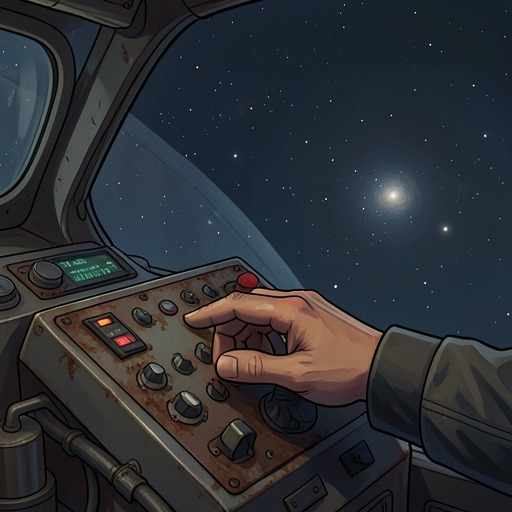
AniaraSpace-hand is a first-person speaker in Aniara whose account gives the evacuation’s long duration a human scale: he remembers years spent moving between Earth and the tundra, the repeated turmoil of departures, and Nobia’s care for those left in Tundra captivity. His voice is both a witness to mass displacement and a keeper of personal memories, returning to the people and places that remain vivid after the journeys themselves have become a life.
Identity and Narrative Position
Space-hand names his position plainly: he has spent nearly thirty years plying the spaces between Earth and the tundra. The description places him not at the center of a single dramatic episode but within the continuing traffic that connects the planet to the evacuation destinations. His experience is defined by movement between places, and by the length of time over which that movement has continued.
He speaks as someone looking back. In one passage, he says that he searches his recollections and thinks he can trace Nobia; elsewhere, he describes memories that still feel like tender wounds. The account therefore brings together two kinds of knowledge: what he has personally witnessed in the evacuation, and what time has left accessible to memory. His testimony is not presented as a complete record of the passengers’ experiences. It is a partial, personal account, shaped by what returns to him.
The poem’s framing also links his recollection to Aniara’s disappearance into the void. Space-hand’s memories do not stop that loss or supply a way back; instead, they give the vanished ship’s history a human point of view. The scale of the cosmic journey is set against the finite work of remembering particular people and places.
Years of Transit and Evacuation
Space-hand recalls the transfer to Tundra Three as taking nine years and the evacuation of Gond as taking ten. These durations make evacuation a protracted undertaking rather than a single departure. The figures also establish the unusual measure of time in his account: years pass in the work of moving people, while successive journeys and assignments accumulate into a working life.
He remembers being aboard the eighth Goldonder. The number gives his own place in the undertaking without making him its sole participant. His ship alternated with other vessels, among them Benares and Canton, as well as Gond and others. The sequence suggests a coordinated traffic in which one ship’s passage was only part of a larger cycle. Space-hand’s recollection thus records both his own experience and the repeated, shared character of the evacuation.
The work’s scale is also present in the span he assigns to his career: nearly three decades between Earth and the tundra. That statement extends beyond the two specific durations. The nine-year transfer and ten-year evacuation become examples within a much longer history of transit, while his own continued presence provides continuity across separate journeys. He is a witness because he has remained in motion through the process, not because the account grants him command over it.
Departure and the Persistence of Memory
When Space-hand describes what he remembers most vividly, he returns to the lift-off zone. The scene recurs in his mind time after time, marked by disorder and by the mingling of tears and angry distress. The emphasis falls on repetition: departure is not retained as one exceptional occasion but as a scene that memory replays. Its emotional force survives the physical movement away from the planet.
This recurring recollection complicates the idea of evacuation as a practical passage from one location to another. Space-hand’s account includes the duration and sequence of transport, but the remembered lift-off zone reveals what those measures cannot contain: the distress of the people being moved. His memories remain tender wounds, suggesting that the passage of years has not made the departures emotionally neutral. The speaker’s long experience is therefore not simply a record of accumulated travel. It is also a record of exposure to scenes that continue to affect him.
The contrast between recurring images of departure and the practical vocabulary of ships, routes, and years gives his testimony its particular shape. The vessels can be counted, and the operations assigned durations; the human memory of leaving returns without being resolved by those measurements. In this sense, Space-hand’s retrospective voice registers the cost of an undertaking that might otherwise be described only by its logistics.
Nobia and Acts of Care
Nobia stands out within Space-hand’s recollections as someone whose practical assistance mattered to the people held in Tundra conditions. He recalls that she cleaned and sewed for the captives there. These acts are specific and useful: they answer ordinary needs within a displaced community, rather than offering an abstract consolation. The account associates Nobia’s value with what she did for people whose circumstances required continuing care.
Space-hand also wonders whether life would be worth much without Nobia there to compensate. The question makes her presence more than one remembered detail among many. It presents her as a person whose contributions helped offset the deprivation of life among the captives. The poem does not explain the full extent of her role, so her importance is most securely understood through these concrete acts and through the speaker’s insistence that her absence would matter.
His later search through memory for Nobia gives that relationship a further dimension. She is someone he tries to recover from the past as Aniara is swallowed by the void. The remembered person and the remembered place are not interchangeable, but both anchor his attention against loss. Through Nobia, his account holds on to the everyday labor that made survival and companionship possible amid the larger process of evacuation.
Narrative Significance
Space-hand’s importance lies in the contrast his voice establishes between cosmic disappearance and grounded recollection. He speaks of decades of travel and ships moving in sequence, yet the memories that surface most powerfully concern the lift-off zone and a woman who cleaned and sewed for captives. The poem’s vast setting does not erase such details; it makes their survival in memory more consequential.
His testimony remains limited and openly retrospective. He can trace back toward Nobia, revisit the departure scene, and report his years of service, but those acts of remembering cannot reverse the journeys or restore what has been lost. The result is a witness whose authority comes from duration and proximity, while the incompleteness of recollection remains part of the account. Space-hand preserves neither a comprehensive history nor an escape from exile; he preserves the human details that the movement through space would otherwise leave behind.