Isagel
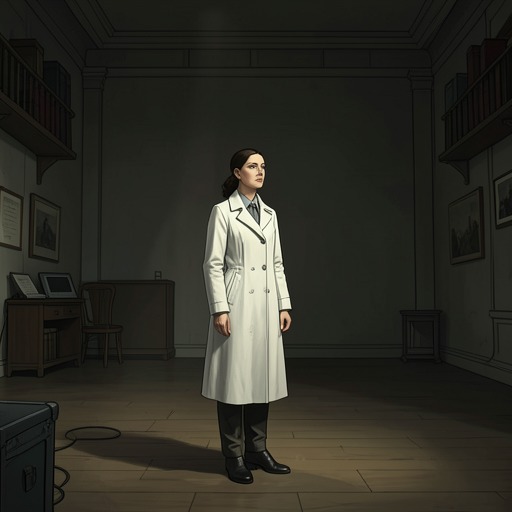
AniaraIsagel is Aniara’s pilot and one of the poem’s most searching figures: a precise scientific mind whose hunger for knowledge is also a hunger for spiritual light and connection to the material world. The catastrophe surrounding the ship frustrates her work and erodes her faith, but the Mimarobe’s final understanding of her changes the scale of her significance. In a dream, Isagel is revealed not simply as a lost companion but as Mima’s inmost self, joining mathematical intelligence to moral sensitivity.
Identity and the Work of Searching
Isagel is introduced as the ship’s female pilot and as an intellectual emanation of Doris. The distinction matters: the comparison links her to an earlier figure associated with the world, while the disaster aboard Aniara makes Isagel a person in acute distress. Even before Mima’s breakdown, the general crisis is visible in her. In the immense darkness into which the ship has blundered, Mima’s promise of spiritual illumination becomes the fuel that keeps Isagel from the suicide she would otherwise gladly choose.
Her work is marked by attention to things that can be read and studied. During the twentieth spring, while the passengers study the blaze of a star in Lyra, Isagel reads a sequence of beta and gamma rays. The scene places her scientific practice inside the voyage’s widening isolation: the lights and signals she examines are present, but the ship’s distance from any usable world leaves knowledge without an obvious path toward repair. Her activity is not mere technical procedure. The poem associates it with a searching intelligence that tries to recover contact with the world through material processes.
Inspiration and Frustration
Isagel’s devotion to Mima leads to what the poem presents as a gift: an infant-like inspiration conceived within her own mind. She receives it with an embrace and evident joy, as though a new life has arrived. Yet this birth offers no practical escape from the ship’s circumstances. The inspiration must travel with the passengers ever farther toward Lyra and is destined to vanish there; Isagel cannot put it to use. The promise of creative renewal thus becomes another measure of the conditions that defeat her. Her “baby” is born in vain, not because the poem denies its value, but because the post-terrestrial world gives her no means to make that value effective.
That frustration alters her relation to both science and other people. As her faith in scientific activity weakens, Isagel grows warmer. She becomes, in spirit, a sister to Libidel, whose rites she had once attended. The change is not described as a return to the confidence of her earlier scientific life. Rather, the poem brings intellectual disappointment and human tenderness into the same arc: the person whose mind once searched for fuel for spiritual light comes to share a closeness once associated with ritual and affection.
Breakdown and Departure
After the collision with the Leonid, Isagel turns accusation against herself and feels like Death. Her wish is for a new dispensation at the heart of things, where the Aleph Numbers are stored. She vanishes into a primordial Mind described as existing before laws and therefore free to establish new ones; Chance becomes the world’s new overlord. This departure is at once a disappearance from the ship’s ordinary life and a movement toward a realm where the existing order can be remade.
The poem also marks the cost of that transition in the body. Its account of Isagel’s breakdown shows her splendid mind giving way: a fevered demon rises into her eyes, and her pupil dilates toward the wellspring of her soul. The image does not explain her condition as a clinical diagnosis. It stages the visible rupture between the concentrated intelligence that has defined her and an inner force that can no longer be held within its former bounds. Elsewhere the narration says that she spared Aniara from a last resort, but the supplied account does not specify the action; what remains clear is that her later collapse follows a life in which she has continued to act amid catastrophe.
Mimarobe, Mima, and the Final Dream
In her phantasmal existence, awaiting rebirth into form, Isagel makes one final visit to the Mimarobe in a dream. The visit illuminates the Mimarobe and becomes an epiphany: Isagel is understood as Mima’s innermost self, Mima’s soul. This recognition binds the two figures through more than their shared association with the ship. Both combine subtle mathematical intelligence with a fastidious moral sensitivity, and both eventually die of that sensitivity.
The Mimarobe’s account also places Isagel among the poem’s searchers. Her early hunger for spiritual light finds a counterpart in Mima’s repeated search for signs of life that might relieve the passengers’ distress. Both use powers of thought arising from material processes—electrical in Isagel’s case, biochemical in Mima’s—to seek renewed connection with the material world and with Things. Their kinship therefore joins matter and spirit rather than treating them as opposites: the world’s substance is presented as a home of worth, and the loss of Things sends these searching figures toward a primordial elsewhere until a new age can begin.
Character and Significance
Isagel’s trajectory does not offer a conventional recovery. Inspiration arrives but cannot be used; scientific faith fades as warmth grows; a mind that has tried to read the physical world breaks down, then passes beyond the order of its laws. The dream revelation gives that ending a relational meaning without undoing its loss. For the Mimarobe, Isagel’s identity reaches beyond the role of pilot or companion: she is disclosed as the inward soul of Mima, another searcher whose intelligence and moral care had tried to keep contact with a world slipping away.
The character’s central tension is between powers of perception and the circumstances that make perception futile. Isagel can study radiation, conceive an inspiration, and seek a new order at the heart of things, but none of these acts restores the world in which her discoveries could be lived out. Her disappearance carries that failure into the poem’s larger metaphysical scale. It imagines the possibility of rebirth and new laws, while leaving the human cost intact: the searching mind has found an elsewhere, but not a way back to the life that made its search necessary.