Mimarobe
AniaraMimarobe is the unnamed narrator and tender of Mima aboard Aniara, a refugee ship whose passengers have been cut off from Earth. His role joins practical care to acts of seeing and telling: he tends the machine, offers its cosmic transmissions to the emigrants, and witnesses its transformation from a source of information into a being wounded by humanity’s destruction. Through him, the poem makes the preservation of knowledge and attention a fragile counterforce to denial and catastrophe.
Identity and delayed introduction
At first, the speaker appears only as one person among the masses registering for evacuation from a radioactive Earth. His identity is withheld: he is presented as a witness to the exodus before the poem identifies him as the man who tends Mima. That recognition comes in Poem 6, retrospectively giving a specific occupation and responsibility to the previously indistinct voice. The delay matters. The narrator first speaks from within a population facing displacement, and only later emerges as the individual entrusted with the ship’s extraordinary instrument of perception.
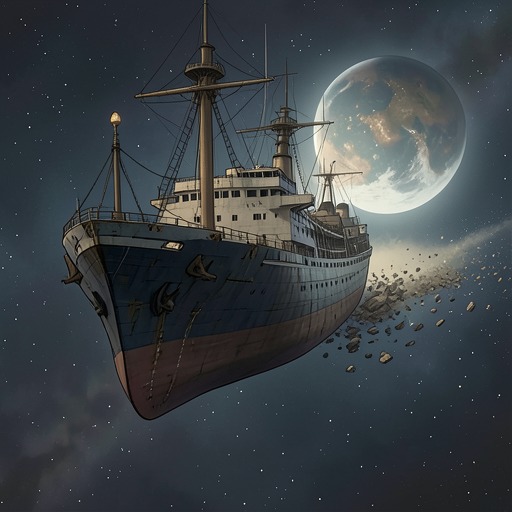
The evacuation is meant to carry refugees to labor camps on Mars or Venus until Earth can be detoxified. Instead, an asteroid knocks Aniara off course and irreparably damages its steering mechanism; the vessel becomes a ghost ship, drifting farther from home. Earth itself is destroyed in the final nuclear war. This situation defines the limits of Mimarobe’s work: he can keep the emigrants in contact with visions and information, but neither his care nor Mima’s reach can restore their route or the world they have lost.
Tending Mima and caring for the emigrants
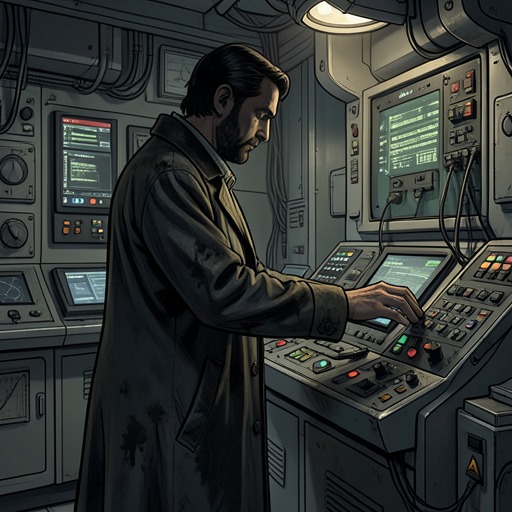
Mimarobe describes his work as tending Mima and calming the emigrants. He does so by showing them scenes from far-flung regions of the universe, material gathered from realms no human eye could otherwise see. The task is more than mechanical maintenance. He mediates between Mima’s immense store of impressions and a shipboard population living through confinement and separation, making the machine’s transmissions available as an experience the passengers can watch and respond to.
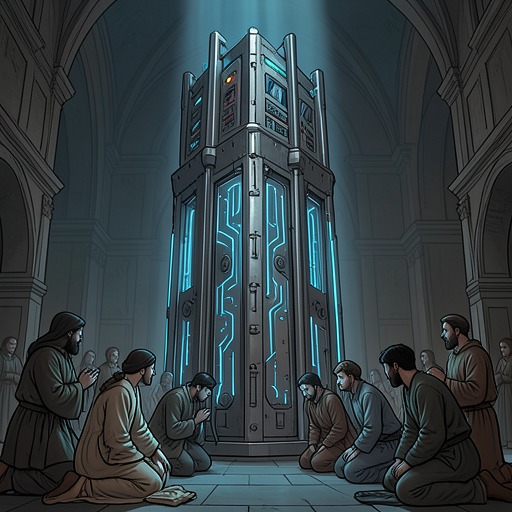
That service has an uneasy consequence. Mima can transmit signals from across the intra-galactic seas, and its truthfulness gives the passengers a connection to realities beyond the ship. Yet the emigrants also use its vivid, continuing images to evade the reality of Earth’s destruction. They worship Mima partly because its transmissions seem to confirm that life still exists within their reach; its visions can blot out the world they remember and have abandoned. The same instrument that preserves knowledge can therefore become a means of denial. Mimarobe’s work brings this contradiction into focus: he offers consolation, but the images cannot undo the loss they soften.
Mimarobe and Mima
Mimarobe’s relation to Mima exceeds that of an operator to a device. He is described as its confidant, and Mima is treated not merely as equipment but as a being capable of suffering. Its transmissions carry the consequences of human violence: Mima has beheld stone and ore vaporizing, and the destruction of even enduring things troubles it. The catastrophe is thus registered not only in the passengers’ exile but in the distress of the entity that receives and communicates the universe’s signals.
Mimarobe’s oath is called the goldondeva, a detail that gives his service a formal and binding dimension without making him a named hero. His own account makes the opposite point about personal identity: he has no name and is called only Mimarobe. The occupational title defines him through his relation to Mima. At the same time, that relation is intimate rather than merely functional: he tends the machine, attends to its power, and stands before it when it calls him forth. The poem leaves the precise boundaries between human attendant and extraordinary machine open, while making their connection central to its account of witnessing.
Voice, ending, and narrative role
The commentary on the poem presents Mimarobe as more than a mechanic: his technical skill serves a mind committed to conceiving and connecting the things of Earth. It also compares his role as the arranger of Mima’s displays to the poet’s power to conjure and communicate things beyond ordinary sight. This parallel does not make Mimarobe identical with the poet; rather, it identifies the work of mediation as the narrator’s defining function. He receives, selects, and shares what might otherwise remain unseen, even as the audience may use that vision to turn away from painful knowledge.
Near the poem’s end, Mimarobe’s voice is placed within a collective image of the passengers lying in an immense sarcophagus as Aniara passes into empty seas. The shift from the earlier work of tending and showing to this image of shared enclosure gives his service a stark limit: the narrator can preserve testimony and accompany the emigrants, but he cannot lead them back. His final narrative significance lies in that unresolved task. He is at once a caretaker of Mima, a witness to the passengers’ self-deception, and the human voice through which the poem’s record of lost worlds continues.