Libidel
AniaraLibidel is a former religious leader aboard Aniara whose decline is registered through small, intimate details: a winter evening spent making herself up, the shrinking attendance of her former devotees, and a brooch that feels like a wound. Her mirror song turns that spectacle inward, making her not simply an object of others’ attention but a speaker examining the precarious place her life has reached. A later secret dirge associates her with the fallows of Karelia, extending her portrait from lost authority to a world marked by barrenness.
Identity and Former Authority
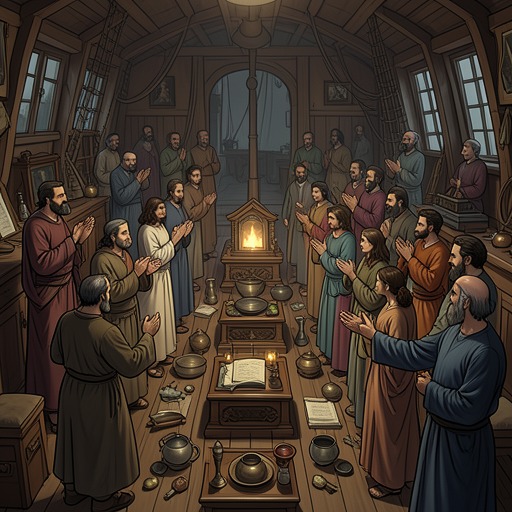
Libidel’s position aboard the ship is defined by a sharp contrast between past influence and present isolation. She had led a body of devout followers, and adepts had once come to seek comfort on her lap. By the time the poem turns to her, however, many of those adepts are privately developing doubts. They no longer crowd around her as they once did. The change is not presented as a formal declaration or a public confrontation: its evidence is the altered pattern of attendance, a diminishing closeness that becomes visible in the space left around her.
That withdrawal matters because Libidel’s authority had been embodied in intimacy. Her followers had approached her for ease and sat close while she led them; the reduced gathering therefore signals more than declining numbers. It marks the loosening of a devotional bond whose rituals had depended on trust in her presence. The poem gives no account of what initiated the adepts’ doubts, and it does not describe Libidel’s response as a policy or campaign. Instead, the change is made legible through her exposed solitude and tremor, as a former leader waits for the attention on which her role once rested.
The Winter Evening at the Mima Hall
Behind the Mima hall, on a winter evening, Libidel sits making herself up. The setting is at once public-facing and withdrawn: she is near a hall associated with her worship, but the scene focuses on her alone, preparing her appearance. She wears a thigh-bell and a buddha-cat. These specific ornaments give the moment a ceremonial or performed quality without erasing its vulnerability; the poem presents adornment as something she actively arranges while the community that once gathered around her is thinning.
Her clothing also directs attention across the body. Fabric from Xinombra draws the eye away from what the poem calls physical disgraces. The image does not treat clothing as a cure or suggest that the bodily conditions have disappeared. Rather, the fabric redirects a viewer’s gaze, making the act of presentation part of Libidel’s effort to inhabit a public role under altered circumstances. The detail connects outward appearance to the social scene: the body is seen, evaluated, and partly concealed at the very moment when her followers’ attention is receding.
The poem then narrows from costume to gesture. Libidel trembles as she adjusts her hair; the navel-brooch feels to her like a wound, even as she continues to hope that her breasts remain ample. The juxtaposition is exacting: an ornament meant to adorn the body is experienced as an injury, while hope attaches to the continued appearance of another part of it. These are not interchangeable signs of vanity. Together they expose the effort required to keep presenting a body as desirable and composed when its owner experiences it through discomfort and the awareness of physical disgrace.
The Mirror Song
The scene leads into Libidel’s song at the mirror, which names her life as occupying a strange or unsettled place and invites another presence to look at and touch it. The mirror is therefore not only a device for checking appearance. It frames self-inspection as an address: Libidel turns the act of looking into a call for a witness. The song’s movement from a life that feels oddly situated to an invitation to approach makes the mirror scene a direct counterpart to the earlier retreat of her devotees. Where followers once came to her for ease, the song asks for renewed attention at the level of the individual body and life.
That invitation does not establish that the audience answers, nor does the poem resolve the gap between the speaker and the listener she calls toward her. Its force lies in the exposure of that gap. Libidel sings from a setting in which adepts are privately losing faith and no longer gathering close, but she still makes an appeal for contact. The mirror holds these conditions together: it offers an image to inspect, yet the song insists that looking alone is not enough. The request for touch gives the scene a human immediacy while leaving the hoped-for response uncertain.
The Secret Dirge and Its Significance
A later appearance identifies Libidel through a secret dirge, set in the context of the fallows of Karelia. The change of register is telling: the winter scene behind the Mima hall has shown her grooming herself and confronting the marks of bodily vulnerability, while the dirge places her voice beside a landscape named for its fallow ground. The poem thus links personal diminishment with a larger image of barrenness without explaining one as the literal cause of the other. Libidel’s song remains an act of expression within a damaged world, not evidence that she has recovered her former following.
Across these scenes, the poem measures decline through shifts in attention and voice. Libidel once led the devout and received their close presence; now many adepts keep their doubts private, and she appears alone in the work of making herself up. Her mirror song converts self-scrutiny into a plea for witness, while the later dirge gives that voice a place among the fallows. The sequence preserves her as both a figure of religious authority in retreat and a person whose gestures, ornaments, hopes, and songs make the retreat intimate. It does not supply a final restoration or a stated resolution: the enduring image is of a former leader still composing herself and singing after the circle around her has begun to loosen.