Sandon
AniaraSandon, called the arch-comic, is a space-dwelling entertainer whose performances give Aniara’s passengers a shared response to the desolation around them. He makes delight audible in the form of a screech called a Blahr, and his comic exchange with the audience briefly turns their isolation into participation. His eventual loss in the cosmic sea, after the fortunes of humanity have worn him down, makes that brief communal laughter part of a darker account of time and mortality.
Identity and Place in the Narrative
Sandon is presented through his function as a comic performer rather than through a personal history or a developed account of his life outside the act. He lives in space, and the poem calls him the arch-comic: both a description of his role and a title that gives his appearance a deliberately outsized quality. The passage does not explain his origins, the circumstances that brought him into space, or what his life entails away from performance. Instead, it places him within a succession of images of people and conditions encountered during the passengers’ long ordeal.
His audience consists of women and men whom the sensation of light-years brings together. The phrasing makes distance more than scenery: the passengers share an experience of immense separation, and Sandon’s entertainment reaches across that common condition. He is not described as changing their circumstances or undoing their isolation. His significance is more modest and more immediate: he gives the gathered people a reason to feel and answer something together.
The Act and Its Audience
The performance is organized around a distinctive sound. When delight falls to zero beneath the glare of distant suns, Sandon gives voice to the screech called a Blahr. The conditional structure makes his act seem responsive to a vanishing of pleasure: the Blahr arrives not amid uncomplicated happiness, but when delight has been reduced to nothing. Comedy thus appears as a countergesture to a bleak setting, rather than evidence that the setting has become benign.
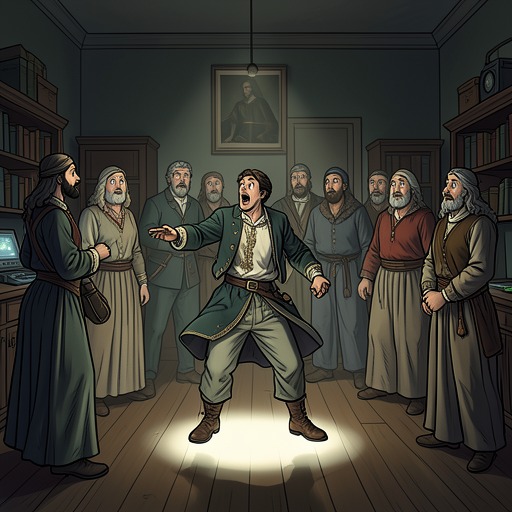
Sandon enters the stage in a three-legged car, an incongruous concrete prop that makes his appearance comic before he even produces the sound. The crowd howls when he arrives; he answers with a blahr. This exchange is the clearest account of how the act works. The audience’s howl can register as laughter and as an echo of Sandon’s own noisy performance, so performer and spectators meet in a deliberately rough call-and-response. The moment briefly makes the audience active participants rather than silent witnesses to their surroundings.
That shared response matters because the passage sets the show against collective distress. The sun has turned its blaze away from the bands of deported, while the speaker describes the group’s condition as a nightmare paralysis. Against that scene, Sandon cavorts. The contrast does not suggest that he can rescue the passengers from what has happened; it marks the narrow interval in which performance can interrupt their distress. His humor is bodily and audible, carried by an entrance, a vehicle, a howl, and its answering sound.
Disappearance and Significance
The poem then overturns the apparent durability of Sandon’s role. Everything, it says, falls to the grave, which even adores jeux d’esprit; the arch-comic himself is lost in the vast cosmic sea. The juxtaposition makes wit and mortality coexist without allowing comedy to defeat death. Sandon’s disappearance is not framed as a triumphant escape or as a joke that outlasts its maker. The cosmic scale that once supplied the setting for his performances becomes the expanse in which he is lost.
The passage links that loss to exhaustion: worn down by the burdensome fortunes of humanity, Sandon gives up his blahr and fills out his lifespan. The Blahr that had answered the audience’s howl therefore becomes a measure of what has ended. The poem does not specify the particular hardships that exhaust him or describe a final performance; it presents the relinquished sound and completed lifespan as the decisive facts. His end is consequently both individual and representative. The entertainer who helped people share a moment of delight is subject, like everything else, to the forces that carry life toward its limit.
Sandon’s brief arc depends on this reversal: he first restores a response where delight has dwindled, then disappears under the same cosmic condition that frames the passengers’ existence. The performance does not cancel the surrounding nightmare, and its value does not depend on lasting forever. Rather, the crowd’s answering howl gives temporary form to a community under strain, while the loss of the performer reveals how temporary that form is. His comedy is remembered alongside, not outside, the grave and the burdensome fortunes of humanity.