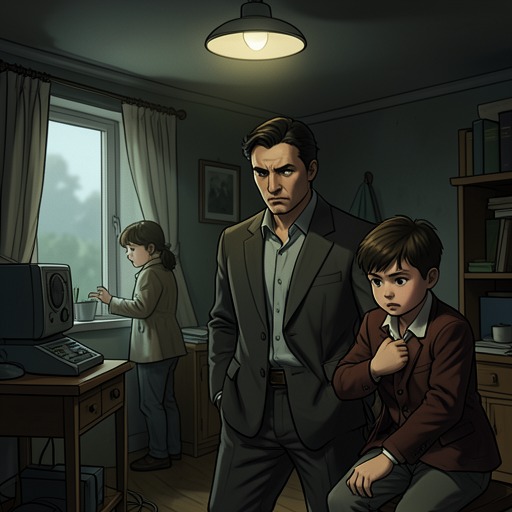
Max Raphael and Charlie Raphael’s father-son relationship
AsylumMax Raphael and Charlie Raphael’s relationship is shown less through private exchanges between father and son than through the pressures surrounding their family: Stella’s absence, Charlie’s return, a new school, and finally his drowning. Max accompanies Stella to meet the returning Charlie and says that he stays with her because the child needs a mother. At the end, however, it is Max who confronts Stella with the silence that preceded Charlie’s death. The relationship emerges through these shifts in responsibility, care, and accusation, rather than through a sustained account of father and son alone.
Family Crisis and Charlie’s Return
After Stella has left, Charlie is staying with Brenda. Stella has called him every day, but has not seen him; she recognizes that he is hurt because she went away without preparing him and that he may have felt abandoned. She imagines that he first took the departure as his own fault, then came to blame her for his unhappiness after Max and Brenda gave his confusion a more definite shape. These are Stella’s interpretations, not a direct account of what Max told Charlie. Still, they place Max within the child’s experience of his mother’s absence: his views, alongside Brenda’s, may influence how Charlie understands the rupture.
Stella believes Charlie wants to come home and wants both to love his mother and to know that she loves him. When Brenda says he is not there, Stella knows she is lying and asks to speak to him. Charlie eventually tells his mother that he has been going to see things and now wants to come home. His return is thus not presented as a simple restoration of the household: he has been hurt, and the adults have not agreed on how or when he should return. Max’s part in this stage is not given as a conversation with Charlie. The account instead shows him in the strained family arrangement around the child, while Stella tries to re-establish contact and Brenda obstructs it.
Reunion and the Hope of a Haven
Max drives with Stella in the afternoon to meet the train. He is silent during the journey, while Stella anticipates that he may want a divorce and decides not to raise the subject. Her immediate wish is for a haven and time to recover from the shock of losing Edgar; she is not yet ready for another upheaval. The meeting therefore carries two different kinds of expectation: for Stella, a chance to regain her son and a measure of ordinary life; for Max, whose thoughts are not disclosed, an encounter within a marriage already under strain.
Charlie is nervous when he gets off the train. Brenda is there with him, and Stella crouches to take his hands. He then falls into her arms and kisses her on the lips. Max is present on the platform, but the narrated reunion concentrates on the physical closeness between mother and son, not on an embrace or exchange between father and child. Brenda’s lifted eyebrow, directed at Max, keeps the scene embedded in the adults’ conflict even as Charlie and Stella come together. On the way to the car, mother and son go first hand in hand, with Max and Brenda following.
Stella feels that a great weight has lifted. She believes that if she and Charlie are all right, some semblance of normal life can continue; she expects Max to stew quietly and Brenda to condemn her to her friends, but regards those judgments as less important than her restored connection with Charlie. This is Stella’s sense of what the reunion changes, not evidence that the tension between father and son has been resolved. Max’s silence remains part of the scene, and the hoped-for normality rests, in her account, on the repaired mother-child bond.
A New Home and the Work of Parenting
After the family’s move, Charlie starts at the local school the following Monday and comes home miserable. He finds the other children rough and unfriendly, and is lonely in the playground and troubled by unfamiliar classroom routines. Stella gives him a long hearing and reassures him that starting again in a new place is difficult, but that he will have to do it throughout his life; learning to manage it now will be useful. His question, “But why do we have to start again?”, makes the move legible from a child’s perspective as repeated disruption rather than simply an adult decision about work.
When Charlie asks why, Stella answers, “Because of Daddy’s job.” The explanation assigns the move to Max’s employment, although it does not describe what Max has told Charlie or how the two of them discuss the change. The scene gives Stella the immediate role of listening and explaining; it does not establish that Max is absent from Charlie’s life or indifferent to his adjustment. Its narrower significance is that the child’s dislocation is connected to the family’s adult circumstances, and that Stella interprets those circumstances for him.
Max later states the reason he remains with Stella: “I stay here, with you, for one reason only, and that’s because I think that child needs a mother.” He frames his continued presence in the household around Charlie’s need, but specifically names the need for a mother. When he adds that Stella shows the child little warmth, his concern is directed at her care of Charlie, not expressed as a description of his own bond with his son. The exchange consequently reveals an important limit in the evidence: Max’s commitment to the family is articulated as a judgment about what Charlie needs from Stella, while the narrative offers no comparable account here of direct father-son tenderness.
Drowning and the Final Exchange
After Charlie drowns, Max comes home and sits at the table, staring at Stella. His first question is, “But why didn’t you shout?” He repeats the point in the same astonished tone: “You didn’t make a sound. You didn’t open your mouth.” The questions make Stella’s failure to call out the immediate subject of their exchange. Max does not ask her to explain the family’s earlier conflicts or the move; his attention fixes on the moment when Charlie needed help and she remained silent.
Stella finds the question amusing, a response that sharply contrasts with Max’s bewilderment and with the gravity of Charlie’s death. That contrast is part of how the father-son relationship is rendered: Charlie is absent from the exchange, but his death shapes every word in it. Max speaks as the surviving parent seeking an explanation of what happened to his son, while Stella’s reaction makes clear that his understanding and hers have diverged radically. The text does not supply a full account of Max’s grief or of his earlier private life with Charlie; instead, it places the father’s stunned question at the point where the family’s shared future has ended.
Across these episodes, Charlie’s needs and losses repeatedly expose the limits of the adults’ accounts of family life. Stella’s departure leaves him feeling abandoned; the return restores their physical closeness without resolving the strain around them; the move produces a new loneliness that she helps him interpret; and his drowning leaves Max confronting Stella’s silence. Max’s fatherhood is thus most clearly visible in the responsibilities and consequences gathered around Charlie, and in the final insistence that the child’s unanswered need for help cannot be reduced to the adults’ earlier disputes.