Stella Raphael and Trevor Williams’s affair
AsylumStella Raphael and Trevor Williams’s affair is a brief, unequal sexual relationship formed during Stella’s emotional withdrawal at Plas Mold. Williams’s advances briefly make her feel more alive, but the encounter begins in resignation, and its temporary relief leaves the deeper collapse of her family life untouched.
Circumstances and First Encounter
Stella is married to Max Raphael, a reserved and melancholy forensic psychiatrist, and they have a ten-year-old son, Charlie Raphael. The marriage had begun when Stella was barely out of her teens. By the time of the affair, the family’s life together has become strained, and Stella’s attention remains fixed on Edgar Stark, whom she imagines still somewhere beyond her reach. Her long walks in the rain and her watch for Edgar in nearby towns coexist with an increasingly colorless domestic routine.
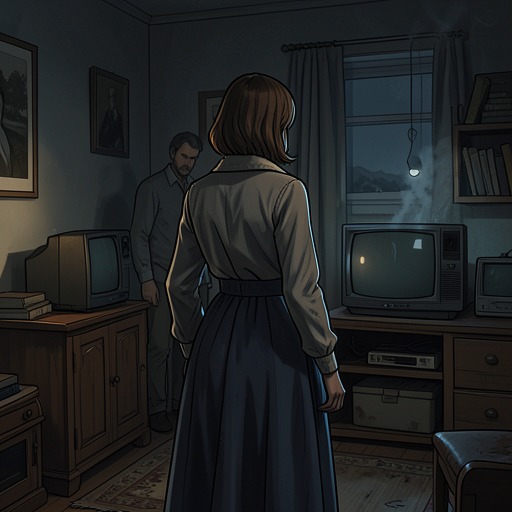
The first encounter takes place in the middle of November, on a morning when Mair has gone to stay with her mother for a few days. Stella is at the kitchen table in her dressing gown when Trevor Williams knocks at the back door and asks to come in. He stands looking out across the valley; Stella watches him from beside the stove, unsettled by the stillness of the day. His visit turns into sexual contact without a prior arrangement or an expressed invitation from her.
As Williams touches her, Stella lets her legs part and reasons that stopping him would be troublesome and that he might rape her. She asks him to go upstairs; in the bedroom, she keeps her mind empty and tells him only that he must not climax inside her. The scene presents her acquiescence not as the beginning of a mutual courtship but as a response shaped by sexual deprivation, passivity, and a diminished sense of agency.
An Affair Without Courtship
After the first encounter, Trevor Williams tried to make what he called arrangements. Stella was uninterested: she would not fit herself into his timetable or ledger. Her curiosity about how he had entered her kitchen and obtained sex seemed satisfied, and she felt as indifferent to him as before. The episode had not opened into a courtship or a shared emotional life; for Stella, it was an incident she had allowed to happen, followed by a refusal to organize her days around him.
Williams returned some days later, and Stella again yielded. She came at least partly to life sexually with him, while the sex made her calm and sleepy and temporarily relieved her anxiety. The relief was real but narrow: it quieted her for a while without restoring her interest in the household or changing her attachment to Edgar. Mair recognized that something was happening, yet continued to visit Stella for tea; their silences offered a brief interruption to Stella’s numbness, whether Mair or Williams happened to be present.
The affair proceeded alongside the deterioration of Stella’s marriage to Max Raphael. Their sleeping arrangements had become awkward, and Max’s suits hung in Stella’s room, which she did not want him entering early in the morning. He began to express his sense of injustice and seemed to withdraw the gallantry with which he had treated her. Stella understood that the family life still sheltering her might end, with Max leaving and taking Charlie, but could not make herself respond to him with anything but indifference. Williams’s visits therefore took place within a household already losing its shape, rather than creating that rupture by themselves.
After Mair returned, Williams twice coaxed Stella into a small stone outbuilding, where he had her bend over hay bales. Stella recalled the encounters on a sleepless, windy night, alongside the children’s laughter at her and a teacher’s warning that she was making Charlie unhappy. She understood their sex as dispassionate, in contrast to the weeks she remembered with Edgar, and the contrast sharpened her sense of emotional disconnection. At the same time, she continued to search for Edgar in the streets of Cledwyn and Chester and to treat clouds, birdsong, and flowers as signs of contact with him. Her relationship with Williams remained a bodily respite within that fixation, not a replacement for it.
Meaning and Limits of the Affair
The relationship’s defining imbalance is that Trevor Williams pursues access while Stella Raphael does not seek intimacy with him. In the kitchen, she submits partly because she expects resistance to be troublesome and fears he might rape her; afterward, she refuses his attempt to arrange further meetings around his timetable. Her acquiescence and her refusal coexist: she allows the encounters, but does not invest them with courtship or emotional commitment. The distinction keeps the affair from becoming a new romantic attachment. Williams briefly interrupts her numbness, yet remains someone to whom she feels largely indifferent.
The sex offers a temporary bodily reprieve rather than a change in Stella’s loyalties or circumstances. Its calming, soporific effect helps her manage anxiety, while her thoughts continue to return to Edgar Stark and to the imagined signs through which she sustains contact with him. In that contrast, the affair registers less as a rival love than as an episode within Stella’s isolation: physical sensation can briefly make her feel alive, but cannot restore connection to her family or displace the absent man around whom her inner life is organized.
The Absent Third Point
The affair unfolded in the shadow of Edgar Stark’s escape and Stella’s continuing hope that he might return. That hope was built around a man whose earlier conduct had not become safer with the restoration of his ordinary functioning: he still insisted that the murder of Ruth Stark had been justified, interpreting trivial household details as evidence of infidelity. The hospital therefore continued to hold him, and he escaped by putting on Max Raphael’s clothes. These facts sharpen the contrast at the center of Stella’s relationship with Trevor Williams: Williams was physically present, but the person who organized Stella’s imagination remained both absent and dangerous.
The difference between what Stella knew and what she sustained emotionally is crucial. She could search nearby streets and invest natural signs with a sense of contact with Edgar, while her encounters with Williams offered only a short-lived bodily quiet. His visits did not resolve the uncertainty of Edgar’s whereabouts or dislodge the imagined bond; neither did they give Stella a new account of herself beyond the domestic life that was failing around her. The affair’s limited force lies in that coexistence: a tangible sexual relationship occupies the same period as a more powerful attachment maintained through memory, expectation, and absence.