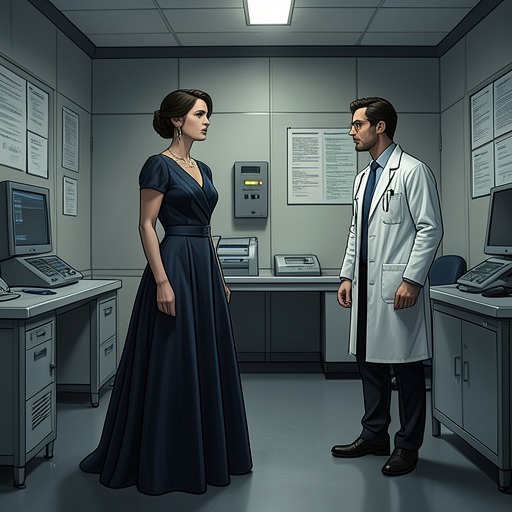
Peter Cleave and Stella Raphael’s friendship and doctor-patient relationship
AsylumPeter Cleave and Stella Raphael’s friendship becomes a doctor-patient relationship at the point when she is most isolated: after Charlie Raphael drowns, she is detained, profoundly depressed, and unable to explain her inaction to the police. Peter is the visitor whose presence brings her to tears and the psychiatrist who arranges her return to the hospital. Their bond is both a source of trust and a relationship shaped by the authority he exercises over her care.
Early acquaintance and professional judgment
Peter first meets Stella and Max Raphael when Max is considered for the deputy superintendent’s post. Peter thinks Max reserved, melancholy, competent as an administrator but weak, and lacking the imagination to satisfy Stella. That judgment establishes an early asymmetry: Peter regards himself as able to read the marriage from outside, while Stella’s later disclosures show how much he does not yet understand about her private life.
Peter’s professional interest in Edgar Stark also forms part of the background to his relationship with Stella. He knows that Edgar has killed his wife, Ruth Stark, and that, despite functioning intelligently, Edgar still insists the murder was justified. Peter considers this unresolved belief grounds for keeping Edgar at the hospital. When Stella begins talking with Edgar in the garden, she tells herself that befriending a patient can do no harm. The situation thus places Peter’s clinical knowledge and Stella’s personal choices in the same institutional landscape, although the evidence does not show him intervening in their early conversations.
The garden and the beginning of the crisis
The vegetable garden becomes a point of return for Peter and Stella after the catastrophe. On a cool morning in late October, they walk there among fallen apples while men burn dead leaves. Stella tells him she is sad that she will not see another spring or summer in the garden. She is paler, slower, and more burdened than before, and says that other people greet her but cannot look at her because she offends their sense of decency. She has heard nothing from Jack Straffen and assumes Peter, her old friend, is with the Straffens.
Peter’s concern is direct, but he cannot know the full depth of her suffering. He tells her he is relieved she has come to no harm; Stella replies that he cannot know what harm she has suffered and touches her breast to distinguish an inward wound from visible injury. When Peter predicts that she will heal, she asks him to visit again and says he is her only friend. Before he leaves, she asks whether he knows where Edgar is. Peter says he does not. Her appeal for friendship and her question about Edgar coexist: she seeks his presence without surrendering the attachment that continues to trouble her.
Bereavement, trust, and treatment
After Charlie drowns at Cledwyn Heath, Stella is questioned at the police station and has no answer when asked why she did not shout. Hugh Griffin’s account—that she stood smoking while Charlie struggled in the water—turns public sympathy into condemnation. People call her unnatural, evil, a monster, or mad. During the questioning and detention, she experiences herself as numb and detached, watching herself from within a barricaded part of the mind and seemingly from a point above and to one side.
Peter’s visit breaks through that numbness. Stella had not expected him; at the sight of him she feels the first faint stirrings of emotion in days, and his expression of sympathy brings her to tears. With medication and no immediate demand placed on her, she can sleep and drift. She also tells Peter what she saw in the water. He observes her depression and physical deterioration, and his visits become the central event of her day, making the rest more bearable. When he asks whether she wants him to continue looking after her, she gives him the name of the hospital she expects to enter; Peter confirms that she will come there and that he will care for her.
Peter’s commitment is also an assertion of professional authority. He believes he is the person best qualified to treat Stella and acknowledges that bringing her back to the hospital may seem unorthodox or dangerous. He nevertheless has the position to make it happen. His care therefore cannot be separated from the power to direct her treatment and movement. His insistence that she meet Max is another exercise of that authority: Stella pleads not to go through with it, but Peter firmly requires the meeting, arguing that she must trust him and that reconciliation matters to Max as well as to her.
Hospital care and interpretation
As Stella’s treatment proceeds, Peter sees the transfer from the admissions ward to a downstairs ward as evidence of progress, while also recognizing the patient’s view of the system. In his account, downstairs patients have more privacy and freedom of movement, and they learn that visible composure is treated as improvement. Stella understands that an outburst could undo weeks of self-control and that her effort must not be obvious to attendants. Her apparent calm is therefore both a step in managing herself and a performance required by institutional expectations.
Peter notices the change in Stella after her transfer: she can wear her own clothes, moves more slowly, and seems stiller. He also notices that Edgar no longer dominates her thoughts as before. When she reports nighttime headaches after indistinct, terrifying dreams, she minimizes them and asks for aspirin. Peter interprets the screaming she cannot explain as the returning sound of a drowning child and believes it signals the beginning of guilt she had repressed. He takes this as evidence that she is letting go of Edgar and beginning to face Charlie’s death. These are Peter’s clinical conclusions, not explanations Stella herself is yet able to give; the relationship depends in part on his willingness to interpret what she cannot articulate.
Friendship and clinical power
Peter’s role combines attachment and treatment without making them equivalent. Stella calls him her only friend, depends on his visits, and entrusts him with the care she cannot manage herself. He responds with practical protection, emotional attention, and a plan for treatment. At the same time, he decides that she must see Max, arranges her return to the hospital, and reads her symptoms through his professional framework. The friendship provides a channel of trust, but the doctor-patient relationship gives Peter control over consequential decisions.
The narrative also marks the limits of that trust. Peter reflects that Stella had deflected him from the truth until it was too late, because she could not afford to let him see how little psychic structure she had left. His retrospective understanding is therefore mixed with regret: he had tried to help, but her romanticized account of events and her concealment prevented him from recognizing the danger in time. Their relationship is significant not as a simple rescue, but as an imperfect bond in which companionship makes treatment possible while neither friendship nor clinical insight can undo the losses Stella has suffered.