Stella and Max Raphael’s marriage
AsylumStella and Max Raphael’s marriage joins a reserved forensic psychiatrist to a frustrated woman whose longing for passion eventually overtakes the family life they have built. Their ten-year-old son, Charlie, and the routines of their home provide the marriage with a visible structure, but not with the intimacy Stella feels is missing. As her affair with Edgar Stark grows, Max and Stella increasingly communicate through concealment and avoidance; she eventually leaves him, and the tragedy that follows makes their separation part of a much wider family collapse.
Identity and Early Circumstances
Stella married Max when she was barely out of her teens. By the summer of 1959, they had a ten-year-old son and were living in London, where Max applied for the position of deputy superintendent at the hospital. He impressed its board and superintendent, Jack Straffen, and the family moved into the deputy superintendent’s house. The marriage therefore entered a new phase amid a change of home and professional circumstance, but its underlying imbalance had begun earlier.
Peter Cleave describes Max as reserved and melancholy, a competent administrator but a weak man who lacked imagination. That assessment is Peter’s, not a neutral verdict: he also concludes that Max was unlikely to satisfy a woman like Stella. The judgment anticipates the sexual dissatisfaction Stella later names herself. Max, meanwhile, appears more at ease with work and practical tasks than with the imaginative or erotic responsiveness she wants from him.
The house gives their family life a concrete, domestic setting. It was too large for the Raphaels, had stood empty for years, and had a neglected garden. Max took an immediate interest in restoring it, cleaning and restocking the goldfish pond and cutting back the rhododendrons until they flowered. This work suggests a capacity for care expressed through rehabilitation and order. It also contrasts with the emotional difficulty the couple has in addressing what is damaged between them.
Dissatisfaction and Concealment
About a year before the affair, Stella told Max she was not prepared to be buried alive in a cold, white marriage. She connected that warning to what she experienced as his weak sexual drive, his limited moral or physical imagination, or his absorption of desire in work. The ultimatum made her dissatisfaction explicit, but she thought Max had probably discounted its force. The marriage thus had a history of acknowledged strain before Edgar became her lover; the affair was not the first sign that Stella felt unseen or deprived.
When Stella grows attracted to Edgar, a patient who works in the Raphaels’ garden, she initially tries to ignore the feeling and justifies their conversations as harmless friendship. Her secret changes how she experiences Max’s attention. When he asks why she missed him, she suddenly sees the psychiatrist in her husband: someone who might read the meaning of small changes in her behavior. In that moment, she regards openness with him as dangerous and decides that the affair must be hidden. Intimacy becomes surveillance in her imagination, and vigilance replaces trust.
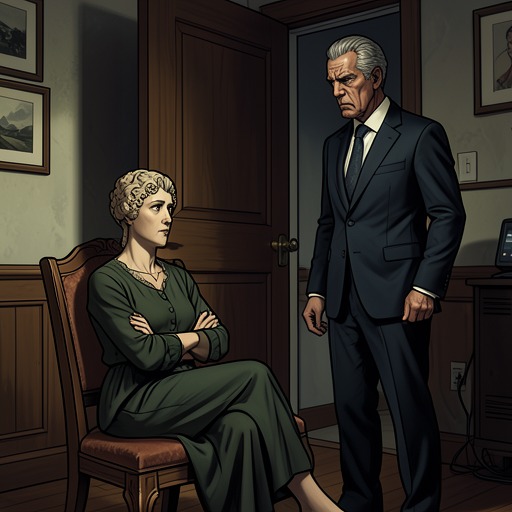
After Edgar escapes, the couple’s silence becomes visible in the house. Stella suspects Max fears the rumors and may doubt that she has been faithful, particularly because she had already warned him about the marriage. She also recognizes that admitting the affair would mean confronting her own responsibility for the relationship’s failure and for choosing a patient as a lover. Max does not raise the subject directly; from Stella’s perspective, denial is his preferred remedy. In the hot final days of summer, they move past one another like ghosts, barely acknowledging each other or saying anything that matters. Brenda’s concern for civilized family rituals supplies a temporary adhesive, while Charlie senses the strain beneath the household’s surface excitement.
Max’s Clothes and the Failed Conversation
Edgar’s escape makes the marital breach literal as well as emotional. The hospital later concludes that Edgar retrieved Max’s clothes, which he had hidden in the woods at the end of the Raphaels’ garden, and wore them to leave the estate. The clothes connect the domestic space Max maintained to the patient’s escape, but the account does not establish that Stella knew Edgar’s plan: he had secured her silence without telling her he intended to flee.
The escape also exposes a consequential delay by Max. After returning to the hospital, he checked with staff in Edgar’s ward, went to his office, and waited before alerting Jack Straffen. Nearly three hours passed between the discovery of the missing clothes and the discovery that Edgar was gone. Peter suggests that Max was determined to get to the bottom of the matter before speaking to Jack, and that the embarrassment of learning the fugitive wore his clothes helps explain his behavior. Max’s actions do not prove what he knew about Stella and Edgar, but they place him inside the practical consequences of their secret: the clothes from his home helped the patient escape, and his delay reduced the chance of finding Edgar quickly.
Back at home, Max’s attention to Stella takes a form she cannot comfortably receive. When he asks about her day in London, she has to redirect the conversation toward his work; she reasons that if she is to see Edgar in London, she must make her marriage seem as it was before. She wants Max to find her invisible again. The phrase captures the relationship’s new arrangement: rather than repair intimacy, Stella needs ordinary married life to cover the movements and desire she is keeping from him.
Separation and Aftermath
The marriage’s immediate endpoint is Stella’s departure. At Nick’s home, when asked whether she has left Max, she nods. This confirms a decisive change in their shared life, but the account does not establish a divorce or a formal legal resolution. Stella has moved from managing secrecy within the household to living apart from her husband.
The family rupture deepens after Charlie drowns. At the pool, Stella watches her son struggle in the water without calling for help; afterward, Hugh Griffin’s account helps turn public sympathy against her, and she is remanded and questioned. The narrative does not give Max’s response to the drowning in these scenes, so it cannot be treated as evidence of reconciliation or of his precise feelings. It does make the consequence for the family stark: the marriage’s earlier silences now sit within the loss of their child and Stella’s detention.
Narrative Significance
Peter’s account frames the marriage through both clinical interpretation and partial access to Stella’s experience. His view of Max as inadequate and his description of Stella’s motives are judgments offered by a narrator who later admits she hid the truth from him. The relationship is therefore not simply a contrast between a deficient husband and an idealized lover. Stella’s own warning to Max, her effort to make him overlook the affair, and her eventual departure show a pattern in which unmet desire and concealment reinforce one another.
The marriage also gives the novel’s larger tragedy a domestic scale. Max restores a neglected garden; Stella seeks a life beyond what she experiences as a cold marriage; and the clothes taken from their home carry that conflict into Edgar’s escape. Routine can preserve the appearance of a family, as Brenda’s rituals briefly do, but it cannot answer the unspoken questions between Stella and Max. By the time Stella leaves, the marriage has been hollowed out by years of dissatisfaction and a secret neither spouse openly confronts.