Max Raphael—Charlie Raphael
AsylumMax Raphael—Charlie Raphael is a father-son relationship rendered chiefly through its aftermath. The novel shows Max keeping Charlie present in a sparse study and later portrays him as a frail mourner, while offering little direct account of their life together. That restraint makes the photographs and Max’s changed bearing carry the weight of the relationship: grief is registered not in an extended explanation, but in what he preserves and how he appears.
A Father’s Photographs
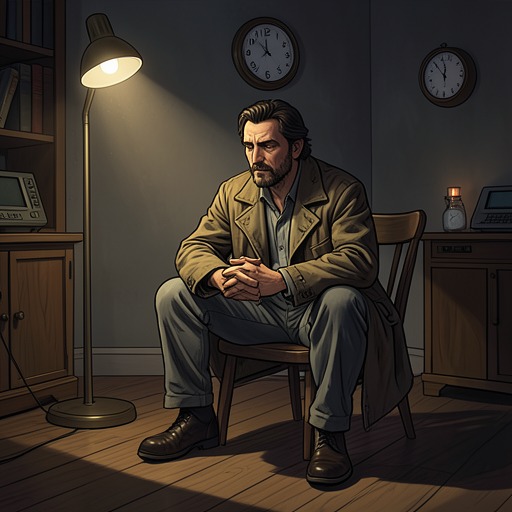
When the narrator visits Max at Plas Mold, the former sitting room has become his study. It is starkly furnished, with an armchair, a few shelves of books, and a desk overlooking the valley. On the desk stands a cluster of framed photographs: most show Charlie alone, while a couple show Charlie with his father. The concentration of images gives Charlie a visible place in Max’s otherwise austere, tightly ordered room.
The narrator lifts one photograph, and Max comes to stand beside him with a glass of sherry. Together they look at Charlie. Their shared attention is a small but intimate act: Max does not need to explain the images for the photographs to establish that his son remains central to his private life. The contrast is equally telling. The narrator observes that there is no photograph of Stella Raphael, and Max confirms her absence. Charlie is represented on the desk; Stella is not. The room thus makes a distinction between the son Max keeps before him and the wife whose image is missing.
Grief and Self-Punishment
The narrator later interprets Max’s condition as a form of inwardly directed punishment. In the yard, Max stands with his hands in his pockets, shivering and looking at the sky, and speaks of struggling with shame and the difficulty of taking responsibility. As the narrator drives away, he understands Max to be turning punitive impulses against himself and slowly putting himself to death. This is the narrator’s judgment, not a direct account of Max’s inner thoughts, but it links the language of responsibility to the visible spectacle of a man diminished by suffering.
Charlie’s photographs offer a counterpoint to that self-punishing present. Max has arranged images of his son in the one room that is unmistakably his own, and the narrator’s shared gaze with him briefly makes grief a relation rather than a solitary condition. The novel does not describe a conversation between Max and Charlie in these scenes; instead, it shows how memory persists in the physical setting Max has made for himself.
The Father at Stella’s Funeral
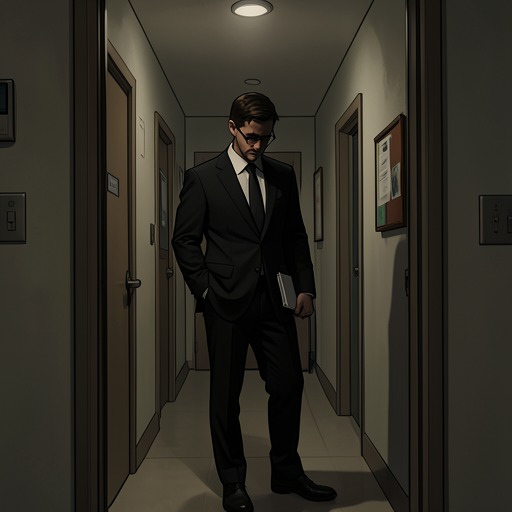
At Stella’s burial, Max has changed further since the narrator saw him in Cledwyn. He is described as thin and stooped, with skin like paper, and leans on his mother, Brenda, for support. The funeral is for Stella, not Charlie, but Max’s appearance extends the portrait of a father living in the aftermath of family loss. His physical dependence and exhaustion contrast with the photographs of Charlie, where father and son remain together in preserved images.
The relationship is therefore defined by the disparity between what the narrative shows and what it withholds. Charlie appears repeatedly in Max’s collection of photographs, but the selected scenes do not reconstruct their shared history. They instead present its residue: images on a desk, a father standing beside them, and a man whose suffering has become visible in his body. Max’s bond with Charlie is made legible as enduring attachment and bereavement, held in objects and gestures rather than explained through retrospective testimony.