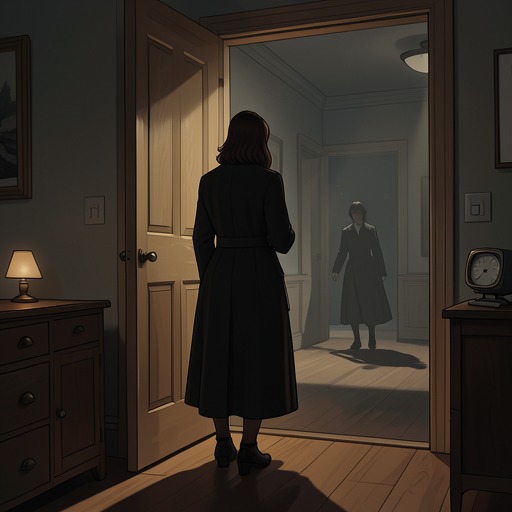
Peter Cleave—Stella Raphael
AsylumPeter Cleave’s relationship with Stella Raphael begins in the unequal setting of psychiatric care and becomes entangled with his wish to be more than her doctor. He offers treatment, attention, and the prospect of a safe future, but his own desire for intimacy shapes how he reads her recovery. Stella’s warmth and eventual acceptance of his proposal do not amount to reciprocal love; the black silk dress she wears at the end reveals that Peter has mistaken her need for refuge, and her capacity to comfort him, for a shared attachment.
A relationship formed in the hospital
Peter’s first view of Stella is already filtered through his judgment of her marriage. When Max Raphael came to interview for the deputy superintendent’s position, Peter opposed his appointment and thought him reserved, weak, and unimaginative. He also privately decided that Max was unlikely to satisfy a woman like Stella. That appraisal does not establish a personal bond between Peter and Stella, but it anticipates a pattern in their later relationship: Peter interprets her life through his own confident judgments about what she needs.
Their connection takes shape after Stella’s return to the hospital following Charlie Raphael’s drowning. Peter visits her during her confinement and sees her as emotionally numb and detached. In the days after the death, she is questioned and remanded, while public sympathy turns against her because she did not try to save Charlie. Peter’s presence stirs the first faint emotion she has felt for days, giving their clinical relationship an intensity that neither can treat as merely routine.
Treatment, trust, and dependence
Peter believes that Stella is shifting her dependence onto him through transference. He is not a neutral observer of this process: he admits that the prospect gives him a complicated satisfaction, which he failed at the time to examine properly. His account therefore presents the therapeutic bond from two angles at once. Peter intends to use the relationship to bring painful material into view, yet he is also personally gratified by the attachment he believes he is cultivating.
As Stella’s medication is reduced, she has to endure boredom and the fear that an outburst will undo weeks of self-control. She understands that staff are watching for a calm, good-tempered manner, and she struggles to perform it without knowing how long she must keep it up or whether her efforts are noticed. Peter sees this conduct as a necessary first step toward recovery; from the patient’s perspective, it is also a calculation demanded by confinement. The gap between those interpretations matters to their relationship: he reads her visible self-control clinically, while she must manage the conditions under which she is judged.
When Peter moves her from the admissions ward to a downstairs ward, she gains more privacy and freedom of movement and is allowed to wear her own clothes. She thanks him warmly. In her new room, she notices that he has abandoned the brisk, detached manner he used upstairs and has made himself available again as a friend, not merely as a doctor. Yet she does not act spontaneously or exploit this new warmth. When Peter asks whether she wants to talk about Charlie, she remains silent; he senses that she is not denying the circumstances of her child’s death, but cannot speak of them. Her silence marks a limit to the intimacy he hopes to establish.
Peter’s hopes and the proposal
Peter sees signs of a change when Stella begins to have night-time headaches after indistinct, terrifying dreams. She wakes in panic with the sound of screaming in her mind, then remembers little beyond the headache and faint traces of the dream. She tries to dismiss the episodes as nightmares and asks for aspirin. Peter interprets the screaming as the first stirrings of guilt and believes that she is beginning to let go of Edgar and confront Charlie’s death. That reading leads him to conclude that her recovery is properly beginning and that she may soon be ready to leave the hospital.
At this point, Peter turns from planning her treatment to imagining a shared life. He is past sixty and does not want to spend his remaining years alone. He pictures Stella living with him, sharing his interests in art, travel, gardening, and books, and bringing light into his quiet house. He describes the arrangement to himself as comfort and safety for her, even as he recognizes its advantages for him. His offer of asylum is thus both a promise of care and a proposal shaped by his own loneliness.
Peter knows that Stella does not love him, but tells himself that she needs him now and that affection might deepen. Stella responds with tenderness when she sees how much feeling she has stirred in him, and touches his hand. Peter experiences this gesture as moving; he also recognizes her pity and suspects she is thinking of him as a poor man. When she asks when they would marry, he answers that it would be in July. She accepts the proposal, calls him dear, and then says she would like to return to the ward. Her response gives him a commitment in form, but it leaves the emotional imbalance plainly visible.
Countertransference and the limits of recognition
Peter’s proposal is not separate from his clinical role. He has been encouraging Stella’s dependence while imagining himself as her future protector, and he has mistaken the satisfaction he takes in that dependence for insight into what she feels. His hope that she will come to understand his life and share it with him is built partly on the same evidence he uses to assess her recovery: her calmness, her gratitude, and her responsiveness to his attention. None of these proves that she loves him.
The final rupture in Peter’s interpretation comes when he sees Stella wearing the black silk dress associated with the night Edgar Stark took her in his arms. He initially imagines the dress as a gesture directed at the hospital community, perhaps an assertion of pride or defiance. Then he realizes that it is for Edgar: in his understanding, she wore it as a wedding dress, marking her bond with the man she had loved. Peter telephones the ward and is told that Stella is asleep, but the reassurance does not dispel his unease. He reviews the recent weeks and recognizes that his judgment has been clouded by private concerns. His belated recognition exposes the central asymmetry of his relationship with Stella: while he planned a future around her dependence, she had not relinquished her attachment to Edgar.