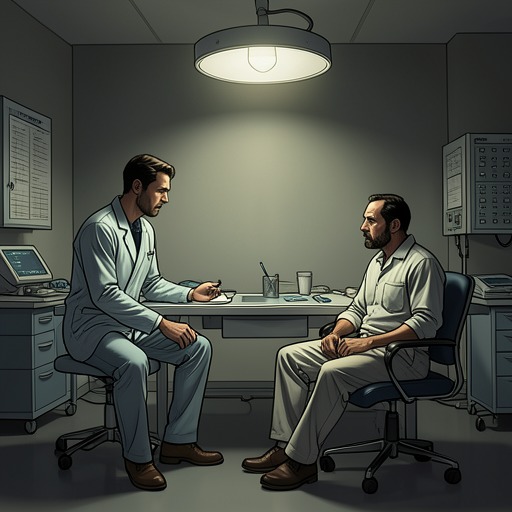
Peter Cleave—Edgar Stark
AsylumPeter Cleave—Edgar Stark is both a psychiatric relationship and a contest over who may interpret Edgar’s violence, determine his freedom, and control access to Stella. Peter treats Edgar as a patient whose apparent recovery cannot be separated from his continuing belief that the murder of Ruth Stark was justified; later, as the clinician responsible for his confinement, Peter also becomes personally implicated in the emotional struggle he is trying to assess.
Clinical Authority and Confinement
Peter’s professional connection with Edgar predates Edgar’s return to the hospital. After Edgar killed Ruth, Peter observed that he regained his equilibrium within weeks and took part in hospital activities, but showed no grief or guilt. Although Edgar was highly intelligent and otherwise appeared to have recovered his sanity, he remained fixed in the conviction that Ruth’s infidelity had driven him to murder. His supposed evidence consisted of ordinary details—a flushing toilet, a stain on the floor, and a box of washing powder on a windowsill—which he interpreted as signs of betrayal. Peter judged that this unshaken belief made release unsafe, and expected Edgar to remain confined for years.
The relationship later resumes under more immediate pressure. After Edgar is arrested in Chester while travelling toward Stella, Peter has him readmitted and holds him alone in a room in the Refractory Block’s top ward. Peter says this arrangement is not intended as punishment, but Edgar’s isolation makes the practical balance between them plain: Peter controls his place in the hospital and still needs to evaluate him and recommend a treatment plan. With retirement approaching, Peter is also preparing to hand his patients to a successor, yet Edgar is the one case that gives him real concern. Edgar’s refusal to speak leaves Peter unable to complete the assessment, turning clinical care into a struggle over whether Peter can elicit a response before his own departure.
Testing and Emotional Leverage
Peter turns professional questioning into a personal test when he tells Edgar that he is engaged to Stella. He does so bluntly and aggressively, hoping to force a reaction and learn what Edgar feels for her. In their bare interview room, Edgar sits in hospital clothes, without a belt or shoelaces, looking thinner and more vulnerable than before; as he responds, Peter watches bitterness, amusement, and skepticism pass across his face. The exchange exposes the imbalance between them: Peter controls Edgar’s confinement, but Edgar can still frustrate the examination by withholding what he feels.
Peter presses that imbalance against the history of Edgar’s violence. He reminds him of what he did to women when he believed he understood them, and recalls the killing of Ruth Stark in its most horrifying form: Edgar severed her head, set it on his sculpture stand, and worked it with his tools. The memory makes the threat behind Peter’s clinical inquiry unmistakable. He sees that Stella might have suffered the same fate, and an attendant waits outside in case Edgar attacks him. Yet Peter is not simply confronting a dangerous patient. He is about to marry the woman Edgar pursued, and his own involvement makes it difficult to separate assessment from rivalry and fear.
Edgar initially meets Peter’s probing with cynicism and contempt toward Stella, seeming almost to dismiss her. Peter doubts that this performance tells the truth. He considers that Edgar may call her an animal while still imagining her as a goddess, and that denigrating her could be an attempt to destroy Peter’s image of her and replace it with Edgar’s own. The possibility leaves Peter unable to read Edgar’s hostility as proof that attachment has ended: love and hate, in his clinical understanding, can coexist, while Edgar’s practiced concealment makes their balance hard to judge.
The performance breaks when Edgar asks to see Stella. His plea is desperate and, to Peter, more sincere than the contempt that preceded it; Edgar cannot sustain the pose of indifference. Peter feels protective tenderness toward him, interpreting the request as evidence of how fragile Edgar has become and how dependent he is on what Stella gave him. Nevertheless, Peter refuses. The refusal confirms that their relationship is not only one of doctor and patient: Peter can control Edgar’s access to Stella, while his compassion does not erase the boundary he imposes.
Aftermath and Mutual Possession
Peter’s refusal to let Edgar see Stella did not end their entanglement; it sharpened the divided roles they occupied in one another’s lives. Peter remained the clinician who controlled Edgar’s confinement, but he was also Stella’s fiancé, and Edgar’s continued attachment to her pressed against the future Peter intended to build with her. When Edgar was readmitted in April, Peter still needed to assess him and recommend treatment before handing his patients to a successor. Edgar’s refusal to speak frustrated that work, while Peter’s own limited time made the impasse feel urgent.
Peter eventually used the intimacy at stake as leverage. He told Edgar of his engagement to Stella bluntly, hoping to provoke a response and discover what Edgar felt for her. Edgar’s reactions did not provide a stable answer: he showed cynicism and contempt, then asked desperately for a five-minute meeting with Stella. Peter read the request as evidence that Edgar could not sustain his apparent indifference. Yet his own interpretation remained uncertain. Edgar might still idealize Stella even while calling her an animal, Peter thought, or might be trying to break down Peter’s image of her and substitute his own. The examination therefore exposed not only Edgar’s concealment but Peter’s inability to keep private feeling separate from clinical judgment.
After Stella’s death, Peter did not tell Edgar, wanting first to hear his side of the story. Edgar remained hostile and uncooperative in the top ward of the Refractory Block, and Peter anticipated that news of her death would reach him through the institution. Peter expected the loss to cause acute suffering and believed vigilance would be necessary. He also continued to wonder whether Stella had knowingly helped Edgar escape by giving him Max Raphael’s clothes, a suspicion that kept the earlier breach of hospital security active in his understanding of their relationship.
The art left behind after Edgar fled the Horsey Street warehouse loft made their attachment tangible to Peter. He obtained Edgar’s drawings of Stella and the small head Edgar had worked on obsessively before leaving. Peter had the head fired and cast in black bronze, then kept it in his desk and repeatedly took it out to admire. His account of the object as a way of having Stella again sits uneasily beside his continued control of Edgar, whom he still held in the hospital. By preserving Edgar’s image of Stella while retaining authority over Edgar himself, Peter became bound to the same triangle he had tried to manage as a psychiatrist.
Escape and the Limits of Clinical Control
Edgar’s escape exposed how fragile Peter’s institutional authority could be once it depended on routine and staff supervision. The hospital’s reconstruction was that Edgar told John Archer he had been called to the chaplain’s garden, then left the work party alone, retrieved Max Raphael’s clothes from the woods at the end of the Raphaels’ garden, and used them as a disguise. He kept away from the road until he was clear of the estate, then apparently made his way to London by hitchhiking, bus, or train. The escape turned the hospital’s own grounds and working arrangements into openings through which the patient Peter had judged unsafe to release could disappear.
Peter was troubled not only by the breach in security but by the delay before the alarm was raised. Nearly three hours passed between the discovery that Max Raphael’s clothes were missing and Edgar’s absence being reported. Peter and Jack Straffen knew that an earlier check of the chaplain’s garden might have brought a much quicker search and possibly recapture. Max’s delay in telling Jack left Peter confronting the consequences after the opportunity had narrowed: clinical judgment could identify danger, but it could not prevent an escape when observation failed. The episode therefore adds an institutional dimension to Peter and Edgar’s relationship, showing Peter’s power over Edgar’s liberty to be real but dependent on a system that could lose track of the man it meant to contain.