Jackson Quincey
Jackson Quincey, one of the nine-year-old ginger-haired twins from the north, arrives at the Tallis house with his brother Pierrot and sister Lola as a refugee from his parents' bitter domestic civil war. His presence is a catalyst for the novel's central tragedy, and his own small, desperate acts—bed-wetting, running away, and the simple utterance of the word 'divorce'—expose the vulnerability of children caught in adult conflicts and the neglect that follows.
Identity and Introduction
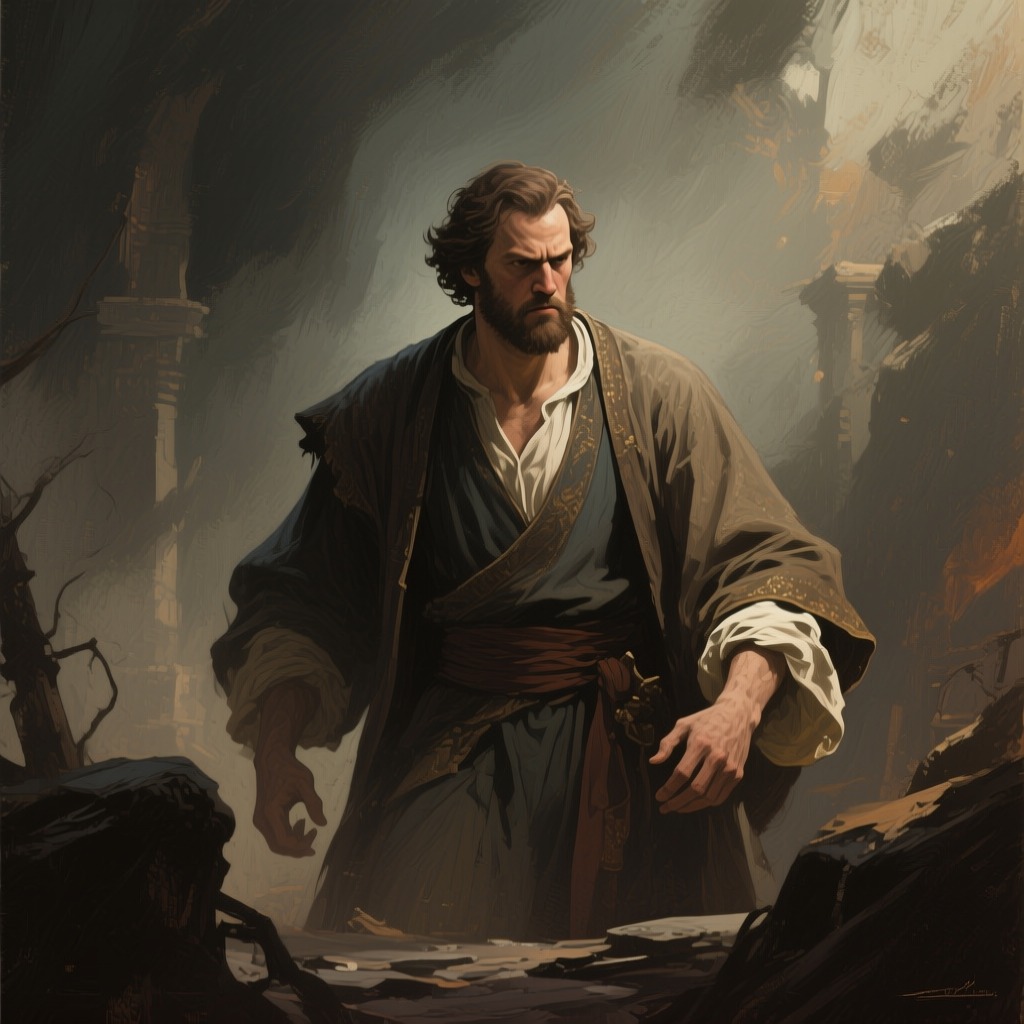
Jackson and his brother Pierrot are nine-year-old twins, ginger-haired and freckled, who arrive at the Tallis house with their sister Lola, refugees from a bitter domestic civil war. They are virtually indistinguishable to a stranger, a fact that complicates Briony's casting for her play, The Trials of Arabella, since the wicked count and the handsome prince would then completely resemble each other. The only distinguishing feature is that Pierrot is missing a triangle of flesh from his left earlobe, the result of a dog he tormented when he was three. The twins are barefoot and wear singlets over trunks that drip onto the floorboards when Briony first assembles them for rehearsal; their long immersion in the pool has puckered and bleached their skin, making their freckles appear black in the low light of the nursery.
Life and Plot Trajectory
Jackson's first major ordeal is wetting the bed during the night, as troubled small boys far from home will. He is obliged by current theory to carry his sheets and pajamas down to the laundry and wash them himself, by hand, under the supervision of Betty, who has been instructed to be distant and firm. The task is not represented as a punishment, but the boy feels it as reproof as he stands at the vast stone sink, suds creeping up his bare arms, the wet sheets as heavy as a dead dog. The two washes, countless rinses, and the sustained two-handed grappling with the mangle take up two hours of rehearsal time. When his mother comes down to see that the task is done, a feeling of release settles on the participants, and Jackson is granted a swim. Later, the twins, along with Lola, find themselves back in the nursery, oppressed by unstructured time and homesickness. Jackson speaks from the heart of their concern: "I don't like it here." The simplicity of the remark unhinges his brother. When Jackson gathers his courage, he says, "It won't be soon. You're just saying that. We can't go home anyway . . . It's a divorce!" The word has never been used in front of the children, and Jackson himself looks distraught as the word leaves him. Lola seizes him by an ear and makes him promise never to use the word again. Later, the twins write a note: "We are gong to run away becase Lola and Betty are horid to us and we want to go home. Sory we took some frute And there was'nt a play." They sign their first names with zigzag flourishes. They are found by Robbie Turner, who carries Pierrot on his shoulders and holds Jackson's hand, trailing a little behind. Jackson lets his head loll against Robbie's waist and draws the man's hand across his chest for protection or warmth.
Relationships and Conflict
Jackson and Pierrot are a unit, finding their courage in each other. They speak in unison, finishing each other's sentences, and their shared identity is a source of both strength and vulnerability. They are terrified of Betty, whom they have seen on the stairs grimly carrying red rubber sheets toward their room. They are also in conflict with their sister Lola, who they feel is keeping them from going home. When Lola tries to ruffle Pierrot's sticky hair, Jackson says, "If you clout us, we'll speak to The Parents." The twins are coerced into participating in Briony's play, but they are eager to please, and Jackson, feeling he is still in disgrace, thinks he might begin to rehabilitate himself by pleasing Briony. They are also the object of Paul Marshall's attention; he comes to the nursery and gives them an Army Amo bar, telling them that soldiers will be fighting for their country. Jackson says, "Your dad says there isn't going to be a war." When Marshall says he is wrong, Jackson adds, "I don't see why everything you buy has to end in o."
Change and Ending
Jackson's journey is one of exposure to the harsh realities of the adult world. He is forced to confront the shame of his parents' divorce, the humiliation of bed-wetting, and the neglect of the Tallis household. His simple utterance of the word "divorce" shatters the family's silence and reveals the depth of the children's suffering. He is found by Robbie Turner, who carries him back to the house, and in that moment, Jackson is a symbol of the innocence that has been lost. He and his brother are later seen at the wedding of Lola and Paul Marshall, lankier by five or six years, wedged between their estranged parents. At the 1999 birthday performance of The Trials of Arabella, it is noted that Jackson died fifteen years ago, but his children, grandchildren, and great-grandchildren have fairly peopled the room.
Thematic Significance
Jackson Quincey embodies the collateral damage of adult failures—divorce, neglect, and the inability of the Tallis household to provide proper care. His bed-wetting, his running away, and his simple, devastating utterance of the word "divorce" expose the vulnerability of children caught in conflicts they cannot understand. He is a figure of pathos, a small boy whose needs are overlooked in the chaos of the day, and whose fate is a reminder of the consequences of the adults' self-absorption. His presence is a catalyst for the novel's central tragedy, as the search for the twins provides the opportunity for the assault on Lola and Briony's false accusation.