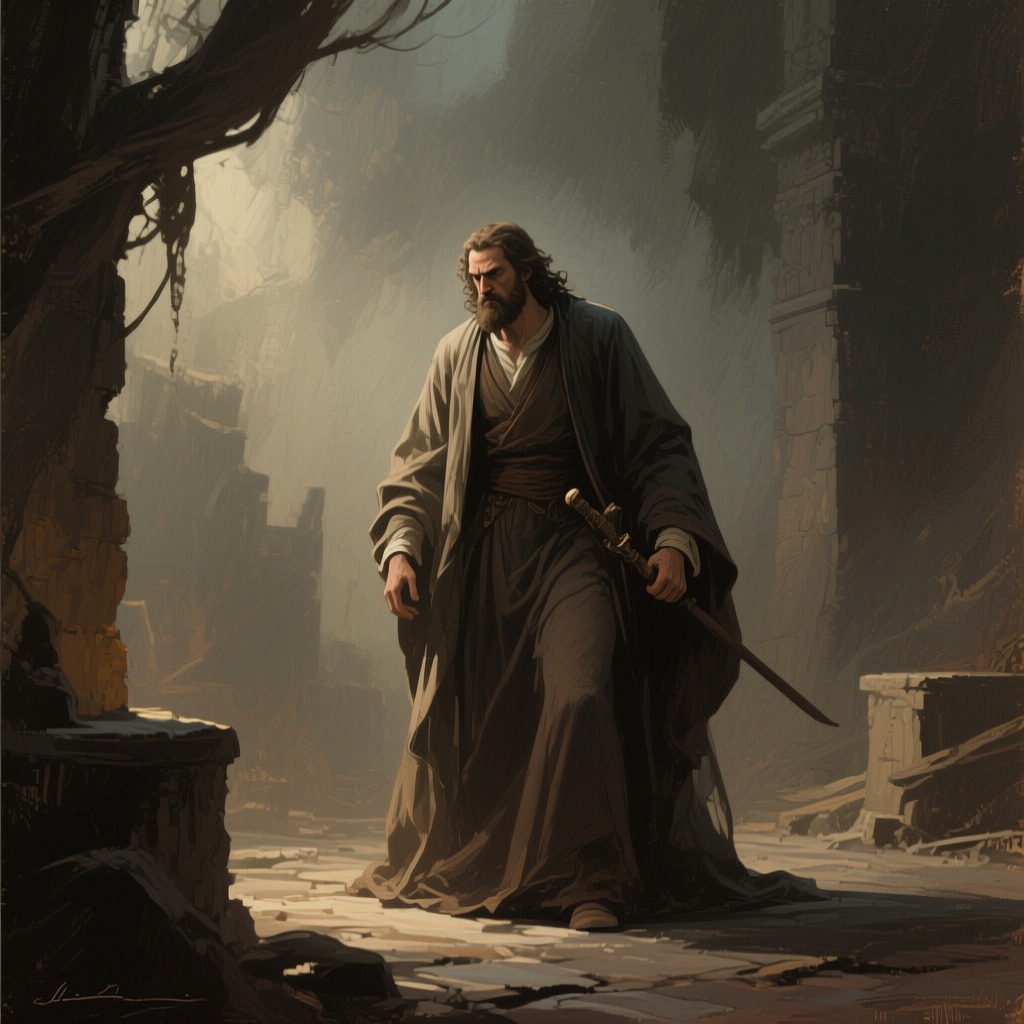
The Cellar
The Cellar is the bombed-out basement of a house in Bray Dunes where Robbie Turner, Corporal Mace, and Corporal Nettle shelter on the night of May 31, 1940, during the final stage of the retreat to Dunkirk. It is the site of Robbie's physical and psychological nadir—feverish, wounded, and tormented by memories of prison and the war—and the place where he receives the news that the navy has returned and evacuation is imminent, a turning point that reconnects him to the hope of survival and reunion with Cecilia.
Location and Condition
The cellar is the half-open basement of a bombed house, its ceiling partly destroyed, giving it the appearance of "a gigantic cave." It is reached by descending a scree of broken bricks. The space is in total darkness, lit only by the glowing tips of cigarettes belonging to the men already sheltering there. The floor is concrete, littered with pieces of brick and grit. The cellar is crowded: men are propped in sitting positions around the walls, most of them asleep, with a few lying in the center of the floor. When a group of soldiers with West Country accents arrives later, they find a place beyond Robbie's feet, and the darkness and weary protests of the residents barely hold the peace when one of the newcomers nearly starts a fight. The cellar offers no comfort—its concrete floor, the grit pressing into Robbie's cheek, the cold—but it provides shelter from the open road and the Stukas.
Robbie's Physical and Mental State
Robbie enters the cellar in a state of extreme exhaustion and fever. His wound, a piece of shrapnel below his rib cage, throbs with each precise beat. He has been walking for days, his blister forces him to walk on the edge of his boot, and he is so thirsty that his tongue is large in his mouth. His mind is slipping: he experiences periods of unreality, illogical certainties, and a loss of continuity. In the cellar, he lies on his back, staring into the blackness of the cavernous roof, unable to sleep. The wound's sharp thing seems to be protruding and snagging on his shirt. He is tormented by memories—the French boy asleep in his bed, the leg in the tree, and above all, the three and a half years in prison: the concrete floor, the piss in the bucket, the gloss paint on the walls, the snores of the men along the row. He thinks of the "stupidity and claustrophobia" of prison, the "hand squeezing on his throat." The cellar, with its darkness and confinement, triggers these memories, making him feel as though he is back in his cell. He does not know how he survived the daily stupidity of it. He thinks of Cecilia's last letter, the poem by Auden she enclosed, and her words: "I'll wait for you. Come back." But in his fevered state, the words seem meaningless, "like an arithmetetic sum, and just as empty of emotion." He cannot even form her face. He thinks of Briony's offer to recant, but the intricacies are lost to him; he thinks, "Everyone was guilty, and no one was." He feels the need to go back, to bury the boy from the tree, to find Mace, to ask the Flemish woman if she holds him accountable for her death. He begins to shout "no" in his sleep, waking the others.
The Turning Point: News of Evacuation
Corporal Nettle, who has been watching over Robbie, wakes him and tells him he has been shouting. Nettle wipes Robbie's forehead with a dirty hand and delivers the crucial news: about an hour ago, he went out and saw the navy coming down the road, putting out the call for officers. They are getting organized on the beach. The boats are back. A lieutenant from the Buffs is marching them down at seven. "We're going home, mate." This news, combined with Nettle's soothing whisper and the water from his canteen, begins to pull Robbie back from the edge. He thinks of the order that will prevail—no breaking ranks, no rushing the boats—and of the tranquil sea. He remembers the feel of the gravel through his thin-soled shoes, the icy touch of the handcuffs, and Cecilia running out across the gravel to speak to him by the open police car door. He remembers her saying, "I'll wait for you. Come back." He realizes that this is "elemental," the reason he has survived. He promises Nettle he will not say another word, and asks to be woken before seven.
Narrative Significance
The Cellar is the spatial and psychological counterpart to the open road and the beach. Where the road is a place of relentless forward movement, exposure, and collective chaos, the cellar is a place of stasis, enclosure, and individual confrontation with the past. It is the site of Robbie's most intense flashbacks to prison, the war, and his lost life. It is also the place where the hope of rescue is finally delivered, transforming the cellar from a tomb-like space into a temporary sanctuary. The cellar's darkness and confinement mirror Robbie's internal state, and the news of the boats' return provides the light that begins to dispel both. The cellar is the last shelter before the beach, the final point of interior reckoning before the external ordeal of the evacuation. It is where Robbie, in his fever, confronts the possibility that he might not survive, and where he is pulled back by the promise of Cecilia's love and the practical arrival of the navy.