Attack on the Old Library
BabelThe Attack on the Old Library is the armed raid that breaks the Hermes Society’s Oxford safe house and marks the transition from covert resistance to unmistakable state repression. Police storm the building, the postgraduates fight to delay them, Robin Swift is beaten and taken prisoner, and the library is subsequently left as a burned, blasted ruin containing unburied bodies. The attack matters not only because it destroys a place, but because it exposes how knowledge, belonging, and violence are administered through institutions that present themselves as orderly and legitimate.
Causes and Institutional Pressure
The raid occurs within a wider contest between the Hermes Society and Babel, whose control over silver-working knowledge gives the institution both intellectual authority and political power. Babel’s procedures make that power appear technical: admission requires legal and bodily recognition, its wards identify authorized scholars through blood, and fluency determines who can use the silver bars. Professor Richard Linton Lovell’s earlier arrangement for Robin Swift had made him a legal citizen of the United Kingdom and Lovell’s ward, while Babel’s hidden blood-vial system distinguished scholars from intruders by storing each scholar’s blood for its protective wards. Such practices turn identity into a recordable substance and make exclusion seem like security rather than coercion.
The same institutional logic governs silver-working itself. Professor Jerome Playfair explains that a bar can operate only when someone genuinely thinks and lives in the relevant language; a superficial acquaintance is insufficient, invented languages cannot work, and even Old English has lost its effect because nobody speaks it as a living language. The rule makes linguistic expertise a material necessity, but it also supports Babel’s monopoly by tying power to disciplined education and authorized fluency. Against that hierarchy, the Hermes Society shelters research and people who exist outside the academy’s approved order. Professor Lovell’s response to Robin’s suspected association with the society is not immediate expulsion but conditional reclamation: Robin is told that leaving Babel is difficult, that harmful influences have led him astray, and that useful information about the Hermes Society could secure his future. The raid is therefore the violent culmination of a pressure system that first seeks confession and cooperation before resorting to force.
The Police Assault
The attack begins inside the Old Library with an ordinary domestic sound made suddenly menacing. A kettle shrieks near the front door, and the noise initially resembles a human scream. Before the defenders can fully respond, the front door crashes inward and Oxford policemen pour into the building, shouting for everyone to raise their hands. The abrupt conversion of a household object into an alarm gives the scene its first shock: the refuge’s fragile ordinary life is interrupted by an authority that arrives as noise, impact, and armed bodies.
The postgraduates react with practiced speed. Cathy O’Nell and Vimal Srinivasan run from the workshop carrying silver bars. Ilse Dejima throws her weight against a towering shelf, bringing it down and beginning a chain reaction that collapses the route before the police. Ramiz Rafi Mirza starts forward to help, but Anthony Ribben orders him to hide in the Reading Room. Outside, booms and crashes continue as Anthony calls for the beacon and Cathy answers; the defenders are not merely fleeing but fighting to protect those who have been pushed into hiding.
Their defensive position is also a trap. The Reading Room has no other doors and no windows, leaving Robin, Ramiz, Victoire Desgraves, and Letitia Price with nowhere to escape. They huddle behind a table while gunshots sound outside. When they begin moving chairs to barricade the entrance, the door swings open and Letitia stands in the frame holding a revolver. Her appearance transforms the raid from an assault by an external force into a crisis of recognition and trust. The person whose presence should have offered continuity instead becomes inseparable from the attackers’ arrival.
Letitia turns and flees behind a mass of constables. Robin pursues her in a burst of rage, pushing against police armed with truncheons and guns. The authorities overpower him methodically: strong arms wrench him back, a blunt impact strikes his back, a cloth bag is thrown over his head, his hands are cuffed behind him, and hard blows to his cheekbone leave him limp. Two people drag him from the Reading Room. The physical sequence strips away any possibility that the police operation is a neutral arrest. The state’s order is experienced through concealment, restraint, pain, and the removal of sight.
Capture, Separation, and Uncertainty
Robin’s capture also produces a second form of destruction: the severing of the group’s shared field of knowledge. Through the bag he catches only glimpses of overturned shelves and blackened carpet. He cannot see Vimal, Anthony, Ilse, or Cathy, and he can no longer hear Victoire Desgraves screaming. His repeated attempt to call for Victoire is answered by silence. The attack thus denies him not only freedom but evidence: he is taken away without knowing who remains alive, who has escaped, or what has happened to the library’s defenders.
The assault echoes an earlier failure in the underground struggle, when Robin had been shot in the arm during a trap that went wrong. That injury had already exposed the danger of relying on imperfect coordination and on Griffin Harley Lovell’s assurances that the operation had gone well. The Old Library raid enlarges that vulnerability from one wounded participant to an entire community. A silver-working network built on language, secrecy, and mutual action is forced into a situation where guns, police formations, and institutional intelligence determine the outcome.
Destruction and Aftermath
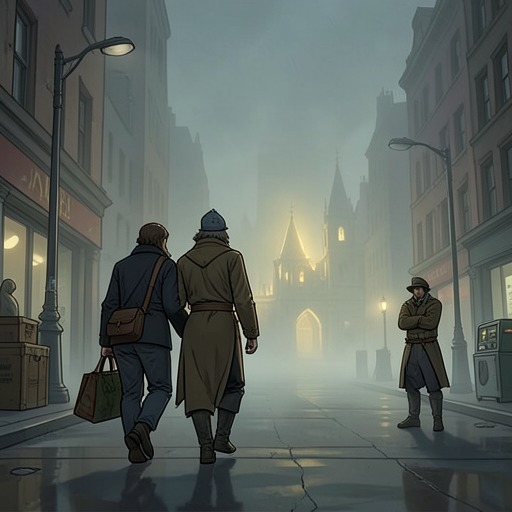
At daybreak, Robin and Victoire return secretly to the Old Library, approaching through the forest behind the yard while dozens of policemen remain stationed around the building. They had hoped to recover supplies, but the police presence is too dense. Instead, they stand witness. Their purpose is not practical rescue but remembrance: someone must register the loss and remember the betrayal.
The building has been utterly destroyed. Its entire rear section has been blown away, leaving a gaping opening into the library’s interior. The exposed structure is described as a wound, making the architecture itself bear the marks of assault. The shelves are half-bare, while surviving books sit in wheelbarrows around the building, apparently awaiting removal and analysis by Babel’s scholars. The likely fate of that research is further suppression: independent discoveries may disappear into imperial archives, concealed because of what they might inspire.
The bodies make the destruction irrevocable. Robin sees a pale arm beneath fallen bricks, a shoe buckle attached to a charred shin, and a dust-covered mass of black hair near the side of the building. He turns away before seeing the face. The bodies have not yet been cleared, so the ruin remains both crime scene and burial ground. Victoire covers her mouth, and the two witnesses are forced to absorb a loss that official power has not even taken the trouble to conceal or properly dispose of.
Narrative Significance
The attack is a reversal from institutional persuasion to direct coercion. Babel’s earlier demand for information had treated Robin as recoverable property; the raid treats the Hermes Society as an enemy to be rooted out. The contrast reveals the continuity beneath the change of method. Legal papers, blood wards, examinations, language requirements, disciplinary pressure, police weapons, and the destruction of books all perform the same larger function: they decide who may belong, who may know, and which knowledge may survive.
The Old Library’s fate also gives the conflict a material image. Independent research is not defeated in argument; it is burned, carted away, and threatened with absorption into imperial archives. The building’s exposed interior makes hidden knowledge physically visible at the very moment it is being destroyed. Robin and Victoire’s return cannot restore the library, but their decision to witness prevents the loss from becoming only an administrative fact. In that sense, the aftermath begins a new form of resistance: when the institution has destroyed the archive, memory becomes the first surviving record.