Battle between Griffin Lovell and Sterling Jones
BabelThe Battle between Griffin Lovell and Sterling Jones is a fatal confrontation at the gates of Oxford Castle, where an escape that briefly appears possible is halted by a single armed opponent. Its decisive significance lies in the collision of two histories that Robin Swift only dimly understands: Griffin Lovell and Sterling Jones are bound by years of intimacy, love, hatred, and accumulated accusation, yet meet as enemies with guns drawn. Their simultaneous shots leave both men down, but the violence does not end there. Griffin Lovell, still alive, is shot at close range by the guards, making the encounter not merely a duel but the immediate cause of his death and one of the most devastating reversals in Robin Swift's experience.
Causes and Background
The gunfight occurs during an escape from Oxford Castle. Griffin Lovell has given Robin Swift and Victoire Desgraves plain black cloaks taken from his satchel; from a distance, the garments resemble those of the constables, allowing the three to move along the castle wall toward the main street while the sentries are distracted by flames. The square seems deserted, and the high stone walls provide shadows in which they can hide. The apparent simplicity of the escape creates the scene's central expectation: speed and concealment may carry them through the gate before the authorities recover control.
That expectation is broken by the presence of one person standing between the fugitives and freedom. Sterling Jones approaches with burned hair, a scratched and bloody face, and dust coating his clothing. He recognizes the Latin silver-working that has contributed to the destruction around the castle and addresses Griffin Lovell with the familiarity of someone who has known him for a long time. His accusation also reaches beyond the immediate escape: he gestures toward the ruined castle and invokes the death of Eveline Brooke, implying that Griffin Lovell's destruction has already crossed a moral boundary that Sterling Jones believes Griffin must answer for.
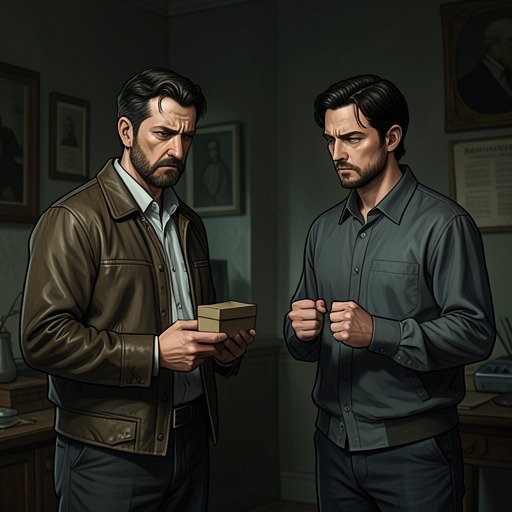
Robin Swift recognizes that the exchange contains a history he has not been told. Griffin Lovell and Sterling Jones do not speak like strangers or merely like members of the same cohort. Their intimacy resembles that of old friends caught in a complicated knot of love and hatred, something that has developed over many years. The confrontation therefore carries two kinds of conflict at once: the immediate struggle over whether Robin Swift, Victoire Desgraves, and Griffin Lovell will escape, and a private feud whose causes remain only partially visible to Robin Swift.
The Confrontation
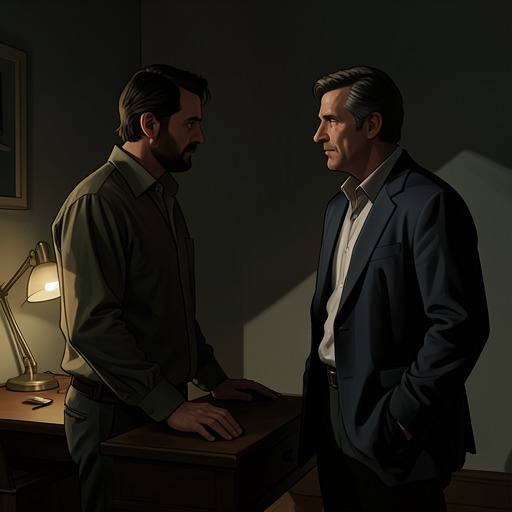
Sterling Jones raises his gun and orders Griffin Lovell to put his hands up. Griffin Lovell responds by pointing out the tactical imbalance: there are three targets but only one gun, and he forces Sterling Jones to confront the question of whom he intends to shoot. Sterling Jones appears to understand that he is outnumbered, but he does not retreat or show concern. His indifference makes the standoff less a negotiation than a ritualized recognition between two men who have been moving toward this encounter for a long time.
The exchange ends almost instantly. Griffin Lovell draws his revolver as Sterling Jones points his gun at Griffin Lovell's chest. They appear to pull their triggers simultaneously, and the two shots merge into what sounds like a single report. Both men collapse at once. The scene's movement is consequently compressed from verbal challenge to irreversible violence: the possibility of escape gives way to a paired fall, and the apparent duel produces no clean victor.
Robin Swift initially focuses on Griffin Lovell's wound. He finds a wet patch of blood spreading over Griffin Lovell's left shoulder and tries to calculate whether such an injury must be fatal. His thoughts turn to the fragmentary medical knowledge supplied by adventure stories: a shoulder wound might cause death through bleeding, but help might still save the injured man if the bleeding could be stopped and the wound bound or stitched. In the confusion, Griffin Lovell gasps for the front pocket of his coat, and Robin Swift retrieves a thin silver bar from it, a final practical clue that Griffin Lovell still possesses a means of action even after being shot.
Griffin Lovell's Death
The first exchange does not immediately kill Griffin Lovell. When the guards reach the bodies, someone confirms that one man is still alive, bends over Griffin Lovell, and draws a gun. Another voice begins to protest, but the warning is cut short by the click of the trigger. Victoire Desgraves clamps a hand over Robin Swift's mouth as he tries to object, yet the shot follows. It booms at close range, Griffin Lovell convulses, and then lies still.
The second shooting changes the meaning of the duel. Griffin Lovell's simultaneous shot against Sterling Jones might have left the two men in a tragic symmetry, each responsible for the other's fall. The guards' intervention destroys that symmetry. Griffin Lovell is not allowed medical aid, formal judgment, or even the possibility of survival; an armed authority finishes him while he is helpless on the ground. The battle thus becomes an execution as well as a duel, and the institutional force surrounding the castle determines the final value shift from danger to death.
Robin Swift confirms the result by pressing his fingers to Griffin Lovell's neck. Griffin Lovell's eyes are open and glassy, his body has turned a ghastly white, and the direct blast from such short range has left no plausible uncertainty. The scene does not soften the death through distance or euphemism. Robin Swift knows he will find no pulse, while Victoire Desgraves stands over the body and asks whether Griffin Lovell is dead. The answer is conveyed through the body before it is spoken.
Robin Swift's Witness and Aftermath
Robin Swift's response is defined by the impossibility of action. He drops to his knees, pulls at Griffin Lovell's coat, searches for the wound, and tries to imagine some procedure that might still repair it. After the guards fire the final shot, his grief becomes so intense that it demands physical release: screaming, beating, or tearing the world apart. Yet he cannot move. The narration describes him as incorporeal and voiceless, trapped in the square until it is clear. His suffering is therefore not only emotional but bodily: the shock immobilizes him at the precise moment when grief would ordinarily become movement and sound.
Victoire Desgraves shares the immediate danger and helps keep Robin Swift silent while the guards remain nearby. Griffin Lovell's death consequently marks a rupture in the small group attempting to escape together. He had been the armed escort, the person who supplied the disguises, and the one who stood physically between Robin Swift, Victoire Desgraves, and Sterling Jones. His fall removes both protection and leadership, leaving the survivors to confront the consequences of the failed escape without him.
Sterling Jones is also left down after the simultaneous shots, and the alias of his death reflects the scene's unresolved violence. The evidence establishes the exchange of fire and Griffin Lovell's subsequent death by guard gunshot, but Robin Swift's immediate attention remains fixed on Griffin Lovell rather than on any clear resolution for Sterling Jones. The encounter's emotional center is therefore not triumph but the destruction of a relationship whose full history Robin Swift never learned.
Narrative Significance
The battle joins escape, rivalry, revelation, and sacrifice in a single compressed sequence. It begins with the practical mechanics of disguise and concealment, passes through a confrontation charged with unspoken history, and ends with Griffin Lovell's death before Robin Swift can understand what bound Griffin Lovell and Sterling Jones together. The scene's power comes partly from that withheld history: Robin Swift sees enough to know that the hostility is ancient and intimate, but not enough to reduce it to a simple opposition between good and evil.
It also exposes the difference between individual violence and institutional violence. Griffin Lovell and Sterling Jones fire at one another in a recognizably personal contest, with each man choosing the other as an adversary. The guards' final shot is different. It arrives after the duel, when Griffin Lovell is already down, and converts a contested encounter into an administrative act of elimination. The battle therefore dramatizes how personal loyalties and private vendettas can be overwhelmed by the larger machinery of authority surrounding Oxford Castle.
For Robin Swift, the event is a traumatic threshold. He has already been drawn into dangerous operations, has been shot in the arm during an earlier trap, and has been pressured by Professor Richard Linton Lovell to provide useful information about those opposing Babel. But witnessing Griffin Lovell's death gives those pressures an irreversible human consequence. The silver bar in Griffin Lovell's pocket, the blood spreading over his shoulder, the guard's gun, and the absence of a pulse become linked images of knowledge and power: technical skill may open a path through danger, yet it cannot guarantee survival once institutional violence takes control.