Oxford Castle prison break
BabelThe Oxford Castle prison break is a rescue and escape in which Griffin Lovell frees Robin Swift and Victoire Desgraves from confinement at Oxford Castle. Its decisive significance lies in the abrupt conversion of Robin’s helplessness into movement: Griffin does not merely open a cell, but dismantles the prison’s security, locates Victoire, creates an exit through a wooden door, and leads both prisoners out through a burning tower. The action also changes Robin’s understanding of Griffin, making the older brother’s abstract commitment to violence visible as soot, shattered masonry, flames, and calculated risk.
Captivity and the Rescue’s Immediate Stakes
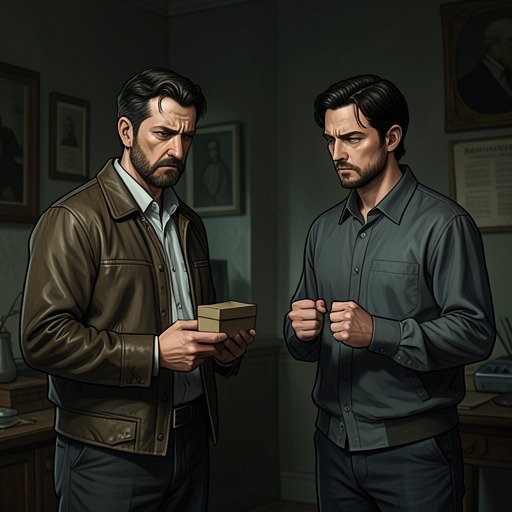
Robin begins the sequence exhausted, injured, and unable to rest. Pain and grief push him between waking and sleep, where memories of the Hellas, his father’s death, and the consequences of the words that began the catastrophe become nightmarish. When Griffin arrives, Robin’s first perception is almost uncanny: his father’s face gives way to his brother’s, and Griffin stands above him covered in soot while the cell door lies in pieces. The rescue therefore enters the scene through a collision between memory and physical intervention, as the figure associated with family violence becomes the person breaking Robin out of imprisonment.
Griffin’s first method is linguistic as well as mechanical. He brandishes a silver bar and uses the Chinese word Wúxíng, the same old trick that Robin had believed could not work for him. Griffin explains that hearing Robin say the word for the first time allowed him to understand it, as though he had been waiting to hear those words throughout his life. The silver-working is consequently presented as an act of transmission between brothers: Robin’s speech has given Griffin access to a power he could not previously use, and that newly acquired ability becomes the first instrument of the escape. Griffin then works on Robin’s cuffs and demands that he get up, refusing to let injury or despair define the limits of the rescue.
The rescue is not complete when Robin is released. Robin immediately asks where Victoire is, and his fear turns toward the possibility that she has been killed, removed from the prison, or buried without explanation. He cannot articulate those possibilities without making the loss real. Griffin answers by converting uncertainty into action: he insists that they look for her and shakes Robin hard enough to force him back into motion. The emotional stakes thus extend beyond individual escape. Freedom depends on finding the absent companion before the prison’s violence can become irreversible.
Silver Work, Explosives, and the Prison’s Collapse
The hallway is inexplicably empty, and Griffin reveals that he has already neutralized the guards. He has used another silver bar in a daisy-chain riff on the word explode. His explanation traces the word from the Latin explōdere, a theatrical term for driving an actor from the stage by clapping, through an older meaning involving rejection or noisy expulsion, to the modern sense of detonation. The etymological chain mirrors the operation itself: language moves from performance and expulsion into physical force, and a word’s historical transformations become a weapon capable of clearing the way.
Griffin reaches Victoire’s cell carrying an improvised hand grenade, a ceramic sphere roughly a quarter the size of a cricket ball with a fuse protruding from one end. He does not need the device to break iron, because the door is made of wood. Before lighting it, he tells Victoire to move into the far corner and protect her head and knees, then places the grenade against the door and drags Robin several paces down the hallway. The blast is deliberately limited. It does not destroy the door outright, since an explosion large enough to do so would have killed Victoire; instead, it punches a hole near the bottom, just large enough for a child to crawl through.
The controlled damage demonstrates both Griffin’s ingenuity and the narrow margin between rescue and slaughter. He kicks away the charred wood until the opening widens, and Victoire crawls out coughing. Griffin and Robin pull her through by the arms, after which she reaches her knees and embraces Robin. The physical form of the escape is therefore shaped by restraint as much as by destruction: the door must be broken, but not too completely; the explosive force must defeat confinement without reproducing the prison’s lethal logic.
The Route Out of Oxford Castle
Griffin tells the prisoners that the exit lies four floors below. The guards remain trapped in the stairwell, but they will soon break through, so the escape has a precise deadline. Robin looks from the empty passage toward a window and realizes that the building is not the city gaol on Gloucester Green, which is only two storeys high. The ground is far below them. Griffin identifies the location as Oxford Castle’s north tower and reveals that there is no alternative staircase.
The window becomes the only route. Griffin orders Robin to break the glass with his elbow and produces a rope from his satchel. He descends first, followed by Victoire and then Robin. The descent is more difficult than Griffin makes it appear. Robin loses control during the final ten feet when his arms give way, and the rope burns his palms. Escape is therefore not an effortless triumph but a bodily ordeal, with freedom purchased through pain, fear, and the risk of falling from the tower.
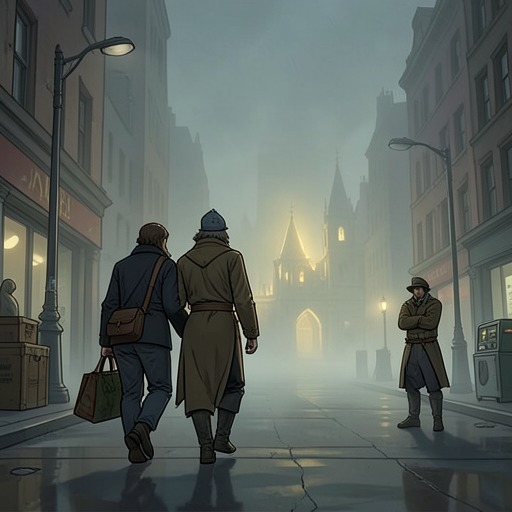
Once outside, the scale of Griffin’s operation becomes clear. He has created far more than a temporary diversion: the entire north front of Oxford Castle is ablaze, and fire and smoke are spreading through the building. Griffin gives Robin and Victoire plain black cloaks from his satchel, garments that will look vaguely like constables’ cloaks from a distance, and shepherds them along the side of the castle toward the main street. His instructions are practical and severe: move quickly, avoid looking behind, remain calm, and use the guards’ distraction to get away. Disguise and composure become the final mechanisms of the escape, carrying the fugitives from the castle’s interior into the city beyond it.
Robin’s Changed View of Griffin Lovell
The prison break alters Robin’s perception of Griffin more profoundly than the successful rescue alone would suggest. Robin had previously encountered his brother’s commitments to violence in an abstract form. Outside the castle, however, he sees those commitments embodied in the burning north front, the smoke spreading through the structure, and Griffin’s unflinching command of the operation. Griffin becomes unfamiliar to him each time they meet, but this version is the most frightening: hard, sharp-edged, capable of shooting, killing, and burning without hesitation.
That fear is not simple condemnation. Robin also recognizes Griffin’s extraordinary ability. The same man who manipulates etymology, silver, explosives, timing, and disguise has calculated a route through a fortified building and brought two prisoners out alive. Robin cannot determine whether he fears Griffin or admires his sheer competence, and the uncertainty marks a new stage in their relationship. The escape makes brotherhood inseparable from danger: Griffin is simultaneously rescuer, family, revolutionary, and a living demonstration of the violence that Robin has helped unleash.
Narrative and Thematic Significance
Structurally, the episode follows the logic of a rescue plot while complicating its expected moral clarity. Griffin is the active rescuer, Robin and Victoire are the endangered prisoners, and the objective is not simply to unlock a cell but to recover both captives before the guards regain control. Each stage raises the cost of freedom: Robin must rise despite pain, Victoire must be found despite the possibility of death, the guards must be displaced, the wooden door must be breached without killing her, and the prisoners must descend from the tower while the castle burns.
The architecture of Oxford Castle gives the action a gothic force. The high tower, broken window, rope descent, smoke, and spreading fire turn the prison into a vertical passage from entrapment to perilous freedom. The building does not merely contain the conflict; its walls, stairwell, doors, and burning facade make authority visible and destructible. Yet destruction does not equal liberation without qualification. The escape leaves Robin with burned palms, terror, and a troubling recognition of what Griffin is capable of. The prisoners get out, but the route to freedom reveals that the forces opposing confinement may themselves be terrible.
Language remains central even at the most physical moments. Wúxíng opens Robin’s cell, while the history of explōdere becomes the conceptual engine for removing the guards. Words do not stand apart from violence in this world: they circulate through silver, produce material effects, and carry histories of expulsion into the present. The prison break therefore joins intimate rescue to the book’s larger concern with language as power. Griffin’s success depends on making speech, etymology, and silver-work answer to immediate human need, while Robin’s changed vision of him exposes the cost of turning linguistic knowledge into force.