Collapse of Magdalen Tower
BabelThe Collapse of Magdalen Tower is the first major act of destruction produced by the Babel strike and the moment when the translators’ political protest becomes an unmistakable material threat. Magdalen Tower, the second-tallest building in Oxford, falls because the silver-assisted maintenance that had preserved its unstable foundations is interrupted after the Babel faculty are expelled and their knowledge becomes inaccessible. The disaster gives Robin Swift and Victoire Desgraves the force they had sought, but it also binds their campaign to the possibility of unintended deaths and makes destruction itself part of their argument.
Causes and Background
Magdalen Tower had depended for centuries on silver-facilitated engineering techniques to bear the strain created by soil erosion beneath its foundations. Since the eighteenth century, Babel scholars had maintained its supports twice each year, in January and June. The arrangement was therefore not merely a matter of routine administration: the tower’s survival depended on a specialized chain of knowledge, and that chain was broken when Babel’s faculty were exiled and their records were sealed away from them.
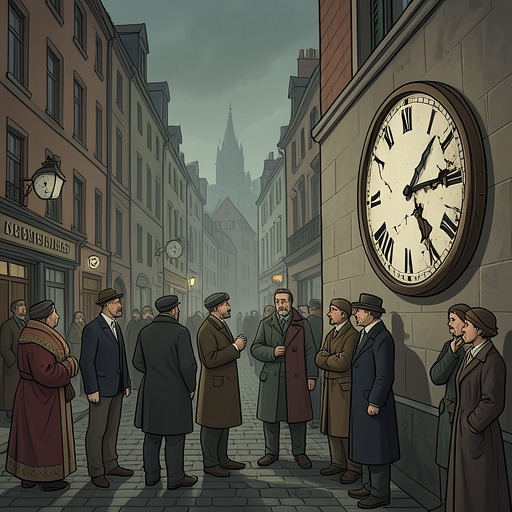
The immediate institutional failure centered on Professor Playfair. For fifteen years he had supervised the biannual reinforcements and kept his notes in his office. Once the Babel scholars were shut out, those notes were inaccessible, while the faculty themselves forgot that Magdalen Tower’s next maintenance appointment was due. The city council had expected Professor Playfair to appear the evening before the collapse, but he was in hospital, unconscious after being given laudanum. One council member spent the early morning pounding on Babel’s door in panic, yet the wards prevented anyone inside from hearing or seeing him. The tower’s destruction thus arose from political exclusion, bureaucratic dependence, and a defensive system that blocked the very warning it needed to receive.
The collapse also followed an earlier failure of persuasion. Robin Swift, Anthony Ribben, and their allies had tried to expose Professor Richard Linton Lovell’s collusion through inflammatory pamphlets, while Ramiz Rafi Mirza and Victoire Desgraves wrote to Radical leaders under assumed identities. Anthony Ribben urged Robin to frame the campaign in terms of scandal, corruption, collusion, and lack of transparency rather than anticolonialism or national sovereignty, because he believed that London opinion would respond more readily to familiar domestic grievances. His larger objective was a coalition joining unlikely sympathizers against the East India Company and the silver industrial revolution: the poor family in Canton and the unemployed weaver in Yorkshire were, in his analysis, harmed by the same imperial expansion that enriched trading companies.
The Collapse
The disaster began at nine o’clock in the morning. A rumbling started at the base of Magdalen Tower and passed through Oxford. At Babel, teacups clattered during breakfast, leading the scholars first to suspect an earthquake. When they looked outside, however, they saw that the movement was concentrated in one distant building rather than spread across the city. They hurried to the rooftop and gathered around Professor Margaret Craft, who used the telescope to describe the structure as it began to break apart.
The damage soon became visible without instruments. Roof tiles slid downward like rain, while enormous sections of the turrets peeled away and crashed to the ground. Victoire Desgraves asked whether anyone might still be inside. The others comforted themselves with the thought that the tower had been shaking for roughly fifteen minutes, enough time, perhaps, for occupants to escape. That assumption became their ethical defense, allowing them to proceed without confronting the possibility that their intervention had trapped people beneath the failing structure.
At twenty past nine, all ten bells began ringing together. They had no rhythm or harmony, and their sound intensified until it reached a level that made Robin himself want to scream. The bells turned the structural failure into a kind of alarm without a human speaker: a city-wide announcement of danger whose urgency could not be translated into orderly speech.
The tower then collapsed with startling speed, falling in less than ten seconds and leaving the rumbling to settle for nearly a minute. It came down as cleanly as a sandcastle kicked at its base, and the place where it had stood became a mound of brick, dust, and stone. Robin Swift and Victoire watched with their hands clasped tightly. Robin acknowledged their responsibility in the brief statement, “We did that,” while Victoire answered that the fall was only the beginning.
Immediate Consequences
The collapse changed Oxford’s visible horizon in an instant. Robin experienced the ruin as both terrible and beautiful because it violated the ordinary rules by which buildings were expected to move and cities were expected to endure. The scene joins aesthetic wonder to political violence: the destruction is horrifying precisely because it is also breathtaking, and its beauty threatens to make force emotionally persuasive.
The tower’s fall also altered the strategic logic of the strike. Robin had attempted to speak to Babel’s scholars about Parliament’s debate over military action against Canton, arguing that the proposed war had no just pretext beyond the greed of trading companies and that the diplomatic crisis surrounding his cohort’s voyage was being used to justify forcing opium on China at gunpoint. His speech initially met scepticism, amusement, and annoyance. After the tower fell, however, the movement no longer depended entirely on the success of such speeches. The disaster seemed to prove Griffin Harley Lovell’s belief that a show of force could accomplish what rhetoric could not.
Yet the practical result was not immediate victory. Before the collapse, the group had spent a night among the stacks, sleeping under coats and spare academic gowns while their pamphlets lay trampled in the streets, caught in grates, or moving uselessly in the breeze. They feared that the strike would damn them without making anyone listen. After the tower fell, the same political uncertainty remained: the choice still belonged to Parliament, and debates continued in London. The collapse produced attention and fear, but not control over the decision it was intended to influence.
Public and Political Meaning
The tower became part of a struggle over competing interpretations of the crisis. Mainstream newspapers presented the war against China as a defense of national pride and described invasion as punishment for supposed insults to the British flag. They called Babel’s occupation by foreign-born students treason and portrayed the Oxford barricades and London strikes as the work of brutish malcontents. Prowar editorials minimized the danger of military action, suggesting that China would be defeated almost immediately.
The newspapers likewise refused to grant the translators a stable political identity. They depicted them variously as allies of the corrupt Chinese government, conspirators with mutineers in India, malicious ingrates, or people motivated by nothing more than a desire to harm England. Members of Parliament on both sides declared that Britain would not negotiate with Babel. In this environment, the collapse could be used either as evidence that the translators possessed a dangerous power or as proof of the newspapers’ claim that they were enemies of the state.
The event therefore exposes the difficulty of converting physical violence into political understanding. Anthony Ribben’s proposed coalition depended on showing that imperial expansion connected the interests of Canton’s poor with those of unemployed workers in Britain. The collapse made that structural argument concrete, but it did not guarantee that the public would read it in those terms. The same destruction could be framed as resistance to imperial exploitation, an attack on Oxford, or confirmation of foreign treason.
Narrative and Thematic Significance
The Collapse of Magdalen Tower is a decisive reversal from failed communication to effective, catastrophic action. Robin’s pamphlets have been ignored, his speech falters, and the scholars’ private fear of irrelevance seems justified; then the city itself becomes the message. The event demonstrates the political power of silver-working while undermining any simple distinction between liberation and coercion. The translators can disrupt the machinery supporting empire, but their capacity to do so also makes them responsible for the structures and lives placed at risk.
Its Gothic force comes from the transformation of a familiar landmark into an unstable body. Tiles drip, turrets peel, bells scream, and a historic tower suddenly behaves according to an alien physics. The ruin is not only a collapsed building but a visible revelation of hidden dependence: Oxford’s architectural stability had always rested on Babel’s technical labor, and the city discovers that dependence only when the translators are absent. The tower makes suppressed infrastructure legible through catastrophe.
The event also marks a change in the group’s understanding of history. Anthony Ribben had argued that the poor and middle class of Britain were connected to people in Canton by the same imperial economy, while Robin had supplied the image of the rabbit and fox grieving for one another because they are animals of a kind. The tower’s fall gives that argument a darker physical counterpart. A political system built on unseen supports can be made to fail when its maintenance is withheld, but the resulting collapse does not distinguish neatly between the guilty and the vulnerable. Victoire Desgraves’s warning that the disaster is only the beginning foreshadows a campaign in which proof of power and proof of moral peril become inseparable.