British plot to invade China
BabelThe British plot to invade China is the central imperial conspiracy behind the crisis in Canton: British trading companies sought to convert the opium dispute into a war that would open Chinese markets and secure access to the Qing dynasty's silver. Its decisive revelation is that the negotiations led by Professor Richard Linton Lovell were not a genuine attempt at compromise. Jardine, Matheson & Company and their allies had been preparing for hostilities years before the delegation sailed, treating translation, diplomacy, naval intelligence, and parliamentary persuasion as connected instruments of expansion.
Economic Motives and Imperial Infrastructure
The plot grows out of Britain's dependence on silver. Griffin Harley Lovell explains that silver had historically accrued to the powers already using it: Spain first dominated the flow, while the Dutch, British, and French pursued it, and Britain eventually emerged with the strongest reserves in Europe, the world's best translation institute, and the navy consolidated after Trafalgar. Yet silver was now flowing toward China. The British position therefore appeared triumphant and precarious at once: the empire possessed military and linguistic power, but feared losing the resource that sustained both.
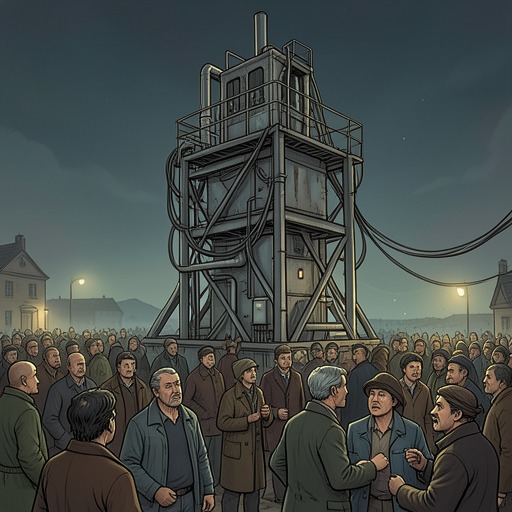
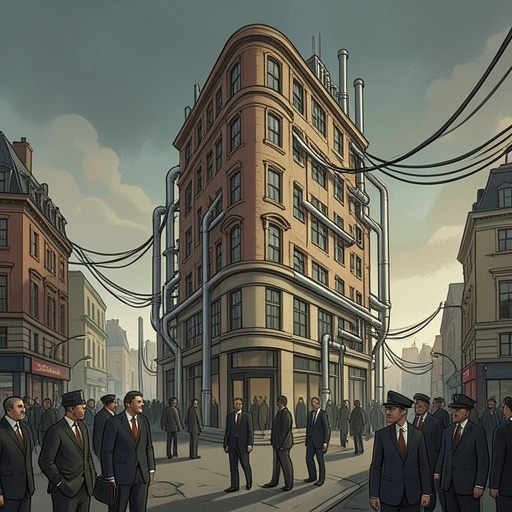
London embodies the material consequences of this system. Silver gives the city its mechanical heartbeat, glimmering in carriages, buildings, clocks, and commercial machinery; it makes London larger, faster, and more industrial than nature would otherwise permit. The city's wealth is inseparable from colonial extraction, and its prosperity already contains the possibility of crisis. Within the silver-working system, Babel functions as a centre whose resonance-dependent bars throughout England draw upon it as a periphery draws soldiers and supplies from an imperial home. The metaphor makes the infrastructure's political structure explicit: technological convenience depends upon a central institution and upon the continued movement of resources toward Britain.
The same dependence makes war attractive to the trading companies. A British victory over China would provide access to what the conspirators regard as the greatest reserve of silver in the world, enabling faster warships, longer-ranging and more accurate guns, and still greater imperial expansion into Africa, Asia, and South America. The proposed invasion is therefore not merely a quarrel over commercial etiquette or national honour. It is an attempt to protect and enlarge a global accumulation system whose industrial benefits are concentrated in Britain while its costs fall on colonized societies and workers displaced by industrial change.
Diplomacy as a Manufactured Pretext
Professor Lovell prepares Robin Swift, Ramiz Rafi Mirza, and Victoire Desgraves for a mission intended to negotiate on behalf of private trading companies, foremost Jardine, Matheson & Company. The talks are difficult because the Qing court distrusts foreign influence and confines British and other foreign traders to Canton and Macau, while British merchants demand free trade, broader market access, open ports, and the removal of restrictions on imports such as opium. Earlier British delegations had failed: the Macartney embassy of 1793 became notorious after Lord George Macartney refused to kowtow to the Qianlong Emperor; the Amherst embassy of 1816 ended with Lord William Amherst refused admission to Peking; and the Napier affair of 1834 culminated in cannon fire and Lord William Napier's death from fever in Macau. Lovell presents Babel translators as the solution to these earlier failures, promising that linguistic and cultural expertise will prevent another fiasco.
The opium bond gives the immediate dispute its legal and commercial form. Mr Baylis explains that foreign ships were supposed to assume responsibility before Chinese law for opium smuggled into China, but that the prohibition had once been treated as practically unenforceable. British ships anchored offshore at places such as Lintin and Camsingmoon, where cargo could be distributed for resale through local partners. Commissioner Lin's arrival changed that arrangement. Captain Elliot allowed the Chinese authorities to confiscate more than twenty thousand chests of opium, worth nearly two and a half million pounds by Baylis's estimate. Baylis calls the seizure an attack on British property and treats it as grounds for war, although the goods had been introduced in defiance of Chinese prohibition.
At the meeting with Commissioner Lin, Baylis's demands expose the diplomatic imbalance beneath the language of negotiation. He asks that agents of Jardine, Matheson & Company be permitted to sell opium legally along the Canton coast, that the Qing government apologize for its treatment of foreign traders, and that the seized opium be returned or compensated at market value. He also insists that the Qing Emperor abandon exclusive trade policies and accept free trade as the secret of national prosperity. Robin translates the demands into deliberately flat English, but the encounter feels less like dialogue than a lecture delivered to a supposedly ignorant child. Translation does not neutralize the coercion; it carries the companies' assumptions across the linguistic boundary while making their demands appear formally diplomatic.
The War Plans and the Lovell Conspiracy
Robin discovers the plot in Professor Lovell's correspondence. A letter from Reverend Gützlaff contains a detailed sketch of Canton's main docks, accompanied by a list of the known ships in the Chinese navy. Other documents record coastal defenses, the number of junks protecting naval stations, the positions of forts on surrounding islands, and the exact number of troops stationed at each. These are not speculative policy papers. They are operational war plans, prepared with the precision of an intelligence dossier.
The papers also destroy Robin's hope that Professor Lovell might have been an unwilling scholar caught in an increasingly hostile trade dispute. Lovell is among the most hawkish voices in the correspondence. He argues for the benefits of war, including the linguistic resources that a conquest would place at his disposal, and describes the Chinese as incapable of serious resistance. An unsent letter to Lord Palmerston assesses the Chinese fleet, dismisses its outdated junks and ineffective cannons, identifies the American-purchased Cambridge as the only potentially formidable vessel, and proposes that the British warship Nemesis would quickly defeat it. Lovell has not merely tolerated the conspiracy: he has helped design it.
The correspondence reaches back to 1837, more than two years before the Canton negotiations become openly hostile. Its authors debate the timing of war and the difficulty of persuading Parliament, not whether hostilities should occur. Jardine, Matheson & Company and Lovell have already decided that war is desirable because it can force access to Chinese silver. Lovell's expedition is consequently double-purpose. Publicly, he travels as a translator and negotiator; privately, the companies fund him as a final mission before introducing a war bill in Parliament, expecting his knowledge to help secure a short, brutal, efficient victory.
Parliamentary and Popular Mobilization
After the opium-burning crisis, Commissioner Lin bans English trade from Canton, and Jardine, Matheson & Company present the resulting confrontation as an assault on British honour. The House of Lords begins debating a military expedition, while the decisive question remains whether Parliament will commit national resources to an unprecedented war at a great distance. The British plot thus moves from private correspondence into public political language. A commercial campaign is recast as national humiliation, and the companies seek to make military intervention appear defensive rather than predatory.
Against this campaign, the task assigned to Anthony Ribben and the Babel students is to persuade Parliament and the British public that war against China would harm Britain's interests. Griffin identifies the immediate stakes as the invasion of Canton: a British victory would give the empire an effectively inexhaustible silver supply and enlarge its imperial capacity, while defeat or restraint would limit the resources available for expansion. An antiwar faction exists in Parliament, led by Sir James Graham, Viscount Mahon, and William Gladstone, although neither Whigs nor Radicals initially has enough confidence in its numbers to call a vote.
The resistance therefore depends on framing as well as evidence. The students retrieve intelligence from Babel, experiment with match-pairs, write to Radical leaders under assumed identities, and extract the most damaging passages from Lovell's letters for inflammatory pamphlets intended for London newspapers. Anthony instructs Robin to emphasize scandal, collusion, corruption, and lack of transparency rather than openly anticolonial arguments or respect for national sovereignty. The strategy is morally compromised but politically calculated: the campaign must speak to the terms that white British readers will accept.
Anthony's broader argument is that the war should be understood as a class issue rather than only a racial or foreign-policy issue. A poor family in Canton and an unemployed weaver in Yorkshire are connected by the same silver industrial revolution, which produces inequality, pollution, and unemployment while enriching trading companies. The coalition must include unlikely sympathizers, including people who would not respond to justice or human dignity but might recognize that imperial expansion threatens their own material interests. Robin's invocation of the Chinese idiom that the rabbit's death makes the fox grieve gives this political theory a compact image of shared vulnerability.
Exposure, Resistance, and Consequences
Robin eventually brings the conspiracy before Babel itself. He announces that Parliament is debating military action against Canton and states that the proposed war has no just pretext beyond the trading companies' greed: they intend to force opium upon the Chinese at gunpoint and use the diplomatic fiasco as an excuse. The speech is halting, especially in the absence of Griffin, but it converts the hidden correspondence into a collective emergency. Babel's scholars must understand that the war threatens not only China but the institution's own position, its students, and the infrastructure built upon the imperial economy.
The antiwar movement's material pressure comes from Babel's occupation, the London strike, barricades, propaganda, and the threat that silver-working will fail. The system is designed to create dependence: bars are made to last weeks rather than months so that maintenance appointments generate revenue, and regional centers in London, Liverpool, Edinburgh, and Birmingham cannot fully compensate for the loss of Babel's maintenance ledgers. As the strike continues, transportation begins to break down. Speed-based match-pairs fail, carriages overturn on Oxford roads, and an eight-person family in the Cotswolds falls into a ravine after a driver has grown accustomed to letting silver-work manage difficult turns. Postal carriages using the French-English match-pair parcelle-parcel collapse under loads that now feel only a fraction of their true weight.
The threatened consequences extend across everyday life and national production. Silver powers ice-making machines, brewery engines, flour mills, locomotives, textile machinery, and the agricultural equipment needed for ploughing, sowing, threshing, and drainage. Without it, rail construction stops, water becomes foul, air grows thick with grime, Britain's textile industry faces collapse, and the countryside itself risks food shortages. The strike exposes the contradiction at the heart of the invasion plan: the same infrastructure that makes British power appear natural and permanent is fragile because it depends on centralized silver-working and on the imperial flows the conspirators want to intensify.
The public response remains hostile. Mainstream newspapers describe the war as a defense of national pride, the invasion as punishment for insults to the British flag, and Babel's occupation by foreign-born students as treason. They portray the Oxford barricades and London strikes as the work of brutish malcontents and insist that China will be defeated almost immediately. Other papers accuse the translators of collaborating with the Qing government, conspiring with mutineers in India, or possessing no motive beyond ingratitude toward Britain. Parliamentarians on both sides declare that Britain will not negotiate with Babel. The plot therefore produces a final reversal: the translators, once recruited to make imperial negotiation function more efficiently, become the targets of a nationalist campaign when they refuse to translate commercial ambition into war.