“The forest of the world”
Barkskins“The forest of the world” is first presented as an immense, circular wilderness with no visible boundary. Recalled across generations of timber commerce and forest management, the phrase acquires an irony: what appears infinite to those seeking wealth is vulnerable to destruction, while its renewal demands a commitment reaching beyond any one lifetime.
The phrase and its first meaning
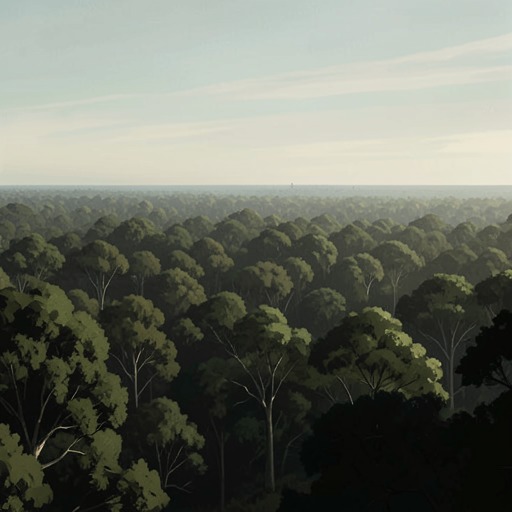
When Duquet asks how large the forest is, Monsieur Trépagny describes it as the forest of the world, twisting like a snake swallowing its own tail, without beginning or end and beyond anyone’s view. The image makes the forest seem not merely vast but self-enclosing: a world whose dimensions exceed human knowledge. Yet the scene also establishes a human practice of finding routes through it. Trépagny follows marks cut high on trees, traces left by someone moving over deep winter snow. The apparently limitless forest is already being read, traversed, and made navigable.
That first description foreshadows a change in the phrase’s significance. Its claim of infinity is not an ecological guarantee; it is an impression that can become an excuse. As timber commerce grows, characters treat the forest’s apparent scale and capacity to replace itself as assurances that extraction can continue indefinitely.
Duquet’s timber calculation
Duquet arrives at his timber ambitions after watching the fur trade swing between surplus and scarcity. Beaver pelts flood the market until French warehouses are full, while the resource itself might disappear through overtrapping, disease, or other causes. Seeking wealth that could endure for generations, he rejects animals, fish, and other living commodities as unreliable and turns instead to the forest, which he believes is everlasting and self-replacing.
His plan is practical as well as speculative: continue earning from furs, accumulate capital, and later move into timber. He sees wood as a commodity with many uses—ships, houses, and fuel—and as a business that could expand where New France has few established forest-goods merchants. The forest’s imagined abundance thus enters a commercial argument: its supposed permanence appears to promise permanent profit. Duquet’s forecast depends on treating regeneration as automatic, not on any demonstrated limit to cutting or obligation to restore what has been taken.
The commercial outlook widens beyond New France. On a trading voyage, Duquet notices the exchange of goods in India and considers whether a three-cornered route could serve a lumber merchant. Later, the company sends its best pine to Sydney, Australia, while a prospective buyer seeks a long-term supply contract and proposes finding a logging partner in New Zealand for kauri. These episodes trace the forest’s transformation into an international commodity: the language of limitless supply travels along with timber from one region and species to another.
Extraction and the cost of apparent infinity
In New Zealand, shore stations combine logging camps with trading posts dealing in flax, spars, and lumber. Warehouses, sawmills, and small shipyards draw European enterprises toward timber-rich harbors. Once a stand is cut, operators move on, leaving smoldering stumps and deep accumulations of waste. Kahikatea is cut first, then kauri; downed timber is burned to clear the land, taking with it not only trees but brush, vines, birds, insects, fruit, bats, epiphytes, ferns, and forest litter. The newcomers’ assumption that the forest exists for their use is the destructive counterpart of the world-forest image: its apparent immensity masks the specific life and places being consumed.
A similar contradiction becomes visible in Michigan. James Duke sees a vast pine forest and imagines that a thousand men could not cut it in a thousand years. Armenius Breitsprecher, looking into the fire, understands that the discovery may make the company’s acquisitive hunger its governing force. He objects to clear-cutting, waste of sound timber, soil destruction, erosion, and the absence of concern for the future. The forest may look boundless from the standpoint of a single company’s ambition, but the consequences of logging are already legible in damaged land and a ruined forest world.
Breitsprecher’s own position sharpens the conflict. His work surveying forests has brought him scattered, difficult-to-sell parcels rather than a substantial share of the valuable Michigan pine. He recognizes the destructive direction of the enterprise, yet his personal stake in the newly discovered timber troubles him. The phrase’s promise of abundance therefore carries both an ecological and an economic tension: the forest is treated as inexhaustible, while access to its profits remains uneven.
Renewal across generations
Dieter Breitsprecher’s correspondence with George Perkins Marsh attends to what extraction leaves behind. Marsh observes tree branches, leaf mold, rainfall caught and slowed by roots, moss, and decaying leaves, and the soil and bird life lost when trees are removed or ponds drained. The forest in this account is not a static storehouse of timber. Its living processes shape soil and water, and their disruption has consequences beyond the sale of felled trees.
After marrying Lavinia Duke, Dieter becomes the company’s figurehead while she retains control of its management. He persuades the board to set aside cutover pinelands in a separate Maintenance Timberland division, which he will oversee and replant. He argues that future timber will become scarce and more valuable, and points to earlier planted lands already growing sturdy trees. The policy gives forest care an economic rationale, but also changes the company’s timescale: decisions must be considered across decades rather than only months or years. It marks a real departure from the assumption that another untouched forest will always be available, even as it remains entangled with the pursuit of future wealth.
In New Zealand, Dieter proposes planting young kauri to replace trees felled there. Ahorangi explains that mature kauri may be thousands of years old and that a seedling could require a hundred human generations to replace one. Dieter answers that seeds should be planted for the health of the world, even when those planting them will never see the trees grown. The seed becomes the inverse of the timber contract: it asks for work whose benefits exceed an individual lifespan and cannot be reduced to immediate return.
That long horizon reappears in Conrad’s forestry work. He enrolls in forestry school and concludes that merely leaving a few wild trees to seed logged land will not reliably regenerate forests. Replanting requires preparation of the site, and logging companies must be persuaded that their future depends on planting among the stumps. He decides that Breitsprecher will offer site preparation as a service and considers research into growing seedlings in soil-filled paper cylinders rather than bare-root stock. In this final movement, the forest’s apparent infinity gives way to practical questions of species, sites, survival, labor, and cost. Its future is no longer presumed: it must be cultivated deliberately.