a forest living for itself
Barkskins“A forest living for itself” is Charley Breitsprecher’s description of wild woodland as an interdependent world with its own life, not merely a stock of timber for human use. The phrase crystallizes a conflict that runs through the novel: whether forests matter chiefly as managed sources of revenue or as complex living systems whose worth exceeds their usefulness to people. Dieter Breitsprecher understands the distinction, even as his work and family business tie him to the industry transforming those systems.
The forest as an ecological whole
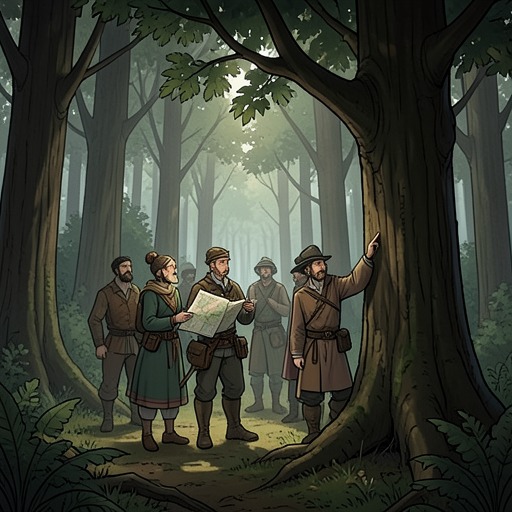
Charley offers his definition when Dieter asks what he considers a forest. He describes more than trees: the surrounding air, intertwined roots, ferns and lichens, insects and diseases, soil and water, and weather all play together like a “grand wild orchestra.” In his account, a forest is not simply a collection of valuable plants. Its parts belong to a living system, and its existence need not be justified by a human benefit.
The exchange distinguishes such wild woodland from plantations of pine planted in orderly rows, which Charley has seen but does not regard as forests. His phrase “a forest living for itself” gives that distinction its ethical edge. A managed plantation may supply timber, work, shade, or pleasure, but those benefits do not make it equivalent to a woodland shaped by relations among many forms of life.
Dieter’s counterargument and the industry’s logic
Dieter does not dismiss Charley’s idea; he repeats the key words, then sets them against the practical definition of managed land. In his explanation, people plant and tend trees to provide revenue for owners, lifetime jobs for workers, and shade and pleasure for visitors. Since wild forests cannot be managed in this way, his argument runs, they are cut for their wood and replaced with trees that can be managed. The replacement is presented as renewal, but the contrast makes clear that a planted crop is not the wild ecological whole Charley describes.
Dieter invokes Austin Cary’s effort to persuade the timber industry that trees can be grown as a profitable, renewable crop and that managed forests can control erosion while maintaining timber supply. Cary faces resistance from loggers who see his advocacy as a threat to their business, as well as anxiety from people who fear forests are ending and rivers are being damaged. The phrase thus sits between two proposed responses to depletion: sustain a steady supply through managed production, or recognize the irreducible value of forests that do not exist for human ends.
The material costs behind the disagreement
The novel gives this dispute a history in the destruction of forest and soil. When Lennart Vogel reports that settlers have burned and cut nearly all the white pine on Duke & Sons’ Ohio property, the trees have been replaced with farms; James Duke reacts to the loss of thousands of acres. In Michigan, the discovery of great pine stands excites James, who imagines a thousand men cutting them. Armenius Breitsprecher, looking into a fire, recognizes the company’s acquisitive hunger and fears that the new forest find will turn rapine into the company’s engine. He objects to clear-cutting, waste of sound wood, soil destruction, erosion, and the assumption that another forest will always be available.
Dieter’s later anger focuses on the gap between conservation laws and the waste they fail to prevent. He argues that only a small fraction of standing forest becomes lumber while much of it is burned or abandoned, and condemns the land-lieu provision for enabling logged-off land to be exchanged for untouched timberland. His frustration is personal as well as ethical: Lavinia employs lobbyists, and by association so does he. The phrase “a forest living for itself” therefore marks a position within a compromised world, not an easy escape from it.
From preservation to restoration
Dieter’s response to that compromise includes a proposal to keep cutover pine lands out of the hands of speculators and place them in a separate division, Maintenance Timberland, for replanting and management. He argues before the board that timber may become scarce and that maintaining forestland can support future lumber and paper revenues. The board is forced to consider a horizon of decades rather than months or a few years. This conservation effort does not reproduce Charley’s wild forest, but it shifts the company’s planning toward regeneration and a future beyond immediate cutting.
In New Zealand, Dieter expresses the longer ethical horizon in planting kauri seedlings, despite being told that a seedling could take a hundred human generations to replace a fallen mature tree. His faith in planting for the health of the world, including people not yet born, contrasts with the short-term extraction that treats trees as immediately available wealth. Later, Conrad Breitsprecher makes that long view practical: after enrolling in forestry school, he concludes that leaving scattered wild trees to seed logged cuts is inadequate, that site preparation matters, and that logging companies must bear its cost. He decides Breitsprecher will offer site preparation as a service.
A phrase carried into later forestry
The question remains alive in later generations. When Dieter asks Charley what he thought of the forests, Charley’s distinction between wild woodland and plantation becomes a measure against which managed forestry must be judged. Conrad’s work does not simply repeat the ideal of untouched wilderness: it tests how seedlings, site preparation, and research might support regeneration on damaged sites. At the Breitsprecher Tree Project, Sapatisia Sel describes a small team working with conservation groups, planting trees, monitoring test plots for as long as ten years, and studying seedling growth in burned soil, where mycorrhizal fungi affect nutrient uptake.
The phrase retains its force because restoration and replacement are not identical. Tree planting, forestry research, and conservation planning respond to real damage, but Charley’s wording insists that a forest’s air, soil, water, weather, and living relations cannot be reduced to the crop that might replace it. Across the novel’s successive forests and generations, “a forest living for itself” is both an ecological description and a challenge to the belief that land has value only when it can be put to work.