Trees are Persons
Barkskins“Trees are Persons” expresses a Mi’kmaw understanding of the living world that refuses to place humans above trees, plants, animals, and fish. Set against Christian and colonial arguments that forests exist to be cleared and land belongs to whoever improves it, the expression becomes a measure of competing ways of knowing, using, and caring for the forest. Its meaning recurs from everyday practice to industrial logging and, finally, the difficult work of replanting.
A relational understanding of the forest
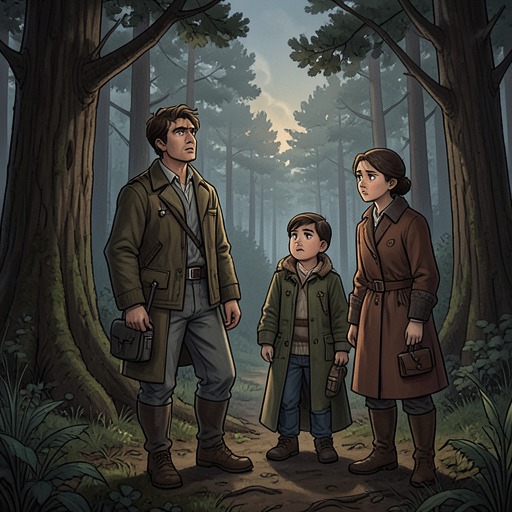
In a letter to his sister, Père Crème observes that Mi’kmaw life follows the abundance of animals, fruits, and fish through the seasons rather than an imposed agricultural calendar. He describes Mi’kmaq people as regarding trees, plants, fish, moose, and bears as equals, and recounts stories in which people form kin-like relations with animals or change between human and animal forms. In the forest, he writes, they speak to toads and beetles as acquaintances. His account registers a worldview in which the nonhuman world is not a silent backdrop but a community of beings with their own standing.
The phrase is stated directly when Père Crème contrasts that understanding with his own teachings. He tells the Mi’kmaq that trees are for human purposes, including houses and ships, and urges them to farm and bring order to their days. They refuse his instruction. He interprets their resistance through a colonial standard of productivity, while the narrative makes visible the assumption beneath it: that land and trees acquire value through human improvement and use. The disagreement is therefore not simply over work. It is over whether a forest is a store of materials or a living society to which people belong.
The Mi’kmaw perspective also appears in practical knowledge. Mari makes eel traps, baits them with fish scraps, and shows René where in the river to set them; she explains that the traps suit him and that her sons could teach other methods. Her expertise is learned through relation to place and species, not abstracted from them. Elsewhere, a physician comes to see Mari because her reputation for treating the sick and injured has reached Kébec; he returns with wild vegetable specimens for a botanical garden. Such episodes place Indigenous knowledge in contact with outsiders who may seek, record, or use it, while leaving its original setting and practitioners central to its meaning.
Land, labor, and colonial claims
Père Crème’s private writing exposes how religious instruction supports a theory of possession. He argues that land belongs to the person who improves it, equating improvement with clearing forest, building a house, and sheltering livestock. Because Mi’kmaq people fish, hunt, and gather rather than farm in the French manner, he treats their use of the land as evidence that they have failed to claim it. The expression “Trees are Persons” directly unsettles that reasoning: a forest already inhabited by persons is not empty or unimproved merely because it remains uncleared.
The pressure is material as well as ideological. When a sawmill opens in the interior, René and members of the Sel family take paid work cutting trees for Duquet et Fils, partly because wages can buy flour and other goods. Père Crème urges the community toward that labor. At the same time, he distrusts the Sel family’s French literacy and their preference for seasonal work in woods, rivers, trapping, and hunting over farming. The novel thus shows Indigenous people navigating new economic demands without simply abandoning their own seasonal practices or knowledge.
Sosep gives the cost of that unequal transition a communal voice. He describes settlers’ livestock damaging food sources, their boats and nets taking fish, and introduced plants displacing local ones. He warns that settlers are many while the Mi’kmaq are few, and recalls that the woods once belonged to his people and could be traveled freely. His response is not to demand a return to an untouched past: he urges the community to keep its Mi’kmaw world alive in thought and practice, a world in which people, plants, animals, and birds are persons who help one another. The expression consequently carries both an ethical claim and a strategy for cultural survival amid dispossession.
Industrial forests and opposing time scales
When James Duke encounters Michigan’s great pine forest, he imagines deploying a thousand men to cut it. Armenius Breitsprecher recognizes in that ambition the acquisitive hunger of Duke & Sons: the company seems intent on clearing a continent. He objects to clear-cutting, wasted sound timber, soil loss, erosion, and the assumption that another forest will always be available. The contrast with “Trees are Persons” is stark. Under the company’s extractive logic, trees become inventory and forest destruction is treated as a temporary cost; under a relational logic, a forest is a world whose life cannot be reduced to the next supply of lumber.
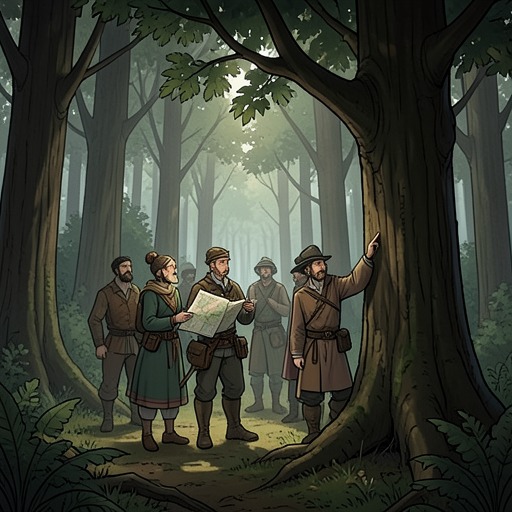
Dieter Breitsprecher’s correspondence with George Perkins Marsh develops an alternative attention to forest processes. Marsh notices how branches fall, how leaf mold accumulates, how roots, moss, and decaying leaves slow and absorb rain, and how the removal of trees affects soil and birds. This close observation makes environmental change legible as a chain of consequences, not a blank space left behind after logging. Dieter’s interest in such evidence helps turn forest care from a sentiment into a long view of ecological effects.
After marrying Lavinia Duke, Dieter persuades the company to retain cutover pine lands rather than sell them to speculators. He oversees a separate Maintenance Timberland division devoted to holding, replanting, and managing those lands, as well as acreage he kept outside the merger. He argues that timber may become scarce and more valuable, and points to older Breitsprecher plantings already growing into valuable timberland. Conservation enters the company’s practice, but remains entangled with future commercial returns: protecting forests is also presented to the board as a way to preserve future wealth.
Seeds, knowledge, and responsibility to the future
In New Zealand, Dieter proposes planting young kauri trees to accompany the cutting of mature ones. Ahorangi explains the scale of the loss: a seedling could take a hundred human generations to replace a fallen kauri of great girth. Dieter answers that planting is worthwhile even when those who plant will never see the trees mature, because they plant for the health of the world and for people not yet born. Here the expression’s refusal to treat trees as mere human instruments converges with a cross-generational ethic: the forest’s value extends beyond the lifespan or profit horizon of any one person.
That ethic becomes practical and contested in the later work of Conrad Breitsprecher. He enrolls in forestry school and concludes that leaving a few trees to seed logged clear-cuts is not enough; experience shows poor regeneration. He decides that Breitsprecher should offer site preparation as a service, so that logging companies and lumbermen will have reason to prepare ground and plant seedlings among stumps. He also studies alternatives to bare-root seedlings, including seeds grown in soil-filled paper cylinders, and recognizes the need for research into species, labor, costs, and planting conditions. The challenge is not only to grow trees, but to persuade an industry organized around cutting to accept a time scale measured in decades and centuries.
The expression therefore holds together a sustained contrast in the novel: forest as community and forest as commodity, knowledge grounded in reciprocal attention and knowledge organized for extraction, immediate gain and responsibility to lives that will not be present to claim it. Later conservation and nursery work do not erase the dispossession or the industrial destruction already shown. They do, however, make the question raised by “Trees are Persons” practical: whether human use of forests can recognize their lives as more than a future supply of timber.