“Nothing is everlasting. Not forests, not mountains.”
Barkskins“Nothing is everlasting. Not forests, not mountains.” The statement, voiced by Wuqua in conversation with Charles Duquet, punctures Duquet’s conviction that timber could be an inexhaustible foundation for permanent wealth. Repeated across the book’s generations of logging and forest stewardship, it becomes a principle against which commercial confidence, ecological loss, and efforts at renewal are measured.
The Maxim and Duquet’s Plan
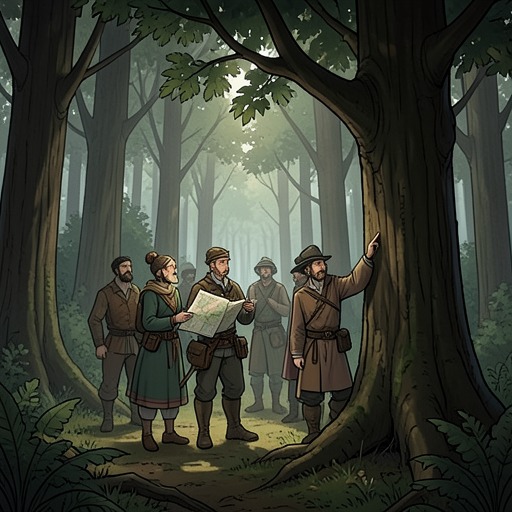
Duquet has turned toward timber after recognizing the instability of the fur trade: animal populations, supply, and markets can all shift abruptly. He imagines the forest as a more dependable resource, vast enough to provide wood for ships, houses, and fuel, and capable, as he assumes, of replacing itself. His ambition is not simply to earn money but to establish lasting wealth and a family name. The maxim directly challenges the premise behind that plan: a resource that appears immense is not therefore permanent.
The challenge acquires particular force in Duquet’s discussion with Wuqua. Wuqua explains that wood is consumed in France and China as well as in the colonies, including for ink soot and the work of craftsmen; in some places, shortages have driven people to use grass or animal dung for fuel. Duquet responds by asking whether the forests of France and China are not everlasting, and observes that Italy’s mountains have been stripped. Wuqua answers with the maxim. The exchange makes depletion legible through examples beyond Duquet’s immediate business prospects, while Duquet’s unhappiness registers how directly the answer unsettles his expectation of permanence.
The Forest as an Industrial Resource
Duquet’s belief does not disappear with the warning. During a trading journey, he notices the movement of goods through India and considers whether a three-cornered route might serve a lumber merchant. Forest remains, in his thinking, the basis for an expanding commercial enterprise. The contrast is important: knowledge of shortages exists alongside the desire to make timber a source of enduring profit.
Later episodes reveal the consequences of treating forests as effectively limitless. When Lennart Vogel warns James Duke that the New England and New York pine has been cut out, he describes a further loss in Ohio: settlers have cut and burned almost all the white pine on a property acquired by James’s father, replacing forest with farms. The episode turns the maxim into a recurring historical correction. A forest can be exhausted within the span of a commercial venture, even when its scale once seemed to promise abundance.
At the discovery of Michigan’s great pine stands, James imagines that a thousand men could not cut the timber in a thousand years. Armenius Breitsprecher sees the danger in that confidence: Duke & Sons’ appetite appears large enough to clear the continent, and the discovery threatens to make destructive extraction the company’s engine. He objects to clear-cutting, wasted wood, soil destruction, gullying, and erosion, while recognizing that he is helping the company pursue the very expansion he condemns. The maxim’s opposition to permanence thus bears on both forest ecology and commercial imagination: the prospect of more timber can conceal the cumulative damage of taking it.
Damage, Waste, and Delayed Consequences
Dieter Breitsprecher gives the warning a later, more explicit ethical force. He sees eastern forests and soils worn down by cutting, burning, and farming, followed by continued migration into western timberlands. He condemns conservation laws whose loopholes allow logged-over land to be exchanged for untouched forest, and objects that most standing timber never becomes lumber but is burned or abandoned. His complaint that waste is the greatest ill identifies a mechanism by which apparent abundance is squandered rather than converted into lasting use. Yet he also knows that Duke & Breitsprecher employs lobbyists, implicating the business in the political arrangements he deplores.
The book also connects forest damage to consequences that unfold beyond the logging site. A later account of spruce budworm control describes the spraying of DDT in the 1940s and its effects on the food organisms that supported salmon in the Miramichi River. The episode complicates any idea that forests can be managed as isolated stocks of useful trees: interventions in a boreal forest can reach aquatic life and disrupt a wider ecological system. In this history, impermanence is not only the disappearance of timber; it includes the loss and alteration of relationships among forests, soil, water, and other living things.
Replanting Beyond a Lifetime
Dieter’s answer to depletion is to reserve and manage cutover land rather than sell it to speculators. He argues that timber scarcity may make forests more valuable in the future and points to older Breitsprecher land where trees planted decades earlier have become sturdy. The plan shifts the company’s time horizon from immediate returns to decades, and it gives conservation a place within an enterprise still organized around lumber and paper. This is a real change in practice, but not a resolution of the conflict between stewardship and extraction.
During the New Zealand journey, the scale of time becomes impossible to overlook. Nashley Oval explains that a mature kauri may be thousands of years old and that a seedling could require a hundred human generations to replace a fallen tree of immense girth. Dieter’s response is to plant without expecting to witness maturity, for the health of the world and the benefit of people not yet born. His faith in the seed does not deny the maxim. It accepts that no single person or generation can command permanence, while making care for what outlasts them an obligation.
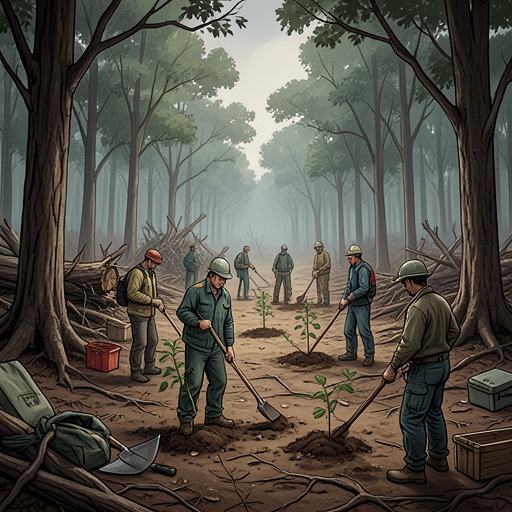
That obligation becomes practical work in the later Breitsprecher Tree Project. Sapatisia describes a small work group planting trees, monitoring test plots over periods of up to ten years, and recording conditions such as chlorosis and the effects of mycorrhizal fungi on seedlings. The project attends to particular sites and the conditions needed for growth, rather than assuming that planting alone restores a forest. Read against Duquet’s hope for a resource that would yield wealth forever, this work offers no promise of endless forests. It offers sustained observation and repair in recognition that forests can be damaged, may recover only over time, and require care beyond the lifespan of those who plant them.