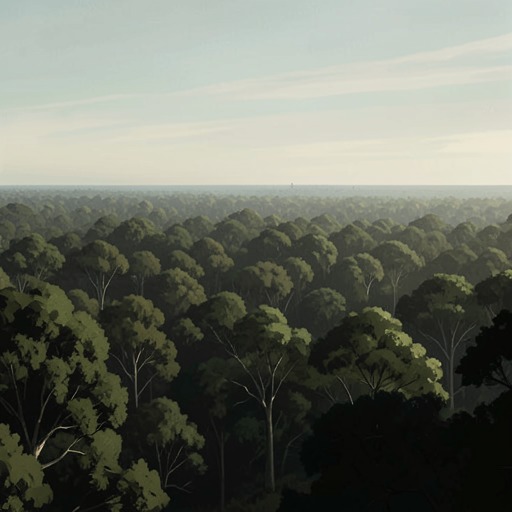
“The forests are infinite and permanent”
Barkskins“The forests are infinite and permanent” is Edward Duke’s blunt defense of taking timber without regard for the future. Across the novel, the claim becomes an organizing delusion: it turns living forests into seemingly inexhaustible commodities, while successive scenes expose the damage and obligations that the slogan denies.
The Claim and Its Immediate Logic
At a discussion of where to acquire more timber, Cyrus Hempstead proposes looking toward the Susquehanna and Allegheny Rivers and buying with an eye to fifty years ahead. Freegrace Duke likewise argues for beginning purchases with that longer horizon. Edward dismisses their caution: he sees no need to worry about the future and asserts that forests are infinite and permanent. His statement is not an isolated description of nature but a business position—take what is available now, without allowing future scarcity to constrain present acquisition.
That confidence echoes the premise behind Charles Duquet’s decision to turn from the fur trade toward timber. Beaver and other animals, he recognizes, can become scarce and their markets can fluctuate; he instead imagines the forest as an everlasting commodity that Europe lacks, capable of supplying ships, houses, and fuel indefinitely. He plans to accumulate money in furs before moving into wood. His expectation that the forest replaces itself makes expansion appear permanent, even as the plan depends on continual commercial growth.
Landscapes That Contradict It
The novel repeatedly sets such confidence against material change. René Sel’s years of cutting are accompanied by settlers clearing forest for fields, wildlife retreating, and the realization that the woods keep extending beyond the reach of his axe. His efforts seem puny beside the forest’s scale, but that apparent vastness does not mean that any particular stand or landscape is immune to loss.
In Mi’kmaw country, French settlement has plowed woodland edges and drained salt marshes for livestock; moose, caribou, and bear have retreated, while beaver numbers have fallen sharply under trapping pressure. The beaver skin, once placed on graves, has become a form of money exchanged for guns and metal pots. The scene makes the costs of treating nature as a limitless supply visible in altered land, diminished animal populations, and changes to cultural practice.
The timber stations established along New Zealand’s shore offer an even harsher counter-image. Logging camps and trading posts take flax, spars, and lumber; enterprises move on after stripping productive forest, leaving waste and smoldering stumps. The cutting shifts from kahikatea to kauri, and fallen timber is burned to clear the land, destroying habitat along with trees. The newcomers’ assumption that the forest exists for their use is shown not as permanence but as a pattern of extraction and abandonment.
From Expansion to Long-Term Responsibility
The discovery of Michigan’s white pine brings the slogan into conflict with the consequences of corporate power. James Duke sees the immense stand as an opportunity to employ a thousand men. Armenius Breitsprecher, however, understands that the company’s appetite may clear a continent: he objects to wasteful clear-cutting, soil destruction, and erosion, and recognizes that the promise of another forest encourages the same destructive practice to continue. His limited personal share of the land sharpens the conflict between the company’s profits and the costs borne by the forests and those who work them.
A different time horizon enters the business when Dieter Breitsprecher argues that cutover pine lands should be managed and replanted rather than sold to speculators. The separate Maintenance Timberland division is to preserve and tend those lands. Existing plantings on older Breitsprecher holdings, already growing into valuable trees, give practical force to his argument that future timber and paper wealth depends on continuity rather than endless new acquisitions. This policy marks an early, qualified sign of conservation within a company still built around timber extraction.
The novel then makes the time-scale problem explicit through Dieter’s discussion of kauri with Ahorangi Oval. Mature kauri may be thousands of years old; a seedling cannot replace a large fallen tree within a human lifetime. Dieter nevertheless argues for planting seeds for the health of the world and for people not yet born. The seed becomes the counter-image to Edward’s slogan: not an assurance that forests will simply renew themselves, but an act of responsibility whose benefits may arrive far beyond the planter’s own life.
Replacing the Myth with Practice
Dieter’s correspondence with George Perkins Marsh deepens the alternative to the idea of permanence. Marsh attends to the processes that sustain a forest—branches falling, leaf mold accumulating, rain being caught and slowed by roots, moss, and decaying leaves—and also observes what follows when trees disappear: soil changes and birds vanish when a pond is drained. Forest health is therefore not an automatic, invisible guarantee; it depends on relationships among trees, soil, water, and wildlife that extraction can disrupt.
Conrad Breitsprecher carries that lesson into forestry training and the family nursery. He finds that bare-root seedlings marketed as able to grow anywhere often die on rough logged-over sites, and that leaving a few wild trees to seed a clear-cut produces poor regeneration. Replanting requires site preparation, research, and cooperation from logging companies, so he decides that the business should offer site preparation as a service. His questions about seedling species, planting conditions, labor, and cost turn the abstract hope of renewal into practical work, with the proceeds of his uncle Charley’s legacy also drawing him toward philanthropy.
The expression’s significance lies in the gap between what it asserts and what the novel shows. Forests may look immense beside an individual axe, but animal decline, drained marshes, burned timberlands, eroded soil, and failed regeneration reveal that scale is no promise of permanence. Against the confidence of immediate extraction, the novel sets management, ecological knowledge, and the planting of trees that their planters may never see mature.