“How far back can a forest withdraw before it replenishes itself”
BarkskinsThe question “How far back can a forest withdraw before it replenishes itself?” crystallizes Charles Duquet’s central gamble: he treats the forest as a renewable source of permanent wealth, even as evidence accumulates that settlement, agriculture, and commercial cutting push forests back and alter the lives dependent on them. Asked of Wuqua in China, it reaches beyond one conversation, recurring across generations as the novel tests the difference between a forest imagined as inexhaustible and one understood as a complex living world.
Duquet’s Question and Timber Ambition
After recognizing the instability of the fur trade, Duquet rejects animals and other living commodities as foundations for lasting wealth: their numbers and markets can shift or collapse. He turns instead to the forest, which he believes Europe lacks and the colonies possess in seemingly limitless abundance. Timber can supply ships, houses, and fuel; he imagines profits that could continue indefinitely and establish a family name. He plans to use the fur trade’s immediate returns to prepare for a later move into timber, inviting the Trépagny brothers to remain his partners, though they respond without enthusiasm.
The question comes during Duquet’s China voyage, after he has begun to prosper through trade and is considering what further voyages might finance his forest enterprise. He notices China’s miniature garden landscapes and wonders about its real forests, while acknowledging that forests have diminished in France and are retreating near settlements in New France. His question to Wuqua is therefore both inquiry and test: can the apparent renewal he has taken for granted withstand the evidence of depletion?
Wuqua’s Answer and Its Limits
Wuqua returns with an account from an elderly scholar of Meng-tzu’s writing. People clear land, remove vegetation, cut trees, and plow because they need food and fuel; the population was already numerous and poor in Meng-tzu’s time. Wuqua describes land division as the basis of human government, placing forest clearance within the practical demands of agriculture and political order rather than treating it as an isolated commercial choice.
When Duquet asks whether forests are diminished, Wuqua qualifies the answer. Timberlands may shrink while cropland expands, and people transplant useful trees, including bamboo, pine, oak, and species valued for lacquer or oils. He presents the exchange in terms of more food, money, people, and contentment. Duquet nods but does not perceive contentment in this account. The exchange does not settle whether a forest can replenish itself; instead, it shows that what counts as renewal depends on what has replaced the forest and whose needs are being measured.
The Question Meets the Landscape
The novel places Duquet’s confidence beside landscapes that contradict the idea of effortless, unlimited renewal. Around René Sel, Crown labor gangs widen a trail into a road and more settlers enter the forest. Chopping drives woodpeckers away; trees fall, maize is planted among the stumps, and deer and moose retreat, followed by wolves. René keeps cutting even as the forest’s spread and the vigorous growth from stumps and living roots make his labor seem small against its immense extent. Here regrowth is visible, but so are the animals displaced and the expanding human pressure that gives the cutting its direction.
When Sosep and his companions reach Mi’kmaw country, they encounter French settlement reshaping the woodland and shore. Land once supplying berries and edible roots has been plowed for maize and turnips; salt marshes have been drained for livestock hay. Moose, caribou, and bears have retreated, and beavers have been so heavily taken that their skins have become a form of white-man money, replacing an older grave custom. The scene makes the question political as well as ecological: forest loss is bound to settlement, agriculture, and trade, while those who have long depended on the land bear the changes.
A Repeating Pattern of Extraction
Across later periods, the forest is repeatedly treated as a resource awaiting exploitation. New Zealand shore stations combine logging camps with trading posts for flax, spars, and lumber. European enterprises take valuable timber, move camps when a site is exhausted, and leave smoldering stumps and deep accumulations of waste. The destruction reaches beyond trees to birds, insects, fruit, bats, ferns, and other parts of the forest. The commercial gaze recognizes what can be sold and assumes the forest exists for that purpose—the practical answer to Duquet’s question is displaced by an extractive system that moves on rather than waiting for renewal.
The discovery of Michigan’s white pine exposes the same logic on a continental scale. James Duke sees a vast supply and imagines mobilizing a thousand workers to cut it. Armenius Breitsprecher, watching the company’s acquisitive hunger, understands that the discovery may turn rapine into Duke & Sons’ governing business practice. He objects to clear-cutting, waste of usable wood, soil destruction, erosion, and the assumption that another forest will always be available. Duquet’s once-speculative confidence thus becomes an industrial program, while the costs that his question left open become explicit.
Renewal, Management, and the Unresolved Measure
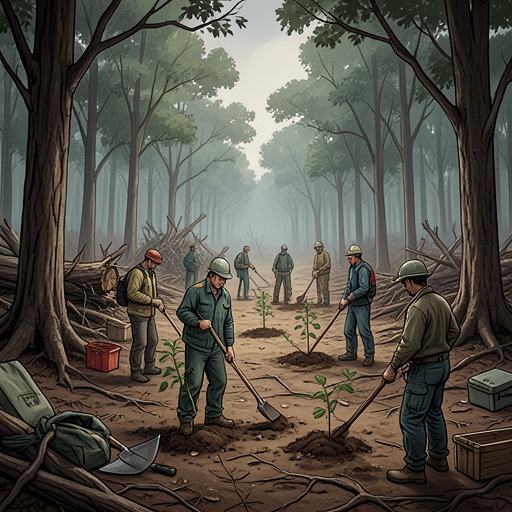
The novel also distinguishes replenishment from simple replacement. Dieter Breitsprecher observes how trees slow rain and how roots, moss, and decaying leaves hold water and soil; when trees disappear, soil changes and birds vanish from drained ponds. His attention to these linked processes challenges the notion that planting trees alone restores everything a forest is. Later, he argues for keeping cutover pine lands under a separate division, Maintenance Timberland, to be replanted and managed rather than sold to speculators. His case turns toward future scarcity and value, asking the company to think across decades rather than months.
That conservation measure remains within a commercial framework: managed forests are intended to provide timber, employment, and revenue. In a later conversation, Charley describes a true forest as a wild woodland whose air, roots, ferns, lichens, insects, soil, water, and weather form an interconnected whole, a forest living for itself. Dieter answers that modern forestry treats timber as a crop, cut and replaced to maintain supply and control erosion. The contrast sharpens the original question without resolving it. Renewal may mean a continuing timber yield, or the recovery of a living system whose worth exceeds its usefulness to people; the novel’s successive landscapes show why those meanings cannot be assumed to coincide.