One must have faith in the power of a seed
BarkskinsOne must have faith in the power of a seed is Dieter Breitsprecher’s expression of an ethic that measures forestry beyond a single lifetime. Spoken during a discussion of replanting kauri, it answers both the immense age of the trees and the extractive logic Dieter sees in industrial logging: planting is an act of responsibility toward a future the planter will never witness.
The phrase in its immediate setting
During a visit with Ahorangi Oval and Nashley Oval, Lavinia Duke explains that she is there to examine kauri for cutting, while her husband is interested in replanting what is taken. She asks whether young kauri might be planted, perhaps one for each mature tree felled. Ahorangi points out the scale of the problem: the largest trees are thousands of years old, and a seedling could take a hundred human generations to replace a fallen kauri of that girth.
Dieter’s answer, “One must have faith in the power of a seed,” does not deny that disparity. He states the obligation in terms of deliberate planting despite the absence of any personal reward within one’s lifetime: “We plant them knowing we will never see them when they are grown. We plant them for the health of the world rather than for people not yet born.” The seed becomes a measure of time and responsibility, not a promise of quick replacement.
Against extraction without a future
The idea gains force from Dieter’s earlier view of Duke & Sons. When James Duke celebrates a vast discovery of Michigan pine and imagines sending a thousand men to cut it, Armenius Breitsprecher recognizes that the company’s appetite may extend to clearing the continent. He condemns clear-cutting, wasted timber, damaged soil, erosion, and the destruction of the forest world by men who treat supply as endless. The contrast is stark: the company sees a forest as a fortune to seize, while the seed asks what will remain after the cutting.
Dieter’s position is not merely an appeal to sentiment. He studies the forest as a system in which trees slow rain, roots and forest floor hold moisture, and the removal of trees changes soil and drives birds away when ponds are drained. His correspondence with George Perkins Marsh deepens his attention to these linked effects. In that context, planting looks beyond replacing marketable timber: it recognizes that forests sustain conditions and forms of life whose loss cannot be measured by the price of lumber.
From principle to practice
Dieter gives the ethic an institutional form after his marriage to Lavinia. Although he becomes the company’s figurehead, she continues to manage and control the business. He asks that cutover pinelands not be sold to speculators, but held and managed through a separate division, Maintenance Timberland, which he will oversee and replant. He also retains acreage outside the merger. These steps introduce an element of conservation into the reputation of Duke & Breitsprecher, even as the company remains a powerful timber enterprise.
Before the Board, Dieter argues that timber will become scarce and more valuable, and points to old Breitsprecher lands planted two decades earlier, now carrying sturdy trees. His proposal asks the directors to think in decades rather than months or a few years. The seed’s long horizon thus becomes both an ecological principle and a challenge to ordinary business time: care for the forest can be responsible stewardship and a way of securing future timber, though the ethical and commercial motives are not identical.
A legacy carried forward
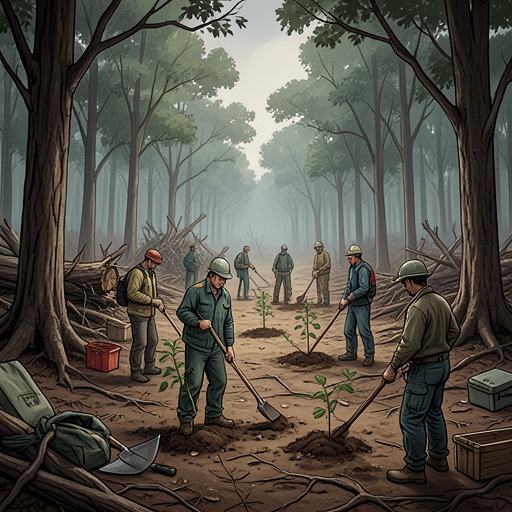
The maxim also anticipates Conrad Breitsprecher’s later work. After deciding to study forestry, Conrad concludes that seedlings alone cannot ensure regeneration on rough logged-over sites. Logging companies and lumbermen must prepare the land and plant among the stumps; relying on a few remaining wild trees to reseed barren cuts has proved inadequate. He decides that Breitsprecher will offer site preparation as a service, making the conditions for new growth part of the business rather than an afterthought.
Conrad’s practical questions—what species to plant, how to prepare sites, and whether seedlings grown in soil-filled paper cylinders outperform bare-root stock—give the seed ethic a more technical form. Its central claim remains that forests demand planning on a scale longer than an individual life or a company’s immediate returns. The phrase joins Dieter’s proposed kauri nursery, his preservation of cutover land, and Conrad’s forestry experiments in a recurring idea: planting is meaningful precisely because its full result belongs to a future beyond the planter.