Amy Denver
BelovedAmy Denver is a white runaway indentured servant who appears in the novel's central flashback as the unlikely savior of the pregnant fugitive Sethe. She is a ragged, talkative girl of about sixteen, with arms like cane stalks, hair enough for four or five heads, and slow-moving eyes. Her encounter with Sethe in the wild onion fields near the Ohio River in 1855 not only saves Sethe's life but also brings Denver into the world, giving the child her name. Amy's brief, intense presence—marked by her obsession with velvet and her dream of Boston—becomes a touchstone of the novel's meditation on kindness, survival, and the strange bonds that form between the dispossessed.
Identity and Background
Amy is introduced as a "raggediest-looking trash" white girl, a runaway indentured servant fleeing a life of servitude under a master she calls Mr. Buddy. She is heading to Boston, a hundred miles away, to buy velvet from a store called Wilson, having seen pictures of it. Her mother, who worked to pay off her passage, died shortly after Amy's birth, leaving Amy to work off the debt. Amy's speech is a constant stream of chatter about Boston, velvet, and good things to eat, revealing a desperate hunger for a better life. She has been beaten by Mr. Buddy, once for looking at him straight, and she carries the scars of her own servitude, though her skin is new and lineless, suggesting a youth not yet hardened by the worst of the world.
The Encounter with Sethe
Amy finds Sethe collapsed in the wild onion fields, her feet swollen beyond recognition, her back freshly whipped into a chokecherry tree of scars. Sethe, believing Amy to be a white boy with "mossy teeth," prepares to attack, but Amy's voice and her offer of help disarm her. Amy's first act is to massage Sethe's feet, a painful but life-giving touch that brings Sethe to tears. She then leads Sethe to a lean-to, where she treats her back with spiderwebs, calling the scars a "chokecherry tree" in bloom. Amy's hands, though thin, are strong, and her voice, like a sixteen-year-old boy's, keeps the baby in Sethe's womb quiet and grazing. She talks incessantly of Boston and velvet, but her actions are those of a healer, not a hunter.
The Birth of Denver
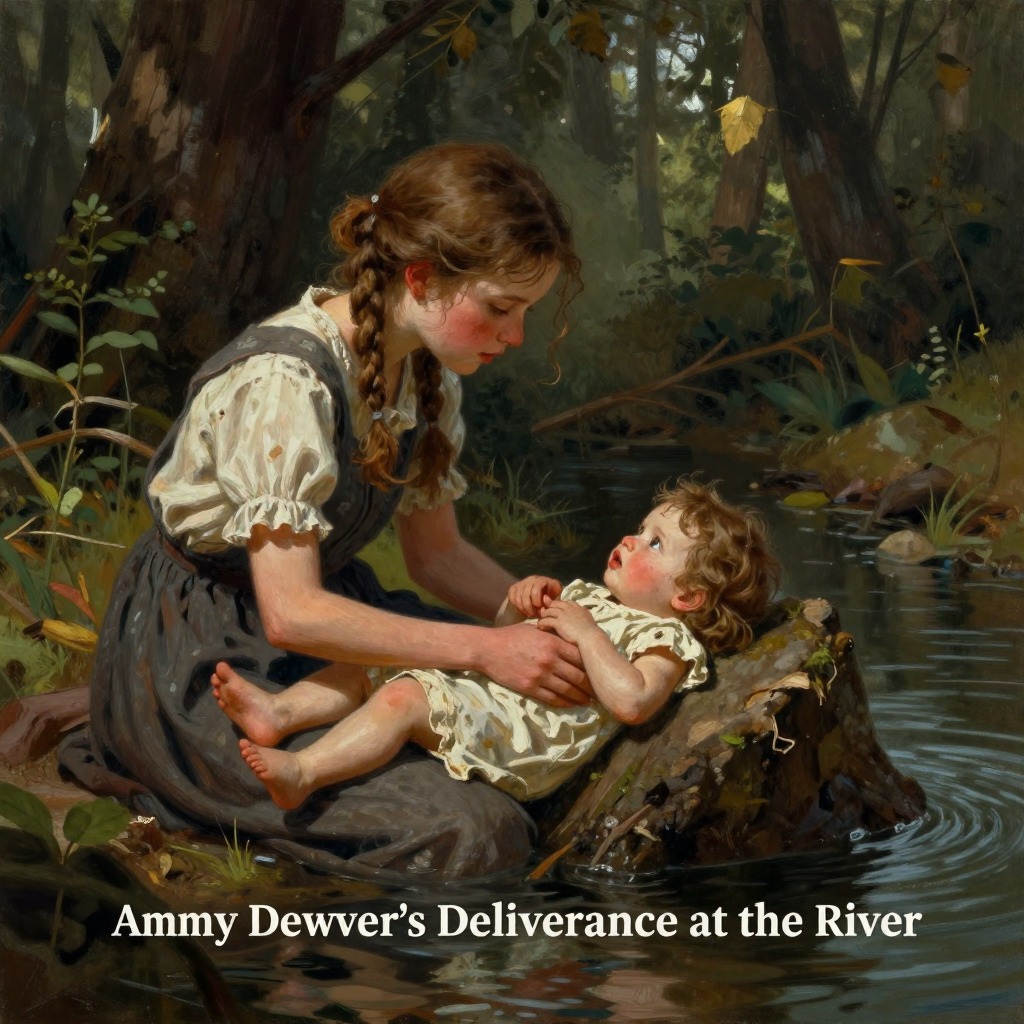
When Sethe's labor begins, Amy helps her into a stolen rowboat on the Ohio River. The baby is born face up, stuck, and Amy, cursing Jesus's daddy, works to free it. With Sethe's whispered "Pull," Amy's strong hands deliver the child. Afterward, Amy wraps the newborn in her own skirt, and the two women, a slave and a barefoot whitewoman, perform the birth "appropriately and well" on the riverbank. Amy names the baby, telling Sethe to say "Miss Amy Denver. Of Boston." Sethe, falling into a deep sleep, thinks the name is "pretty." Amy then leaves, heading for the Pike to Boston, never to be seen again.
Relationships and Significance
Amy's relationship with Sethe is brief but transformative. She is the "whitegirl" Sethe credits with saving her life, and her name becomes Denver's. Sethe remembers Amy's good hands and her voice full of velvet and Boston, and she later tells Denver the story of her birth, emphasizing Amy's role. Amy's kindness stands in stark contrast to the cruelty of schoolteacher and his nephews, and it complicates the novel's portrayal of white people. She is a figure of pure, uncalculated compassion, driven by her own hunger and dreams, yet she gives without expectation. Her legacy lives on in Denver, who is "charmed" and "saved" from the start, and in the story that Sethe tells to Beloved, a story that binds the women of 124 together.
Thematic Resonance
Amy Denver embodies the novel's theme of unexpected grace. She is a "throw-away person," like Sethe, an outcast who nonetheless acts with agency and love. Her dream of velvet—a fabric she describes as "like the world was just born"—represents a longing for beauty and newness that transcends her circumstances. In a novel haunted by the horrors of slavery, Amy's brief appearance offers a counterpoint: a moment of human connection that is not based on race or power but on shared vulnerability. Her name, given to Denver, becomes a permanent reminder of that connection, and her story, passed down through Sethe, becomes part of the family's history. Amy is not a ghost, but she lingers in the novel's memory, a bright spot in the darkness, a testament to the possibility of kindness in a brutal world.