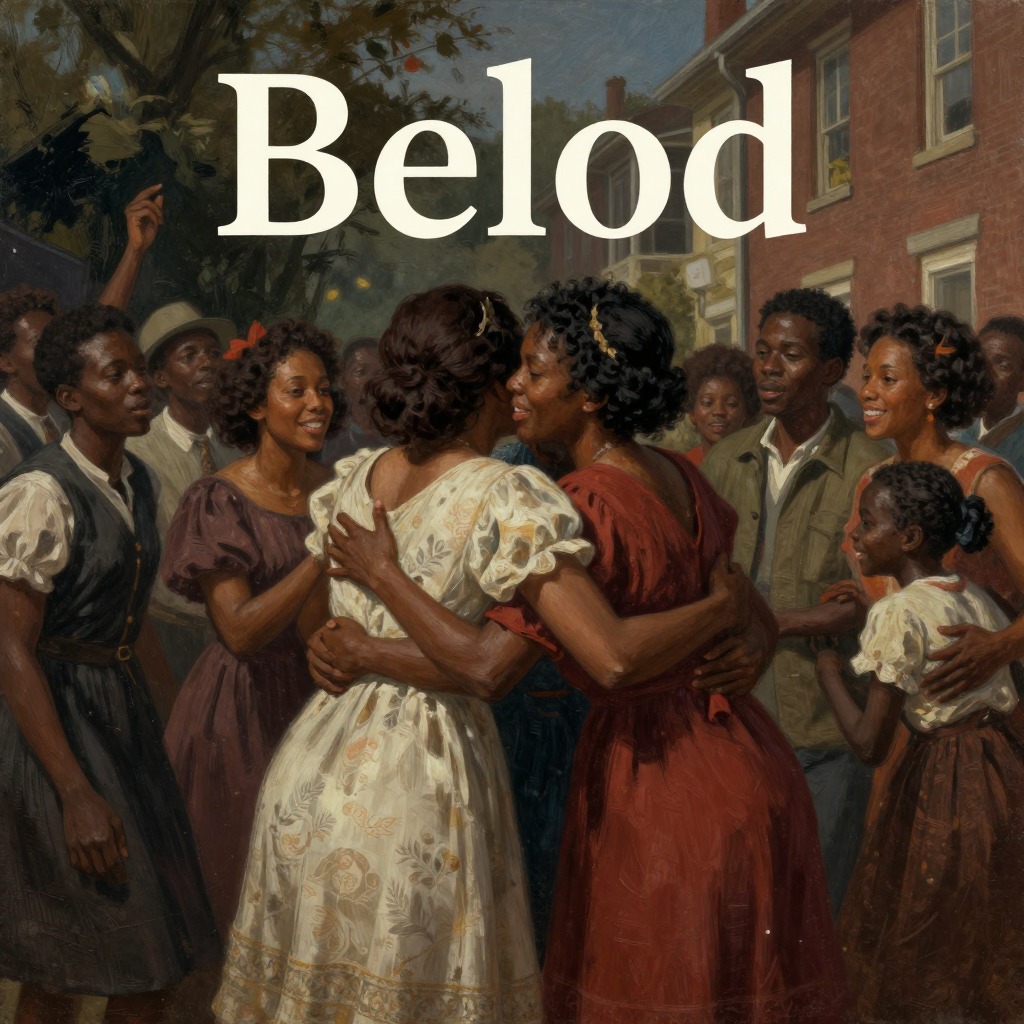
Sethe
BelovedSethe is the central figure of Toni Morrison's Beloved, a woman whose life is shaped by the horrors of slavery and the desperate act of killing her own child to save her from it. Her journey from Sweet Home plantation to 124 Bluestone Road in Cincinnati, and her struggle to confront the ghost of her past, form the novel's emotional and thematic core. Sethe's story is one of survival, guilt, and the search for a self beyond the roles of mother and former slave.
Identity and Background
Sethe was born into slavery, likely in Carolina or Louisiana, and remembers little of her early life except song and dance. Her mother, whom she barely knew, was pointed out to her in a rice field; the woman bore a circle and cross burned into her rib, a mark Sethe was told to recognize her by. Her mother was later hanged, and Sethe never learned why. She was raised by a woman named Nan, who told her that her mother had thrown away all her children by white men but kept Sethe, giving her the name of the black man she loved. At thirteen, Sethe was sold to Mr. Garner and brought to Sweet Home, a Kentucky farm where she was the only woman among five men. She chose Halle as her husband, a decision influenced by his devotion to his mother, Baby Suggs, for whom he worked five years of Sundays to buy her freedom. Sethe and Halle had four children together, and Sethe's iron eyes and backbone became her defining traits.
Life and Plot Trajectory
Sethe's life at Sweet Home changed after Mr. Garner's death. His widow, Mrs. Garner, brought in schoolteacher, a man who treated the enslaved people as animals, measuring them and recording their "animal characteristics" in a notebook. When Sethe overheard schoolteacher instructing his pupils to list her human traits on one side and animal ones on the other, she resolved to escape. Pregnant with Denver, she sent her three older children ahead to Baby Suggs in Cincinnati and fled on foot. During her escape, she gave birth to Denver in a boat on the Ohio River, helped by a white girl named Amy Denver. After reaching 124, Sethe enjoyed twenty-eight days of freedom, but then schoolteacher arrived to reclaim her. In a desperate act to prevent her children from being taken back into slavery, she tried to kill them, succeeding with her crawling-already? baby girl, whose throat she cut with a handsaw. She was arrested and jailed, but the Bodwins helped secure her release. For eighteen years, she lived at 124 with Denver, haunted by the ghost of her dead baby, until Paul D, the last of the Sweet Home men, arrived and drove the ghost away.
Key Actions and Objectives
Sethe's primary objective is to protect her children from the horrors of slavery, a goal that leads her to the ultimate act of infanticide. She explains to Paul D that her love was "too thick" and that she had to put her babies "where they'd be safe." Her actions are driven by a fierce, almost primal motherlove that she believes justifies any sacrifice. After Paul D leaves, Sethe becomes consumed by Beloved, the young woman who appears at 124 and whom Sethe believes is her dead daughter returned. She devotes herself entirely to Beloved, quitting her job and spending her savings to please her, hoping to make amends for the past. This obsession nearly destroys her, as Beloved's demands grow increasingly voracious, and Sethe's health and sanity decline.
Relationships and Conflict
Sethe's relationships are marked by intense love and conflict. With Halle, her husband, she shared a tender but brief marriage, and his disappearance after the escape attempt leaves her with unresolved grief. Paul D, who becomes her lover, offers her a chance at a new life, but his judgment of her infanticide drives them apart. Her relationship with Denver is strained, as Denver feels excluded by Sethe's devotion to Beloved. The most complex relationship is with Beloved, who embodies both Sethe's guilt and her longing for the daughter she lost. Sethe's interactions with the community are also fraught; after the infanticide, she is shunned by her neighbors, who see her as proud and dangerous. Only when Denver seeks help does the community begin to reach out, ultimately gathering to exorcise Beloved.
Change and Ending
Sethe's arc culminates in a breakdown and a tentative recovery. After Beloved's disappearance, Sethe retreats to bed, unable to face the world. Paul D returns and finds her in Baby Suggs' bed, singing a lullaby. He tells her, "You your best thing, Sethe. You are," a revelation that challenges her lifelong belief that her children were her only worth. This moment suggests the possibility of self-love and healing, as Sethe begins to see herself as valuable in her own right. The novel ends with the community's memory of Beloved fading, but Sethe's future remains open, marked by the hope that she can reclaim her own identity.
Narrative Role and Evaluation
Sethe is the novel's moral and emotional center, embodying the trauma of slavery and the complexity of motherlove. Her story is told through a fragmented, non-linear narrative that mirrors her psychological state, as she struggles to repress and confront her memories. Morrison uses Sethe to explore themes of memory, identity, and the possibility of redemption. Sethe's infanticide is not presented as simple madness but as a rational, if horrifying, response to the dehumanization of slavery. Her character challenges readers to consider the limits of love and the cost of freedom. Through Sethe, Morrison gives voice to the unspeakable experiences of enslaved women, making her one of the most powerful and enduring figures in American literature.