Paul D
BelovedPaul D, the last of the Sweet Home men, walks into 124 Bluestone Road after eighteen years of wandering and changes everything. He is the man who drives out the baby ghost with a table and a loud voice, who learns the story of Sethe's chokecherry tree and her stolen milk, and who ultimately must confront the limits of his own manhood. His presence forces the novel's central questions—about love, safety, and the possibility of a future—into the open, and his journey from a man who loves small to one who can say "You your best thing" charts the novel's most hopeful arc.
Identity and Background
Paul D is one of the six Sweet Home men, the enslaved men on Mr. Garner's Kentucky farm who were, by Garner's proud claim, "men every one of em." He is the youngest of three half-brothers—Paul D Garner, Paul F Garner, and Paul A Garner—all sold to Garner and kept there for twenty years, forbidden to leave the farm. Unlike the others, Paul D survives to the novel's present, carrying the weight of having seen his brothers and friends destroyed: Paul F sold, Paul A lost, Sixo burned alive, and Halle broken by what he witnessed in the barn. His identity is forged in the crucible of Sweet Home's peculiar brand of slavery, where Garner's policy of treating his slaves as men—allowing them to correct him, handle guns, and even learn to read—created a fragile sense of manhood that schoolteacher would systematically dismantle.
Paul D's face is described as immobile, yet "amazing how ready it was to smile, or blaze or be sorry with you." He has peachstone skin and a straight back, and his presence has a peculiar effect on women: they see him and want to weep, to tell him their secrets. This quality—what the novel calls "something blessed in his manner"—makes him a confidant, but it also masks the deep trauma he carries. His tobacco tin, a rusted-shut box in his chest where a red heart used to be, holds the memories he cannot speak: the iron bit in his mouth, the roosters, the chain gang, and the face of Halle smeared with butter.
Arrival at 124 and the Driving Out of the Ghost
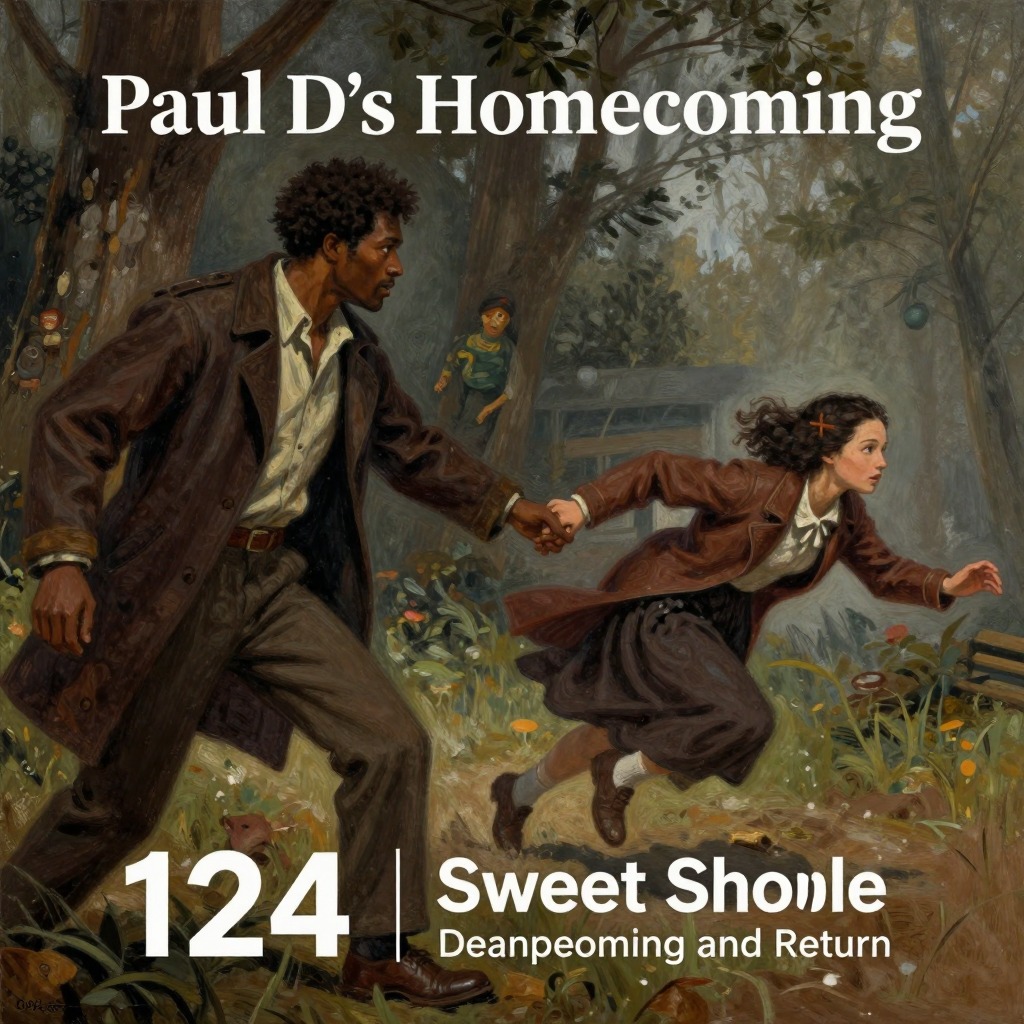
Paul D arrives at 124 in 1873, having walked from Delaware, and finds Sethe, now eighteen years older, barefoot and carrying her shoes and stockings. Their reunion is charged with the memory of Sweet Home, and Paul D immediately recognizes the change in her: her face, softened by hair, makes him trust her enough to step inside her door, where he is met by a "pool of red and undulating light"—the presence of the baby ghost. He is the first to confront it directly, shouting "God damn it! Hush up!" and bashing a table about the room until the house is quiet. This act, which he performs with a violence born of his own need to protect Sethe, drives the ghost out and makes room for him in the household.
The driving out of the ghost is a pivotal moment. It marks the beginning of Paul D's relationship with Sethe and Denver, but it also sets the stage for the novel's central conflict. Denver, who had come to rely on the ghost's company, resents Paul D's intrusion, and Sethe, who had lived in a state of suspended grief, begins to imagine a future. Paul D's presence, however, is not simply a blessing; it brings with it the weight of his own past, which he has kept locked away. As he tells Sethe, he has been walking for eighteen years, and his arrival at 124 is the first time he has stopped. The house, once full of the baby's spite, becomes a place where the past can be spoken, but only in fragments.
The Revelation of Halle's Fate and the Limits of Manhood
Paul D's most devastating revelation comes when he tells Sethe what happened to Halle. He reveals that Halle was in the barn loft when schoolteacher's nephews held Sethe down and took her milk, and that the sight of it "broke him like a twig." Halle, who had been the one person who did something hard for Baby Suggs—buying her freedom with five years of Sundays—was reduced to squatting by the churn, smearing butter and clabber over his face. Paul D saw him there, but could not speak to him because he had an iron bit in his mouth. This confession shatters Sethe's hope that Halle might still be alive, and it forces Paul D to confront his own shame: he could not save his friend, and he could not even speak.
This revelation is intertwined with Paul D's own story of Alfred, Georgia, where he was sent after trying to kill Brandywine, the man schoolteacher sold him to. In Alfred, he was chained in a box in the ground, his hands trembling uncontrollably, until the rain came and the chain gang escaped through the mud. He followed the tree flowers north, guided by the Cherokee, and eventually found his way to Delaware, where a weaver woman took him in. But the experience left him with a profound sense of his own worthlessness. As he tells Sethe, "Mister was allowed to be and stay what he was. But I wasn't allowed to be and stay what I was. Even if you cooked him you'd be cooking a rooster named Mister. But wasn't no way I'd ever be Paul D again, living or dead. Schoolteacher changed me. I was something else and that something was less than a chicken sitting in the sun on a tub."
The Struggle with Beloved and the Question of Love
Paul D's relationship with Beloved is one of the novel's most unsettling threads. From the moment she appears, he is suspicious of her, noting her new shoes, her shining skin, and her strange behavior. He tries to place her, to find her a home elsewhere, but she resists, and her presence begins to erode his place in the household. Beloved's power over him is sexual and psychological; she moves him out of the house, room by room, until he is sleeping in the cold house, and she demands that he "touch me on the inside part and call me my name." When he finally gives in, his tobacco tin bursts open, and he is flooded with the memories he has kept locked away.
Paul D's struggle with Beloved is also a struggle with his own manhood. He wonders if schoolteacher was right, if he is indeed less than a man, and he is humiliated by being "moved, placed where she wanted him." His response is to ask Sethe to have a baby, a desperate attempt to "document his manhood and break out of the girl's spell." But this plan fails, and when Stamp Paid shows him the newspaper clipping about Sethe's infanticide, Paul D leaves 124, unable to accept what Sethe did. He tells her, "Your love is too thick," and she replies, "Love is or it ain't. Thin love ain't love at all." This exchange marks the novel's central philosophical divide: Paul D believes in loving small, in protecting oneself by not loving too much, while Sethe's love is all-consuming, willing to kill to protect.
Return and Reconciliation
After Beloved's disappearance, Paul D returns to 124, drawn back by his love for Sethe and his guilt over leaving. He finds her in Baby Suggs' bed, having given up on life, and he is determined to bring her back. He tells her, "Sethe, me and you, we got more yesterday than anybody. We need some kind of tomorrow." And in the novel's final lines, he offers her the words that undo her grief: "You your best thing, Sethe. You are." This is a profound reversal for Paul D, who has spent his life believing he was less than a man. By affirming Sethe's worth, he begins to reclaim his own.
Paul D's arc is one of the novel's few gestures toward hope. He moves from a man who loves small, who keeps his heart locked in a rusted tin, to a man who can offer himself fully to another person. His return to Sethe is not a simple happy ending—the novel insists that "This is not a story to pass on"—but it is a moment of genuine connection, a recognition that the past, however terrible, does not have to define the future. Paul D's final act is to hold Sethe's hand and tell her that she is her own best thing, a statement that echoes Baby Suggs' sermon in the Clearing and offers the possibility of a life lived with love, however fragile.