churn
BelovedIn Toni Morrison's Beloved, the churn is a humble dairy implement that becomes the focal point of one of the novel's most devastating revelations. It is not a recurring motif like the chokecherry tree on Sethe's back or the white stairs of 124, but its single, stark appearance carries the weight of Halle's destruction and the unspoken horrors of Sweet Home. The churn is where Halle, the gentle husband and father who sacrificed five years of Sundays to buy his mother's freedom, is last seen by Paul D—squatting beside it, his face smeared with butter and clabber, reduced to a wordless, broken state. This image, delivered to Sethe years later, shatters her remaining hope and forces her to confront the true cost of her escape.
The Churn as the Site of Halle's Collapse
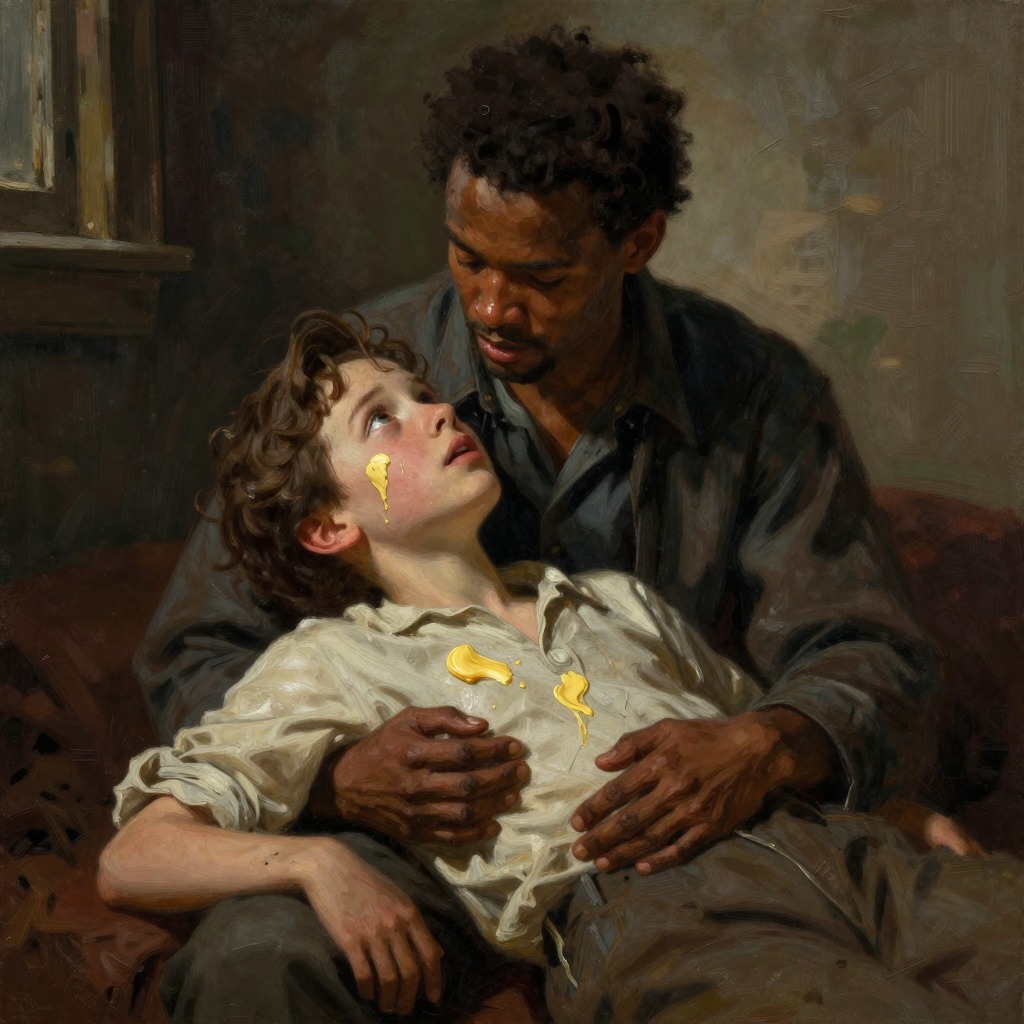
The churn first enters the narrative through Paul D's memory, when he finally tells Sethe what happened to Halle after the failed escape from Sweet Home. Paul D recalls: "Last time I saw him he was sitting by the chum. He had butter all over his face." The detail is precise and grotesque—Halle, who had been a man of quiet strength, who had worked extra years to pay off his mother's freedom, who had fathered all of Sethe's children, is found smearing butter on his face, a gesture of utter mental disintegration. The churn, normally a tool of domestic labor and sustenance, becomes the stage for Halle's breakdown. He is not weeping or raging; he is mechanically covering himself in the product of the very labor that defined his life, as if trying to erase his identity or merge with the substance of his servitude.
Paul D's account is fragmentary and painful. He tells Sethe that Halle "couldn't get out the loft"—the loft in the barn where Halle hid and watched as schoolteacher's nephews held Sethe down and stole her milk. The churn, then, is not merely a random location; it is the place where Halle's mind finally snapped after witnessing the violation of his wife. The butter on his face is a visceral, almost absurdist image of a man who has lost all capacity for speech or action. Paul D, himself shackled and unable to intervene, could only watch: "I had a bit in my mouth." The churn thus becomes a silent witness to two forms of paralysis—Halle's catatonic grief and Paul D's enforced silence.
The Churn in Sethe's Reckoning
When Paul D reveals this memory to Sethe, the churn becomes the catalyst for her own emotional unraveling. Sethe has spent eighteen years believing Halle might still be alive, holding onto the possibility that he had simply found another way to live. The image of Halle at the churn destroys that hope. She realizes: "If he is alive, and saw that, he won't step foot in my door. Not Halle." The churn, in this moment, is not just an object; it is the proof of Halle's annihilation. Sethe's mind, which she describes as "greedy" for painful memories, immediately seizes on the image: "There is also my husband squatting by the churn smearing the butter as well as its clabber all over his face because the milk they took is on his mind." The churn becomes inseparable from the stolen milk, the violation, and the broken man who could not bear to live with what he had seen.
Sethe's reaction is complex. She is not merely sad; she is angry and resigned. She imagines a grotesque fantasy of joining Halle in his madness: "Other people's brains stopped, turned around and went on to something new, which is what must have happened to Halle. And how sweet that would have been: the two of them back by the milk shed, squatting by the churn, smashing cold, lumpy butter into their faces with not a care in the world." The churn, in this imagined scene, becomes a site of escape—a place where the weight of memory and guilt could be smeared away. But Sethe knows this is impossible: "her three children were chewing sugar teat under a blanket on their way to Ohio and no butter play would change that." The churn thus embodies both the allure of oblivion and the inescapable reality of responsibility.
The Churn as Symbol and Material Object
The churn operates on multiple levels in the novel. As a material object, it is a common household item, used to churn cream into butter—a daily chore that would have been familiar to Sethe and Halle at Sweet Home. Its presence in the barn, where Halle hides, is unremarkable; it is simply part of the farm's equipment. But in the context of Halle's breakdown, the churn becomes what thing theory might call a "thing" rather than an "object"—it ceases to be transparently useful and instead asserts its material presence, forcing attention to its physicality: the butter, the clabber, the smearing. The churn is no longer a tool for making food; it is a surface on which a man's sanity is smeared.
Symbolically, the churn is linked to the themes of milk and motherhood that pervade the novel. Sethe's milk is stolen, Halle's face is covered in butter—both are products of the body, both are taken or defiled. The churn, which transforms cream into butter, mirrors the way the institution of slavery transforms human beings into property, breaking them down and reshaping them. Halle, who was once a man of dignity, is reduced to a figure smeared in butter, his humanity churned away. The churn thus becomes a symbol of the dehumanizing process of slavery, a process that Paul D himself describes when he says, "Schoolteacher changed me. I was something else and that something was less than a chicken sitting in the sun on a tub."
The Churn's Narrative Significance
The churn's appearance is brief but crucial to the novel's structure of revelation. It is part of Paul D's confession to Sethe, which occurs after he has already told her about the stolen milk and the beating. The churn is the final piece of the puzzle, the detail that explains why Halle never came to find her. It is also a moment of connection between Paul D and Sethe, as they share the burden of knowing what happened to Halle. Paul D's memory of the churn is tinged with his own guilt—he could not save Halle, could not even speak to him because of the bit in his mouth. The churn thus becomes a shared wound, a point of intimacy between two survivors who have both been broken by Sweet Home.
In the broader narrative, the churn is one of many objects that carry the weight of memory in Beloved. Like the chokecherry tree on Sethe's back, the churn is a physical marker of trauma. But unlike the tree, which is a permanent scar, the churn is a transient object, easily overlooked. Its significance lies in the moment of its use—the moment when Halle, in his madness, chooses it as the focus of his despair. The churn is not a symbol that the novel dwells on; it is a detail that emerges from Paul D's memory, stark and unforgettable. It is a testament to Morrison's skill that such a small object can carry so much meaning, and that its image—a man smearing butter on his face—remains one of the most haunting in the novel.
The Churn and the Theme of Memory
The churn also participates in the novel's exploration of memory and rememory. Sethe's concept of rememory—the idea that places and events persist in the world, waiting to be encountered—is directly relevant to the churn. The churn is not just a memory for Paul D; it is a place where the past is still present. When Sethe hears about it, she does not merely recall a fact; she enters into the scene, imagining herself squatting beside Halle. The churn becomes a site where the past is re-experienced, not just remembered. This is consistent with Sethe's belief that "the picture of what I did, or knew, or saw is still out there. Right in the place where it happened." The churn, then, is one of those places where the past is permanently lodged, waiting for someone to bump into it.
For Paul D, the churn is also a reminder of his own limitations. He could not save Halle, and he could not even speak to him. The churn is thus associated with his sense of failed manhood, a theme that runs throughout his character. He later reflects on how schoolteacher's cruelty reduced him to "less than a chicken," and the churn is part of that humiliation. It is a small, domestic object that becomes a symbol of his powerlessness.
In the end, the churn is a testament to the novel's ability to find profound meaning in the ordinary. It is a tool of daily life, a fixture of the farm, but in the hands of Morrison's narrative, it becomes a vessel for grief, madness, and the unbreakable bonds of memory. The image of Halle at the churn is one that neither Sethe nor the reader can forget, and it stands as a powerful reminder of the human cost of slavery.