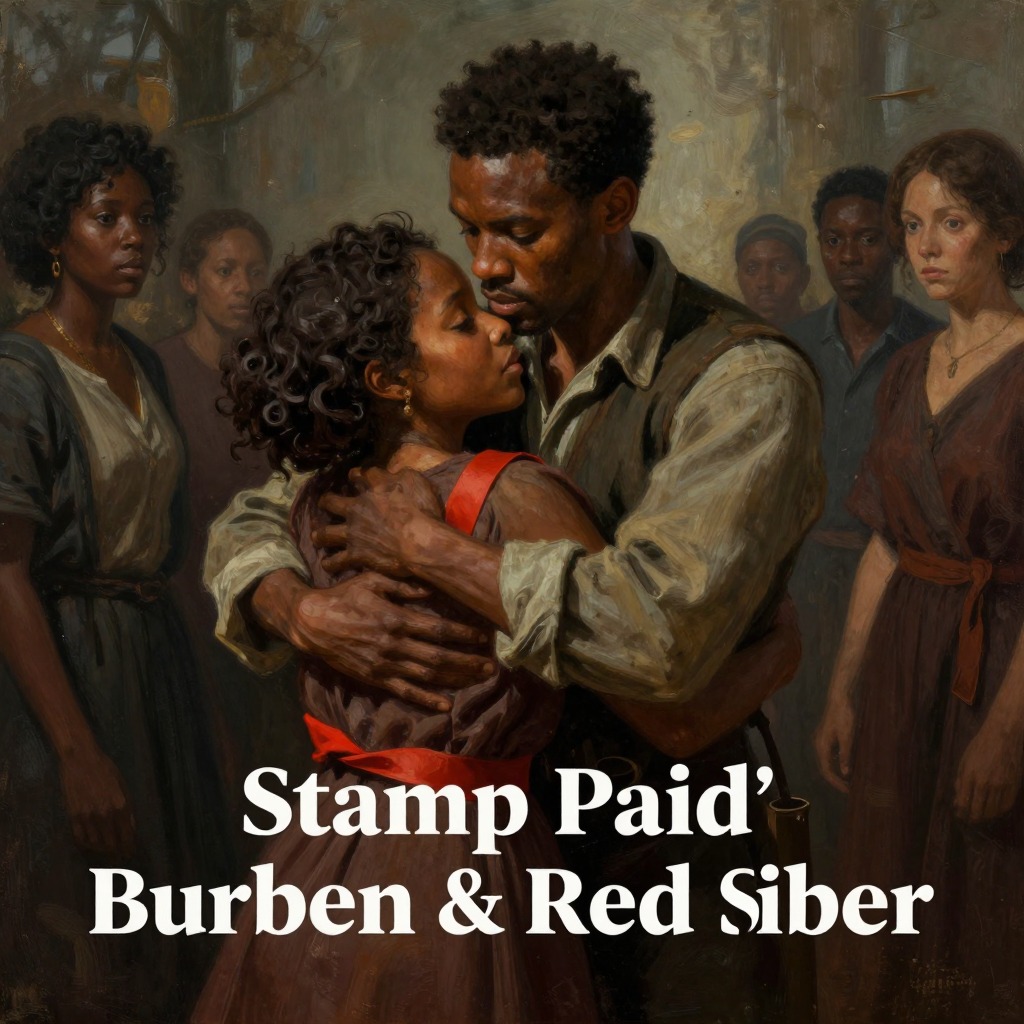
red ribbon
BelovedThe red ribbon is a small but devastating object in Toni Morrison's Beloved, discovered by Stamp Paid on the bank of the Licking River. It is a knotted curl of wet woolly hair, still clinging to its bit of scalp, and it becomes a physical embodiment of the era's racial violence, the 'skin smell' that haunts him, and a catalyst for his confrontation with Paul D and his own past.
Discovery and Immediate Impact
Stamp Paid finds the ribbon while securing his flatbed on the bank of the Licking River. He first mistakes it for a cardinal feather stuck to his boat, but when he tugs it loose, he holds in his hand a red ribbon knotted around a curl of wet woolly hair, clinging still to its bit of scalp. He unties the ribbon and puts it in his pocket, dropping the curl in the weeds. The discovery stops his breath and makes him dizzy; he has to sit down by a fence. The ribbon is not just an object but a synecdoche of the lynching and racial terror that pervade the post-war landscape, a tangible remnant of a black girl's murder. It is this 'skin smell' that nagged him and weakened his marrow, making him dwell on Baby Suggs' wish to consider what in the world was harmless. He hopes she stuck to blue, yellow, maybe green, and never fixed on red.
The Ribbon as a Token of Memory and Guilt
The ribbon becomes a private relic for Stamp Paid, a physical anchor for his grief and his sense of debt. He clutches it in his pocket for strength when he tries to knock at the door of 124, which is now filled with the voices of the dead. He fingers it as he approaches the house, and it makes a little motion in his pants pocket. When he finally sits with Paul D on the steps of the church, he withdraws the ribbon and strokes it between forefinger and thumb, saying, 'This here's something else.' The ribbon is not just a reminder of the anonymous victim but also of his own complicity and helplessness in the face of such violence. It fuels his determination to make amends, to apologize to Paul D for showing him the newspaper clipping, and to confront the reality of Sethe's past.
The Ribbon and the Revelation to Paul D
The ribbon serves as a prelude to Stamp Paid's confession to Paul D. After Paul D snorts at the ribbon's motion, Stamp Paid uses it to introduce the 'second thing' he has come to say. He tells Paul D about his own past, how he renamed himself from Joshua after his wife Vashti was taken by his master's son, and how he changed his name instead of breaking her neck. The ribbon, with its 'skin smell,' connects his personal history of degradation to the larger pattern of white violence. It is in this context that Stamp Paid finally tells Paul D the truth about Sethe's infanticide, saying, 'I was there, Paul D. There in the yard. When she did it.' The ribbon, then, is not merely a found object but a narrative device that bridges the personal and the communal, the past and the present, and that forces Paul D to confront the horror he has been avoiding.
The Ribbon's Symbolic Resonance
The red ribbon resonates with other images of red and violence in the novel. It echoes the 'red baby blood' Sethe remembers, the 'pink gravestone chips' of her daughter's headstone, and the 'red heart' Paul D keeps in his rusted tobacco tin. It is also a counterpart to the 'red light' that once filled 124, the ghost's presence. The ribbon is a 'hot thing' in the sense of Beloved's own fragmented memories, a piece of the 'jungle' that whitefolks planted in black people. Stamp Paid's discovery of the ribbon is a moment of ecological and historical rupture: the natural world (the riverbank, the cardinal feather) is contaminated by human atrocity. The ribbon is what remains when the body is gone, a trace that insists on being remembered, even as the novel's final pages declare that Beloved is 'disremembered and unaccounted for.' The ribbon, unlike Beloved, is not forgotten; it is kept, fingered, and used to provoke a reckoning.
The Ribbon and the Novel's Ending
The ribbon's fate is left unresolved, but its presence lingers. Stamp Paid keeps it in his pocket, a constant reminder of the 'skin smell' and the 'red ribbon' that he cannot discard. It is part of the 'weather' that remains after Beloved's disappearance, the 'wind in the eaves, or spring ice thawing too quickly.' The ribbon is a 'story to pass on' in a way that Beloved is not; it is a concrete artifact that testifies to the violence that the community would rather forget. In the end, the ribbon stands as a counterpoint to the novel's final lines about Beloved's footprints coming and going, disappearing like 'nobody ever walked there.' The ribbon, by contrast, is a permanent scar on the landscape, a reminder that some things cannot be washed away.