Art Students League
BluebeardThe Art Students League is the New York art school where Rabo Karabekian tried to begin a serious career as a painter and instead received a formative rejection. His brief encounter with its teacher Nelson Bauerbeck makes the League a hinge in his artistic development: Rabo arrives seeking instruction and a community, but leaves with a judgment about passion that redirects him toward writing.
Setting and Purpose
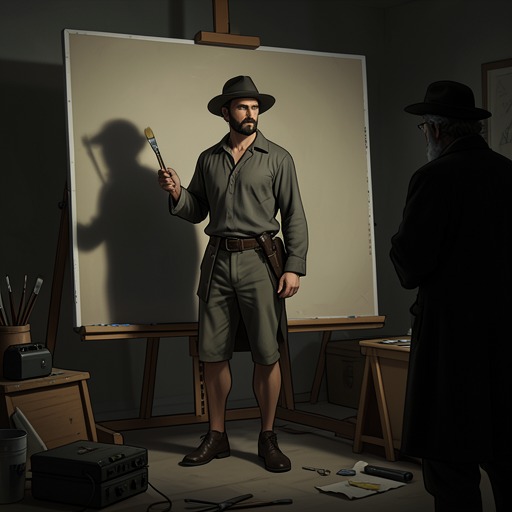
After achieving modest prosperity at Leidveld and Moore, Rabo carried a portfolio to the Art Students League one evening, hoping to learn how to become a serious painter. The painting teachers of the period were mostly representational artists, and he presented his work to Nelson Bauerbeck, a teacher principally known for portraiture. Bauerbeck’s portraits of two presidents of New York University, Rabo’s former institution, were still on view there.
The class contained about twelve students, each working at an easel on a picture of the same nude model. Rabo looked forward to joining them. Their apparent happiness suggested the artistic family he felt he lacked at his advertising job, where colleagues resented the way he had obtained his position. The League represented not only technical instruction but the prospect of belonging to a community organized around painting.
Bauerbeck’s Assessment
Bauerbeck was about sixty-five and had spent much of his adult life in Europe. Rabo understood him as an old painter whose experience reached back to an earlier artistic world: he had briefly spoken with James Whistler, Henry James, Emile Zola, and Paul Cezanne, and claimed to have known Hitler in Vienna before the First World War. Yet their meeting did not become a friendship or an apprenticeship. Bauerbeck leafed through the portfolio and quietly expressed dismay, asking whether Rabo’s work had been done to him or by him.
When Rabo pressed him to explain, Bauerbeck struggled to put his judgment into words. Technically, he said, there was nothing Rabo could not do; the difficulty was that the first picture in the portfolio suggested a man without passion, with nothing he seemed desperate to communicate through painting. Bauerbeck made clear that he had already decided against teaching Rabo before formulating this explanation. His theory articulated the response, rather than causing it.
Rejection and Consequences
Bauerbeck explicitly rejected Rabo, saying it would be unfair to either of them to accept him as a student. Rabo protested that he was being turned away on the basis of a theory invented on the spot, but Bauerbeck answered that the portfolio’s first picture had already supplied his reason. The encounter therefore distinguishes competence from artistic purpose: Rabo’s ability to make pictures was not in question, but Bauerbeck could not see an urgent subject behind that ability.
Rabo responded to the rejection by signing up for a creative-writing course at City College, taught three nights a week by the short-story writer Martin Shoup. The League did not launch the painting education Rabo had sought; instead, Bauerbeck’s criticism helped turn him toward another medium. The episode also anticipates a recurring tension in Rabo’s account of art: technical accomplishment, institutional recognition, and the capacity to communicate are related but not interchangeable.