United States Army Corps of Engineers
BluebeardThe United States Army Corps of Engineers is the military organization that turns Rabo Karabekian’s identity as an artist into a wartime specialty. In the novel, its camouflage work depends on making images deceive an enemy, while its ranks give Rabo a close-knit community he later contrasts with the loneliness of civilian life.
Military Role and Camouflage
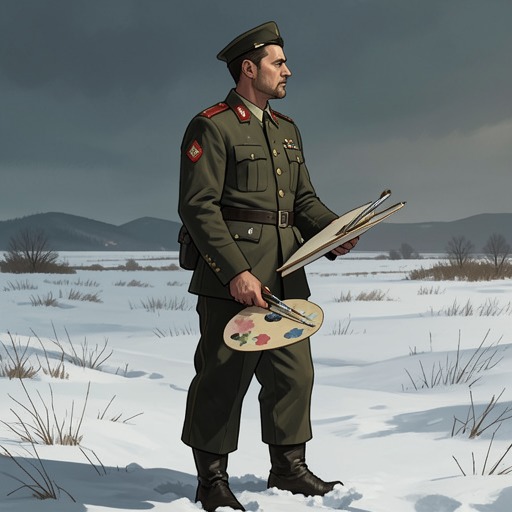
Rabo joins the peacetime United States Army after losing his civilian job during the Great Depression. He scores highly on the classification test and is accepted into the service. The Corps of Engineers becomes his military home: he serves as a lieutenant and commands a platoon of thirty-six men, a unit whose members, like him, have artistic experience in civilian life. The Army’s theory is that artists will be especially effective at camouflage.
That theory proves practical. Rabo recalls the platoon creating illusions about what was dangerous behind its lines and what was not, misleading German forces through visual deception. The unit is not attached to an ordinary division or corps. Orders come directly from the Supreme Headquarters of the Allied Expeditionary Force, which temporarily assigns the camouflage specialists to generals who have heard of their work. Rabo describes those commanders as permissive, fascinated, and ultimately grateful; the platoon then moves on to another assignment.
Camouflage also shapes the unit’s unusual military culture. Rabo says its members were allowed to live like artists, with a relaxed attitude toward dress and military courtesy. He later credits the platoon’s effectiveness with earning it a Presidential Unit Citation, and jokes that some of the things it concealed from the enemy have never been found.
Rabo’s Advancement and Command
Before the United States entered the war, Rabo had been a regular Army lieutenant for two years. He believes he might have reached at least lieutenant colonel by the war’s end, but refuses promotion beyond captain because he wants to remain with his thirty-six-man platoon. He calls this his first experience of a family that large. The Corps thus offers him more than a specialized job: it gives him a collective identity and a durable sense of belonging.
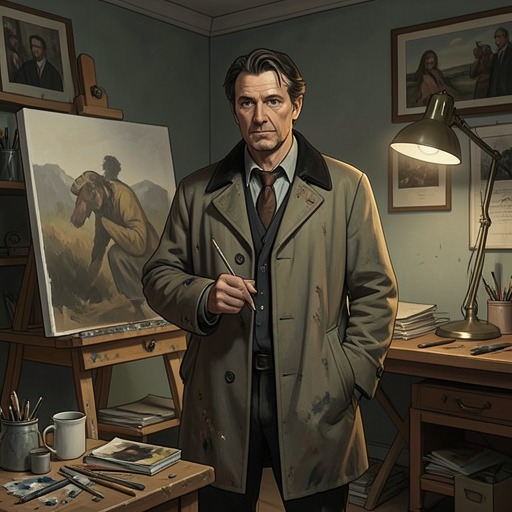
Rabo’s route into the camouflage unit begins with a portrait commission. Major General Daniel Whitehall, commander of the combat troops of the Corps of Engineers, wants an oil portrait in uniform and believes that an artist with a foreign-sounding name can paint him well. Rabo, then a recruit, paints Whitehall during basic training, using expensive materials the general is willing to buy. In conversation, he flatters Whitehall and encourages him to consider the military importance of aerial photography and camouflage should war come.
At Whitehall’s retirement ceremony, the portrait is unveiled before enlisted men assembled in ranks. Whitehall speaks about aerial photography and the Engineers’ mission to teach camouflage to the other service branches. Among his final orders, he announces a new camouflage unit for enlisted men with artistic experience, placing it under Master Sergeant Rabo Karabekian. Rabo, who has completed basic training and become a private first class, hears his name announced publicly; Whitehall’s commission and advocacy have helped turn his artistic skill into an official military assignment.
Injury, Return, and Significance
Near the end of the war, Rabo is commanding his Engineers platoon in Luxembourg when German forces capture him. He does not remember being struck; his recollection is of a German tank and soldiers approaching across a snow-covered meadow. Unconscious when taken prisoner, he is kept under morphine until he wakes in a German military hospital in a church across the border. His left eye is lost, though the wound heals quickly, and he is soon sent to a prisoner camp as an unremarkable captive.
At the war’s end, the Army pays for cosmetic surgery at Fort Benjamin Harrison, outside Indianapolis, at the place where his eye had been. Rabo describes himself as emotionally blank rather than bitter. He sees the service as having paid for the operation, but his return also marks the break between the wartime community in which he had a home and the civilian life to which he must readjust. Years later, after his first wife and sons have left him and he has abandoned painting, he seeks solitude and lives as a hermit for eight years. His recollection of the Engineers’ platoon gives that loss a measure: the army unit had been a family, whereas postwar life does not restore the same belonging.
The Engineers’ camouflage work links Rabo’s military and artistic identities through a shared practice of concealment and visual misdirection. His later paintings do not make the organization a direct explanation for his art, but the wartime experience gives camouflage a concrete meaning in his life: it is both a technical skill used to protect soldiers and a source of recognition, fellowship, and command. The Corps is therefore remembered not simply as the institution in which he served, but as the setting where artists formed a unit, and where Rabo briefly found a home.