Supreme Headquarters of the Allied Expeditionary Force
BluebeardThe Supreme Headquarters of the Allied Expeditionary Force (SHAEF) is the Allied command that directly assigned Rabo Karabekian’s artist-platoon during the Second World War. In his account, it authorized a peculiar military family to deploy its visual ingenuity as camouflage, then, after the German Air Force had been defeated, directed the group to evaluate and catalogue captured artworks. That second mission later shadows the organization’s place in Rabo’s story: an officer who said he had served at SHAEF accused Rabo of keeping European masterpieces in his sealed potato barn, an allegation Rabo denies while conceding that wartime opportunity benefited him in some other way.
Command and Camouflage
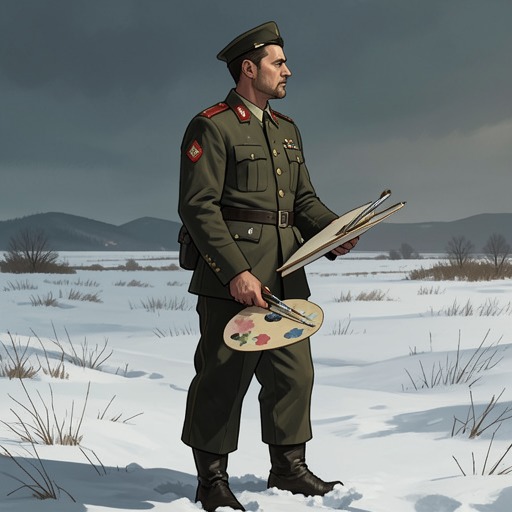
Rabo describes the platoon as a unit of artists assembled because someone in the Army believed that artists would be especially good at camouflage. They were. Near the end of the war, when the specialists were fighting as ordinary infantry for their lives in Luxembourg, their military purpose and artistic skill met under extreme pressure: the platoon created illusions about what was dangerous behind Allied lines and what was not.
The unit’s chain of command was unusual. It was not attached to a division or even a corps; orders came directly from SHAEF, which assigned the platoon temporarily to generals who had heard of its deceptive work. Rabo portrays those generals as short-term patrons—permissive, fascinated, and ultimately grateful—while the platoon moved on to its next assignment. The arrangement gave the artists room to behave, in Rabo’s comic description, with the carelessness of artists about dress and military courtesy.
Rabo remained with this close-knit unit rather than pursuing higher rank. Although he had become a lieutenant before the United States entered the war and might have risen to lieutenant colonel, he refused promotions beyond captain so he could stay with his thirty-six men. He later described the platoon as his first experience of a large family. He also recalled that its camouflage was so successful that it received a Presidential Unit Citation, and joked that some things hidden from the enemy had never been found again.
The Postwar Art Mission
Once the German Air Force had been knocked out of the sky and the need for large-scale camouflage deceptions had passed, the platoon received a different assignment: to evaluate and catalogue captured works of art. Rabo remembers the task as a startling change of setting, likening the artists’ access to the captured objects to children being let loose in Santa Claus’s workshop. The work involved artworks taken by military units, and Rabo says that he had to provide receipts for what was handed over and that Finance Corps auditors visited regularly.
The mission links SHAEF’s wartime administrative reach to the later dispute over Rabo’s private collection and sealed studio. In a letter to a newspaper editor, a man who claimed to have served at SHAEF said that he had known Rabo, or at least knew his platoon and its mission. He alleged that Rabo had stolen masterpieces that should have been returned to their rightful owners in Europe and locked them away in the barn for fear of lawsuits.
Rabo rejects the charge that the barn contains stolen masterpieces. He distinguishes that accusation from a narrower admission: he says that he did take advantage of the unusual opportunities his wartime position afforded him, but that he could not have stolen works formally handed over by military units, since those transfers required receipts and were subject to audit. The novel does not identify the letter-writer or specify what advantage Rabo took; the tension between his denial and his limited concession remains part of the account.
A Wartime Command in a Museum Story
In the present-day frame, the potato barn is a locked, windowless former storage building that Rabo has kept apart from the rest of his home. Its importance is not merely architectural: it was the workspace where he could assemble the eight panels of Windsor Blue Number Seventeen, and, after his wife’s death, he secured the doors with spikes, padlocks, and hasps. The accusation from the former SHAEF officer gives that physical barrier a second possible meaning, but Rabo insists that the suspected masterpieces are not inside.
The barn eventually becomes part of a public tour. Rabo removes the spikes from one end so visitors can pass through the enormous work and out the other, and describes the experience as closer to a tourist attraction, a World’s Fair, or Disneyland than to a conventional painting exhibition. Against that later transformation, SHAEF’s two wartime functions—directing camouflage and assigning the cataloguing of captured art—echo through the book’s persistent concern with what images conceal, what they reveal, and who gets to explain them. The command itself remains an institutional presence in Rabo’s recollection, not a character whose motives or internal structure are independently narrated.